

Key takeaways
- Traditional media research relies on self-reported behaviour, but research shows people can only recall about 10% of their actual social media scrolling activity.
- According to 2025 data, 63.9% of the global population uses social media, averaging 2 hours and 21 minutes daily, but most cannot accurately report what they saw or why it influenced them.
- Screen recording technology allows researchers to capture the actual algorithmic feed people see, not just what they claim to remember.
- Recent studies show that algorithms can shift political attitudes by about two points in just one week, demonstrating the powerful influence of personalised feeds.
- Video-based feed capture with real-time narration reveals the gap between claimed influence ("I saw an ad") and actual influence (dozens of micro-exposures to content, creators, and peer recommendations).
Why can't people remember what they actually saw on social media?
People can describe what they meant to do, but they cannot reliably describe what they were exposed to. Screens move too fast and feeds are too personalised for memory to keep up.
For decades, marketers have asked people to recall: "What made you buy that product?" or "Where did you hear about this brand?" The answers shaped billion-dollar media strategies. But there's a fundamental problem with this approach: people can't accurately report what influenced them.
Academic research on screenomics, the study of people's complete digital experiences through screen capture, demonstrates that "beyond some knowledge about how many texts or pictures individuals share in aggregate, little is known about the temporal organisation of sharing, particularly with respect to what content was engaged immediately before or after." The gap between claimed and actual behaviour isn't just a measurement problem. It reveals something deeper about how digital influence actually works.
What does screen recording research reveal?
Digital influence research examines how content, creators, algorithms, and peer interactions shape consumer attitudes and purchasing decisions on social media platforms. Unlike traditional methods that rely on recall, modern screen recording research captures actual feed experiences as they happen.
When you ask someone "What influenced your decision to buy that product?" they give you a clean, rational story: "I saw an ad on Instagram." But screen recording reveals a messier reality. According to research published in the Journal of Adolescent Research, adolescents' digital lives "differ substantially across persons, days, hours, and minutes," with screenomes highlighting "the extent of switching among multiple applications, and how each adolescent is exposed to different content at different times."
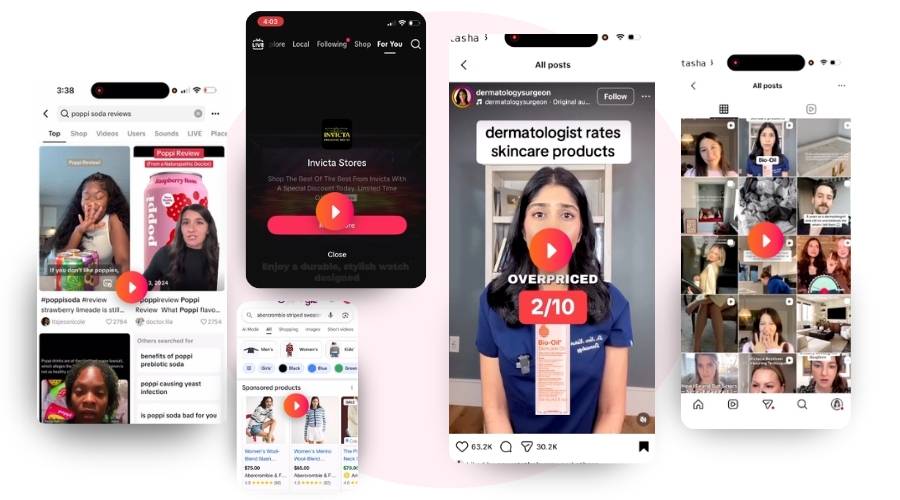
Maybe someone saw that ad three times over two weeks, plus a TikTok review from a creator they follow, plus their friend's story featuring the product, plus an article shared in a Facebook group. The influence path isn't a single touchpoint. It's an accumulation of micro-exposures they've largely forgotten.
Why doesn't social listening tell the full story?
Every person sees a different algorithmic feed. Social listening tools capture what's being said publicly, but they can't see what individuals are actually seeing in their personalised feeds. Recent research from Stanford and Northeastern University demonstrated that algorithms have strong influence on attitudes: users' feelings toward an opposing political party shifted by about two points after just one week of modified feed exposure, an effect normally seen over three years.
You might see that your brand is mentioned 10,000 times on X, but you don't know how many of your target customers actually saw those mentions in their personalised feeds. You're measuring the public conversation, not individual exposure.
How does modern screen recording work?
Modern screen recording technology captures both what people see and what they think about it in real time. Participants record their phone or computer screens as they naturally scroll through social media, providing audio narration of their thoughts: "I keep seeing ads for this brand," "Oh, I follow this creator," "That's interesting. I didn't know they made that product."
This dual capture of visual feed plus cognitive process reveals influence as it happens, not as people reconstruct it from memory.
A few connected capabilities make this work in practice. Screen recording captures exactly what appears in participants' feeds, including algorithmic recommendations, sponsored content, and organic posts. Real-time audio narration runs alongside, so participants explain their thoughts as they scroll rather than reconstructing them after the fact. Optical character recognition (OCR) makes on-screen text searchable across hundreds of videos, which means brand mentions, influencer content, and messaging themes can be analysed at scale. And journey mapping lets participants rate their interest and pinpoint influence moments as they encounter them.
On the operational side, AI-powered transcription and OCR mean researchers can search across hundreds of screen recordings in minutes rather than hours, and subtitled highlight reels make it easy to bring stakeholders inside the moments that matter.
What research questions can you answer?
Modern screenƒ recording methodology opens entirely new research territories.
Feed reality vs claimed exposure. What content, brands, and creators are people actually seeing in their feeds? How does algorithmic curation differ from what people claim they follow?
Discovery journeys. How do people discover new products through social media? What combination of influencer content, ads, peer recommendations, and brand posts shapes consideration?
Influence attribution. Which touchpoints actually influence decisions versus which ones people remember? How do different content types perform in capturing attention?
Competitive context. What other brands appear alongside yours in target customers' feeds? Who are your real competitors in the algorithmic space?
Where does screen recording research deliver value?
Three industry vignettes show how the method plays out in practice.
Consumer packaged goods
A food brand wanted to understand how healthy snacking trends were influencing product discovery among Gen Z. Screen recording research revealed that participants encountered health claims not through brand advertising, but through creator content reviewing products, nutritionist influencers explaining ingredients, and peer conversations about "better-for-you" options.
The brand discovered their actual competitive set included brands they'd never considered: products mentioned by the same creators and appearing in the same conversations. This reshaped their entire influencer strategy.
Beauty and personal care
A skincare brand invested heavily in Instagram ads but saw disappointing conversion rates. Screen recording research showed that whilst their ads did appear in target customers' feeds, participants scrolled past them quickly without engagement. What actually influenced purchase consideration was seeing the products in bathroom tours by relatable micro-influencers, reading ingredient breakdowns in Reddit threads, and seeing friends' stories featuring the products.
The influence path wasn't linear. It was a web of exposures across platforms, and the paid ads played a supporting role rather than a starring one.
Media and entertainment
A streaming service wanted to understand how people discovered new shows to watch. Self-reported surveys suggested that platform recommendations drove discovery. Screen recording revealed a different story: participants found shows through TikTok clips, Twitter conversations about episodes, Instagram story polls from friends, and YouTube review videos, and then went to the streaming platform to actually watch.
The streaming service realised they needed to optimise for social discoverability, not just in-platform recommendations.

Why do algorithms matter for brand strategy?
As of October 2025, 5.66 billion people use social media globally, spending an average of 18 hours and 36 minutes per week using social platforms. According to DataReportal's latest analysis, the typical social media user actively uses or visits an average of 6.75 different social platforms each month.
During this time, people encounter hundreds or thousands of content pieces: ads, posts, stories, reels, comments, and recommendations.
Every social platform uses algorithms to determine what content appears in each user's feed. These algorithms consider factors like past engagement behaviour, content from followed accounts, sponsored content, trending topics, and platform-specific ranking signals.
If algorithms can shift political attitudes by two points in one week, they certainly influence brand perception, product consideration, and purchase decisions. Understanding what actually appears in your target customers' feeds not what you think should appear based on your media plan is critical for effective strategy.
Screen recording research reveals whether your paid content is actually reaching target audiences, how algorithmic feeds surface or bury your organic content, which competitors appear alongside your brand in feeds, what content formats the algorithm prioritises for your category, and how often people see content from accounts they follow versus algorithm-recommended content.
What are the practical benefits for marketing teams?
Evidence-based media planning
According to Deloitte's 2025 State of Social Research, creators took up 24% of total social media marketing spend in 2024. But many brands aren't implementing the most effective creator strategies.
Screen recording research provides evidence of which creators your target audience actually follows and engages with, how much attention different content formats receive, and whether paid placements receive more or less attention than organic creator content.
Understanding the real competitive landscape
Your competition isn't just the brands you think of as competitors. It's every brand appearing in your customers' feeds around the time they're considering a purchase in your category. A coffee brand discovered through screen recording that during morning scroll time, their target customers saw not just competitor coffee brands but also energy drinks, wellness supplements, matcha products, and nootropic beverages. The competitive landscape was far broader than traditional category definitions suggested.
Justifying ROI on social investment
For brand-side marketers trying to justify social media budgets to leadership, video evidence of actual exposure and influence is powerful. Rather than showing impression numbers or engagement rates, you can show executives actual customer feeds, with real-time narration explaining how social content influenced consideration. It's the kind of evidence that helps teams innovate faster, because it cuts through the abstraction layer that usually surrounds media data.
What are the best practices for digital influence research?
Design for natural behaviour
The goal is capturing authentic feed behaviour, not performing for the camera. Clear instructions help: "Record your normal social media time. We want to see what you naturally see and do."
Study multiple sessions over time
A single screen recording session captures one moment. Longitudinal studies over days or weeks reveal patterns — what content appears repeatedly, how attitudes shift with repeated exposure, how interest builds toward purchase decisions.
Analyse across participants for patterns
Individual screens are interesting. Patterns across dozens or hundreds of participants are actionable. What content themes emerge? Which creators appear frequently? What does the algorithm prioritise for your category?
Respect privacy and build trust
Participants share intimate digital lives. Clear consent processes, data security, and participant control over what they share build trust and improve data quality.
Frequently asked questions
What is screen recording research and how does it work?
Screen recording research involves participants recording their device screens whilst using social media, often with audio narration explaining their thought process. This captures the actual content they see in their feeds and their real-time reactions, rather than relying on memory-based recall. According to research from Stanford, this approach provides "a record of individual experiences represented as a sequence of screens that people view and interact with over time." Mobile ethnography platforms like Indeemo enable this type of research at scale.
How is screen recording different from social listening?
Social listening tools track public mentions and conversations about brands across social platforms. Screen recording captures what individuals actually see in their personalised algorithmic feeds, including ads, posts from followed accounts, and algorithm-recommended content. Social listening shows the public conversation. Screen recording shows individual exposure.
Can people accurately remember their social media activity without recording it?
No. Academic research demonstrates that "although developmental and communication researchers are committed to describing and theorising about the details of how adolescents use digital media, the measurement paradigms used for these descriptions do not actually observe how adolescents use their devices." Self-reported surveys cannot capture the rapidly shifting, multi-application nature of actual digital behaviour.
What insights can screen recording reveal that surveys miss?
Screen recording captures passive exposure (content scrolled past without conscious attention), reveals the actual competitive set appearing in feeds, shows how algorithmic curation differs from what people claim they follow, and documents micro-exposures that accumulate to influence decisions. Research published in Human–Computer Interaction notes that screenomes can reveal "threads of experience that pass quickly through numerous information categories."
How do brands use digital influence research to improve marketing?
Brands use screen recording insights to optimise influencer partnerships, improve creative performance by understanding what captures attention in real feeds, refine media planning by seeing actual exposure patterns, and justify marketing investment with video evidence of how social content influences decisions.
The competitive advantage of understanding actual feeds
In an era where algorithms mediate almost all digital content discovery, brands that understand what actually appears in their customers' feeds and how people respond to it have a decisive advantage. Getting closer to that reality is what separates teams who measure social activity from teams who can act on it.
This isn't about asking people what they remember seeing. It's about observing what they actually saw, hearing in real time what they thought about it, and understanding how repeated exposure across multiple touchpoints shaped their eventual decisions.
The gap between claimed behaviour and actual feeds is where competitive advantage lives. Your competitors are still asking people to recall influence from memory. You're capturing it as it happens.
Ready to see what actually appears in your customers' feeds? Explore how screen recording research and video diary studies can transform your media strategy and reveal the real competitive landscape.