

Key takeaways
- Voice of the Customer (VoC) research captures what customers expect, prefer, need, and want and systematically feeds that back into product, service, and experience decisions.
- Done well, VoC research improves customer satisfaction, reduces churn, drives product and service enhancement, informs strategy, and gives brands a real competitive edge.
- Qualitative methods produce the richest VoC insight: diary studies, video responses, one-to-one interviews, focus groups, and mobile ethnography all have a role.
- The best VoC programmes use multiple channels, design thoughtful research frameworks, maintain participant engagement, establish proper feedback loops, and analyse data with the help of generative AI.
- With Indeemo, you can run an end-to-end VoC programme, recruit participants, capture in-the-moment feedback, map journeys, and analyse submissions with generative AI.
What is the voice of the customer?
Voice of the Customer (VoC) captures customers' expectations, preferences, needs, and desires. It involves systematically gathering, analysing, and acting on customer feedback to improve products, services, and overall customer experience. VoC helps businesses understand what customers truly want and need, so they can make informed decisions that align with customer expectations rather than assumptions.
What are the benefits of VoC research?
A strong VoC programme produces five specific benefits for the business.
Improved customer satisfaction
VoC helps identify and address customer pain points, which leads to higher satisfaction and stronger loyalty. A retail company might use customer feedback to streamline their checkout process, resulting in faster transactions and happier customers.
Product and service enhancement
Direct insight from customers drives meaningful improvements. A software company can gather user feedback to identify bugs and desired features, improving usability and functionality across releases.
Competitive advantage
Understanding customer needs better than competitors lets a business differentiate itself in the market. A restaurant chain might use VoC insights to introduce a new menu item that caters to popular customer tastes, setting them apart from competitors.
Reduced customer churn
Engaging with customers and addressing their concerns reduces the likelihood of losing them to competitors. A telecommunications provider could use VoC feedback to improve customer service, resolve issues more effectively, and retain more customers over time.
Informed decision-making
Data-driven insights guide strategic decisions, making sure they're aligned with customer needs. An e-commerce business can use VoC data to personalise marketing campaigns, increasing engagement and sales.
How do you conduct voice of the customer research?
There are many methods and techniques for conducting VoC research, from quantitative surveys through to rich qualitative work. Quantitative methods deliver numerical data and statistical insight, but qualitative methods are where the depth lives.
Here are the main qualitative methods worth considering.
Diary studies
Participants document their experiences over time, providing rich, contextual insight into their daily interactions with products or services.
Video responses
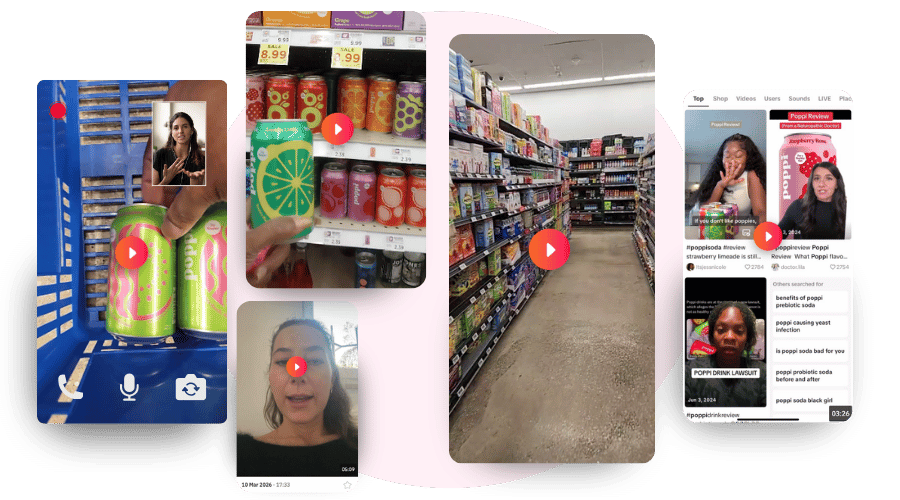
Real-time video responses give a deeper understanding of customer emotions and reactions, capturing nuances that traditional surveys miss, facial expressions, tone, hesitation, the environment around the feedback.
One-to-one interviews
One-on-one interviews allow for in-depth exploration of customer opinions, uncovering detailed feedback and suggestions that group settings can't surface.
Focus groups
Group discussions provide a platform for customers to share views collectively, offering a broader perspective on common issues and potential solutions.
Mobile ethnography
Participants use mobile devices to document their daily lives and interactions with products or services in real time, providing authentic, in-the-moment insight that lab or interview settings can't match.
What are the top tips for successful VoC research?
Five tips consistently separate strong VoC programmes from ones that produce a lot of data but little actual change.
Use diverse channels
Combine qualitative methods, diary studies, video responses, interviews, focus groups, mobile ethnography, to gather comprehensive insight. No single method tells the whole story.
Design thoughtful research frameworks
Create structured research frameworks with clear objectives and detailed prompts to guide participants in providing useful, actionable feedback. Loose briefs produce loose data.
Foster participant engagement
Make sure participants are well-trained and motivated. Regular check-ins and support maintain high engagement levels throughout the research period. Recruitment matters too, target individuals who match your research criteria and offer fair incentives.
Build an effective feedback loop
Establish a robust system for continuously reviewing and acting on feedback. Use iterative research to refine methods, and consider Market Research Online Communities (MROCs) for ongoing engagement, so feedback leads to tangible improvements rather than a report that gets shelved.
Analyse and synthesise data
Use modern analytical tools to identify common themes and insights. Generative AI can process large volumes of qualitative data quickly, surfacing themes, sentiment, and quotes that would take weeks to find manually.
What are the future trends in VoC research?
Three trends are shaping how VoC research will evolve.
Artificial intelligence
AI is increasingly used to analyse customer feedback, offering deeper insight and automating the identification of trends and sentiment. The role of the researcher shifts from manual analysis to interpretation and application.
Omnichannel feedback collection
Collecting feedback across multiple channels — in-app, email, video, social, call centre — produces a more complete view of customer experience than any single channel.
VoC + customer journey mapping
Integrating VoC data with customer journey mapping provides a holistic view of customer experience across all touchpoints. This helps businesses identify critical moments of truth, understand pain points, and improve the overall journey. Mapping customer feedback to specific stages lets businesses prioritise actions that enhance satisfaction and loyalty.
How does Indeemo support VoC research?
Indeemo provides an end-to-end environment for VoC research. Projects can be set up, participants recruited, data collected, and results analysed in as little as 48 hours. The platform's user-friendly interface and AI-powered analysis tools make it straightforward to capture in-the-moment feedback and convert it into insight that business teams can act on.
Indeemo supports VoC research through:
- Participant recruitment. Recruit B2C and B2B participants in hours from a panel of 3 million+ participants, with compelling incentives built in.
- Flexible tasking. Design and deploy research tasks across diary studies, video responses, mobile ethnography, and journey mapping.
- In-the-moment insight. Capture real-time feedback through the mobile app — videos, images, and text in 30+ languages.
- AI-powered analysis. Use generative AI for summarisation, translation, thematic analysis, and sentiment analysis to speed up analysis significantly.
- Omnichannel journey mapping. Convert customer feedback into interactive journey maps that show the full experience across channels.
- Imported interviews. Import interviews and focus groups from Zoom or Microsoft Teams for deeper probing alongside the diary data.
- Highlight reels. Create subtitled highlight reels to share customer voice with product, marketing, or leadership teams.
Done well, VoC research isn't just a report. It's a continuous loop where customer voice genuinely shapes product, service, and experience decisions — and that's only possible when the analysis is fast enough to keep up with the customer.
Do you need a dedicated CX team to run VoC research?
No. Whether you're a customer experience team, a brand exploring VoC for the first time, or an agency running research for a client, Indeemo can support you.
Use the platform independently, or partner with our Catalyst team for study design, recruitment, moderation, and analysis. If you have VoC ambitions but not the in-house capacity, we can lend a helping hand.
Frequently asked questions
What's the difference between VoC research and customer satisfaction surveys? Customer satisfaction surveys are one input into VoC research, not the whole picture. VoC programmes combine multiple qualitative and quantitative methods — surveys, interviews, diary studies, video, journey mapping — to build a rounded view of customer experience rather than a single metric.
How often should a VoC programme run? Ongoing. The strongest VoC programmes are continuous rather than episodic — small, frequent touchpoints that produce a steady stream of insight. That said, larger deep-dive studies can supplement the continuous programme when big strategic questions arise.
How many customers need to be involved? It depends on the method. Qualitative work (diary studies, mobile ethnography, interviews) typically involves 15–50 participants per segment. Quantitative VoC research (surveys) can scale to thousands. Most mature programmes run both in parallel.
What's the hardest part of running VoC research? Most teams say the challenge isn't gathering the feedback — it's closing the loop. Insight that doesn't lead to change creates research fatigue for everyone involved. Programmes that build in clear feedback loops, action tracking, and visible change tend to sustain participant engagement and internal momentum.
Can AI really do VoC analysis? AI is a strong first pass on VoC data — transcription, theme detection, sentiment, summarisation. It's not a replacement for researcher interpretation, especially when dealing with nuanced emotional data or strategic implications. The best programmes combine AI speed with human judgement.