

Key takeaways
- Autoethnography is a self-ethnographic research method where participants use self-reflection to record their own thoughts, feelings, behaviours, and experiences, usually through a mobile or digital ethnography app.
- Unlike traditional ethnography, there's no researcher physically present. Participants document their own lives, which removes the researcher effect and captures more natural behaviour.
- It's widely used in service design, customer journey research, and UX studies where understanding real-world context matters more than a single interview snapshot.
- Mobile ethnography platforms make autoethnography practical at scale — participants record in-the-moment videos, photos, screen recordings, and texts, all in one place.
- With Indeemo, you can recruit from a global panel, run studies in 30+ languages, and analyse submissions with generative AI.
Why is autoethnography growing as a research method?
Hybrid work and digital transformation have reshaped ethnographic research.
Before hybrid work, travelling to spend time observing participants in their everyday context was the norm. That's no longer practical for most teams. At the same time, digital transformation has disrupted every customer experience and customer journey to the point where most are now partially or entirely digital, and almost always omnichannel.
Together, these shifts mean it's no longer possible to understand people's needs, behaviours, and experiences across multiple contexts (home, work, in-store, online) and channels (search, social, mobile, desktop) through traditional in-person ethnography alone. That's what's driving the growth in autoethnography.
What is autoethnography?
Autoethnography (sometimes referred to as mobile ethnography or digital ethnography) is a self-ethnographic research method where the research participant uses self-reflection to record their own thoughts, feelings, behaviours, and experiences, through a first-person perspective, usually using a purpose-built mobile or digital ethnography platform.
As a form of ethnographic research (which itself has its origins in cultural anthropology), there's no independent researcher physically present to record observations. Instead, the participant records their own behaviours and experiences as they live their daily life.
What are some examples of autoethnography?
Service design research and service safari research are two well-known examples of autoethnography in practice.
The method is particularly powerful in service design. It's one of several approaches recommended by the authors of This is Service Design Doing for use by service designers and UX researchers.
Autoethnography is increasingly used in service design because it helps streamline internal workflows, both for the organisation and for the customer-facing touchpoints that shape experience. As an agile, qualitative research method, it uncovers context-rich insights that surface needs or validate hypotheses. The in-the-moment insights it captures provide evidence-based foundations for deliverables like customer journey maps and service blueprints.
What are the benefits of using autoethnography tools?
Autoethnography was traditionally conducted in person. A researcher would go on-site, take copious field notes, then return to the office to reflect on the experience.
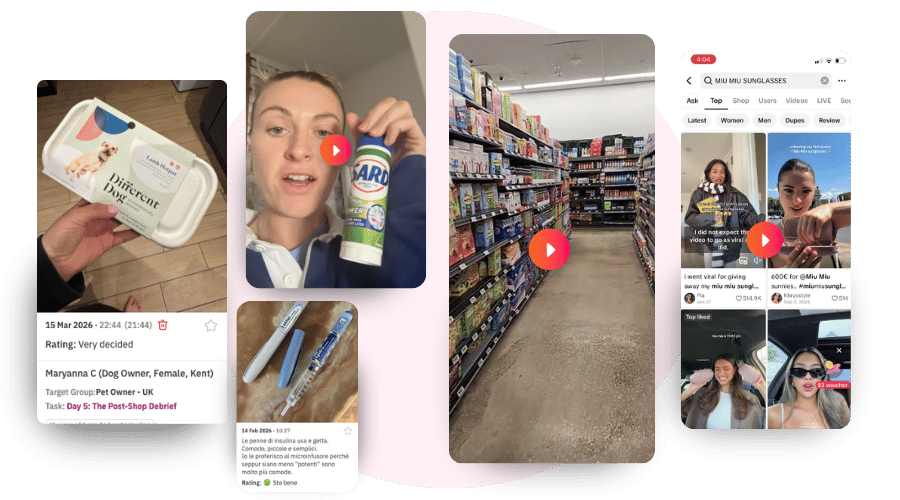
With smartphones, video, and cloud technologies, purpose-built autoethnography tools now let researchers run studies virtually and remotely. Mobile ethnography tools use personal technology like smartphones to capture notes, photos, videos, screen recordings, and any other digital artefacts, all stored in a single platform.
This matters for two reasons. First, it's more efficient for researchers. Second, secure sharing and permission settings make it easy to distribute content to other researchers, designers, and stakeholders, which builds empathy across the wider organisation.
How do you design an autoethnography study?
As with any ethnographic research method, it's important to start with your research goal. Scoping out the area of research upfront helps you tailor the study. Decide whether the study will focus on a full journey or a specific portion of it. This is also the point to think about the deliverables you want to produce from the findings.
What kinds of data does autoethnography capture?
Autoethnography findings are typically recorded in several formats: notes, photos, videos, and screen recordings. For longer studies, diary study techniques are an effective recording approach.
In traditional ethnography, there are two broad types of study. Overt studies, where researchers disclose their identity while on-site. And covert studies, where researchers don't disclose their identity during documentation. Covert studies have the advantage of eliminating the "observer effect," but capturing insight on others without their consent can have serious repercussions if proper steps aren't followed. Legal agreements are strongly recommended when gathering footage and notes on participants during those types of studies.
Autoethnography sidesteps this issue. Because participants are documenting their own lives with explicit consent, there's no observer effect — the researcher isn't physically present to influence behaviour in the first place.
How do you conduct autoethnography research?
Autoethnography is easier to run than you might think. Recruitment is the same as recruiting for traditional ethnographic research or focus groups. Participants are sourced, screened, and incentivised. Instead of paying for a single two-to-four-hour visit, the same time input is spread across several days and multiple contexts.
When conducting a study, participants are assigned tasks that instruct them to record specific behaviours or show how they complete certain activities. Tasks can also be attitudinal — asking participants to record their thoughts, feelings, or reflections on a topic using selfie videos.
Mobile ethnography tools are powerful for autoethnography because they let participants record themselves in the moment, in their everyday contexts. That means the data being captured is both behavioural and contextual in nature, producing rich, raw, real insight that can reveal unmet needs and unconscious behaviour.
Having one platform to collect, collate, and organise findings matters. Researchers can use video transcription, automated keyword analysis, and tagging to analyse the data. Collage and timeline tools then bring participants to life in a visually rich way across multiple real-world contexts, something that's almost impossible to capture through traditional research.
How do you finalise and report autoethnography research?
Once the data is synthesised and the analysis is complete, a research report is written. This is typically delivered in a multimedia format, like a slide deck with embedded images and videos.
Thematic analysis is the usual approach. The researcher codes the raw data into themes, concepts, or topics, and uses quotes, images, and video excerpts as evidence. Modern autoethnography platforms include a suite of tools to filter, analyse, and export findings.
Artefacts collected during the study can be referenced in the report and linked to directly. Mobile ethnography improves this by providing a single repository for all content, with permission settings so other researchers and stakeholders can access the artefacts and insights they need. This builds empathy across the organisation far more effectively than a static PDF.
How can Indeemo support autoethnography studies?
Indeemo is designed for autoethnography, mobile ethnography, and digital ethnography projects. Alongside self-documentation studies, you can:
- Recruit B2C and B2B participants in hours from a panel of 3 million+ respondents
- Capture in-the-moment videos, photos, screen recordings, and texts in 30+ languages
- Use generative AI for summarisation, translation, thematic analysis, and sentiment analysis to speed up analysis significantly
- Import interviews from Zoom, Microsoft Teams, or your computer, and analyse them alongside your autoethnography data
- Create subtitled highlight reels to share participant voice with stakeholders
Everything sits in one dashboard, so you can move from fieldwork to report without juggling tools.
Do you need to be an expert to run autoethnography research?
No. Whether you're an experienced qualitative researcher or a team exploring the method for the first time, Indeemo can support you.
Use the platform independently, or partner with our Catalyst team for study design, recruitment, moderation, and analysis. If you have research ambitions but not the in-house capacity, we can lend a helping hand.
Frequently asked questions
What's the difference between autoethnography and traditional ethnography? Traditional ethnography involves a researcher being physically present to observe participants. Autoethnography flips that: participants document their own behaviour through a mobile app, with no researcher in the room. This removes the observer effect and captures more natural behaviour.
Is autoethnography the same as mobile ethnography? They overlap significantly. Mobile ethnography is the technology-enabled version of ethnographic research, and autoethnography is often run on mobile ethnography platforms. The distinction is emphasis: autoethnography specifically highlights the self-reflective, first-person nature of the documentation.
What kinds of projects work well with autoethnography? Service design research, customer journey mapping, UX discovery, healthcare patient experience studies, and shopper research. Anything where understanding context and real-world behaviour matters more than a single interview snapshot.
How long does a typical autoethnography study run? Field time usually ranges from a few days to two or three weeks, depending on the research question. Diary-style studies tracking behaviour over time tend to run longer than focused service-safari tasks.
What do participants need to take part? A smartphone with a camera and a reasonable internet connection. Participants download the Indeemo app and respond to tasks by recording videos, taking photos, capturing screen recordings, or writing short reflections. The app works on iOS and Android.