
Winnebago: Real-world testing for the future of electric RVs

5
Tester segments
3
US states
4
Capture modes
2
Methods integrated
The Challenge
The eRV2 is the most advanced RV Winnebago has ever built. A zero-emission energy system unlike anything the RV industry has seen, sustainable materials, smart tech integrations, an intuitive new control platform called Winnebago Connect that brings vehicle systems under a single panel. A genuinely new product category for the brand.
For a launch this different, traditional product testing wouldn't be enough. John Bonczyk's product management team and Hillary Waters's research and insights team set out to do something the RV industry doesn't typically do: put a small fleet of working prototypes in real users' hands and watch what actually happens.
We knew we needed to explore another level of testing, so we created a pilot program that integrates interviews with a digital diary.
The team needed to learn not just whether the eRV2 worked, but how people actually related to an electric RV, and how that differed from a traditional RV experience. Range anxiety in Florida versus California. Charging infrastructure friction. The new behaviours that emerge when making dinner while waiting for the charge becomes part of the trip. Things you can only learn by being in the moment with the person.
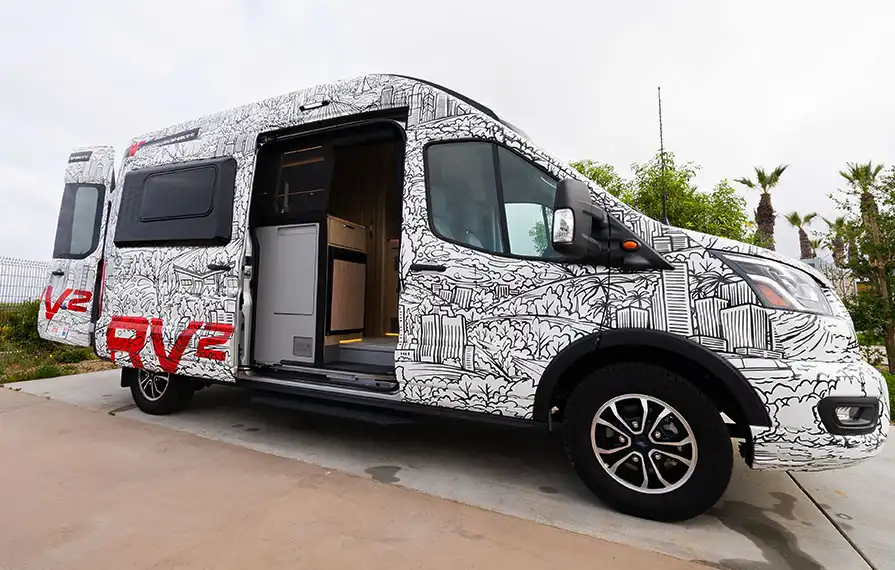
Winnebago's eRV2 model
The Approach
Winnebago built a small fleet of eRV2 prototypes and assembled a tester team that spanned the breadth of who actually uses an RV, not a single homogeneous user group, but five distinct segments tested side-by-side.
Five tester segments side-by-side. Travel bloggers, outdoor content creators, full-time van lifers, EV owners, and Weekend Warriors. Each brings a different baseline: long-term van life expectations, EV charging fluency, weekend-leisure use, content-creation needs.
Coast-to-coast deployment. Testers ran the prototypes across California, Florida and Washington, deliberately covering the full spread of US charging-infrastructure realities so the team could see how environment actually shaped the experience.
Internal team in the field too. Key Winnebago product, marketing and leadership team members also went out on the road as testers, getting first-hand exposure to what the customers were experiencing rather than relying on a research-team filter.
Multi-modal in-the-moment capture. Testers shared screen recordings, video diary entries, snapshots and surveys via a digital platform, with the Winnebago team reviewing in real time.
Open-ended trip framing. Testers were given the units and asked to go off and camp as they normally would for a week or two, with Winnebago catching feedback in the moment rather than relying on after-the-fact recall.
We're now able to get much closer to the customer experience, actually seeing the world through their eyes and hearing about their experiences in their own voices.
The pilot is designed to surface things testers couldn't articulate after the fact. Reactions to the bump-out aesthetics, friction points around charging at night, the moment something goes from sticker to real thing.
The Results
The pilot program was in flight at the time of writing. The findings themselves are still being applied, but the methodology has already changed how Winnebago is approaching product development for the eRV2 and beyond.
Real-time, in-context feedback to the product team. Testers' inputs and reactions came in continuously through the digital diary platform, screen recordings, snapshots, video diaries, surveys, letting Winnebago analyse and respond as the pilot ran rather than waiting for end-of-pilot debriefs.
Behavioural insight that traditional testing couldn't reach. Range anxiety, charging-infrastructure friction, and the new rhythms electric RV life creates, like cooking dinner while waiting for the charge, only surface when you're capturing people in real environments. The pilot program's design makes those insights observable rather than guessable.
Cross-segment, cross-environment patterns. Running the pilot across five tester segments and three US states means the Winnebago team can see how the same product gets used differently in California's dense charging network versus Florida's sparser one, and how the same emotional concepts like range anxiety show up differently in each context.
Insights that will shape the eRV2 launch and beyond. The team has stated explicitly that the truths uncovered through this pilot program will impact the eRV2 brought to market, the van life experience, and every Winnebago RV that follows.
We see things they couldn't describe. It's much more information than interviewing the tester after the fact.



.jpg)
Ready to see Indeemo in action?
Book a personalised demo and discover how teams like yours capture real-world insight with Indeemo.
