

Key takeaways
- Video-based research captures what people say and how they say it — facial expressions, tone of voice, environment — giving researchers a fuller picture than surveys or focus groups alone.
- It's particularly valuable for understanding consumption occasions at home, product preferences influenced by packaging and branding, and shopping missions in real retail contexts.
- Video gets closer to real behaviour than retrospective accounts. Participants document their experience as it happens, without post-rationalisation.
- Brands that use video research get deeper emotional insight, better contextual understanding, more authentic consumer narratives, and faster feedback loops for decision-making.
- With Indeemo, you can capture in-the-moment videos, photos, screen recordings, and texts from participants on their own phones, and analyse submissions with generative AI.
Why video-based research matters for consumer understanding
Researchers and brands are constantly looking for better ways to understand the minds of their consumers. Video-based research has become a practical way to capture not just what consumers say, but the context around it — the environment, the emotion, the moment.
Mobile qualitative research through video isn't new, but it's become significantly more powerful as smartphones and AI have matured. This post covers how video-based research helps brands understand three specific dimensions of consumer behaviour: consumption occasions at home, product preferences in-store, and shopping missions across the purchase journey.
What are consumption occasions and how does video research capture them?
In the age of mobile devices, capturing real-life moments has become second nature. Video-based research uses this to its advantage, letting researchers understand consumption occasions that unfold at home, among family and friends. That kind of insight used to be unreachable. Traditional methods relied on retrospective accounts that lacked the immediacy video brings.
Home is where many consumption occasions happen. Family gatherings. Friendly get-togethers. These moments reveal how products and behaviours intertwine in the personal spaces of consumers.
A family's living room during a holiday dinner. The interactions, the conversations, the particular role a product plays. Video-based research lets participants document these moments in real time, providing a view that words alone struggle to capture. Brands can see the emotions, reactions, and dynamics that shape consumption — and tailor products and marketing to align with those real moments.
How does video research reveal product preferences?
Understanding what drives consumers to choose one product over another has always been a challenge. Video-based research helps by letting researchers observe how consumers react to packaging, branding, and product presentation directly, rather than relying on what people later claim influenced them.
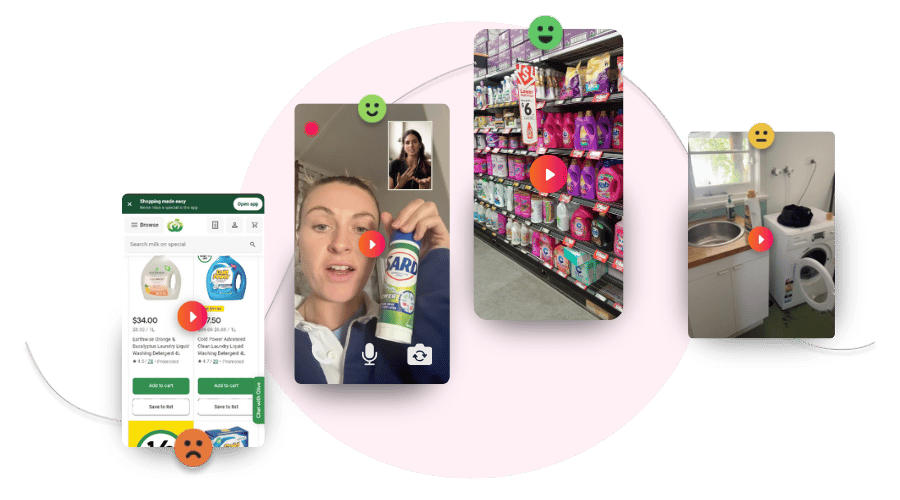
Participants can use their mobile devices (with tools like Indeemo) to record their interactions with products on store shelves. As they browse, touch, and compare items, they narrate their thoughts and feelings — offering candid insight into the role packaging, branding, and product presentation play in their decision-making. Researchers can see not only what attracts consumers but also what might deter them, leading to strategic adjustments that improve a product's appeal on the shelf.
How does video research reveal shopping missions?
The shopping journey is dynamic. Store layout, product arrangement, personal preference, promotions in the aisle — all shape decisions in ways that are hard to reconstruct after the fact. Video-based research lets consumers become narrators of their own shopping missions, capturing the nuances of their thoughts and feelings as they move through the store.
A consumer strolling through a supermarket aisle, capturing their reactions to various products and sharing their internal monologue. That goes well beyond post-purchase interviews and surveys — it's a live window into the decision-making process. Brands can identify pain points, moments of delight, and unmet needs, and refine their approach to align with the actual consumer mindset rather than the assumed one.
Why does context matter so much in video research?
What sets video-based research apart is contextual richness. Context is king in consumer insight, and video captures not only what participants say, but how they say it — facial expressions, body language, tone of voice. All of it carries information that written responses can't.
When consumers share their experiences through video, they offer a multidimensional view that lets researchers immerse themselves in the consumer's world. That depth of understanding is what lets brands build products and marketing campaigns that resonate authentically. In short, video-based research bridges the gap between data and real consumer behaviour — offering a fuller view of how people actually live, shop, and decide.
What are the benefits of video-based research for brands?
Video research opens a range of specific benefits for brands trying to understand their customers better.
Deeper emotional insight
Video captures not just what consumers say, but how they feel. Facial expressions, gestures, tone — these emotional cues give brands insight into the consumer's connection with products and experiences that written responses would never reveal. That's useful for crafting marketing strategies that connect at a real, human level.
Contextual understanding
Video research offers context that textual responses can't match. You can see consumption occasions, product interactions, and shopping missions in their natural settings. Contextual richness provides a holistic view of behaviour, revealing nuances that feed into decision-making.
Authentic consumer narratives
Videos capture genuine, unfiltered consumer narratives. When consumers narrate their experiences, preferences, and thoughts in the moment, brands access raw, unscripted insight — which strengthens the credibility of research findings and informs brand strategy that aligns with real consumer voice.
Faster decision-making
Observing consumers in action lets brands adapt to emerging trends or unexpected behaviours faster. That agility matters in markets where consumer preferences are shifting quickly.
Better product development
Video research reveals user experiences, pain points, and unmet needs in a way that accelerates product iteration. Brands can identify how consumers actually interact with a product, where improvements are needed, and which features resonate most.
Refined marketing strategies
Understanding the influence of packaging, branding, and presentation is essential for effective marketing. Video research gives a real-time view of how consumers engage with those elements, letting brands optimise messaging, align visuals with consumer sentiment, and craft campaigns that connect.
Subconscious signals
Video captures subtleties that participants may not consciously articulate. Micro-expressions and hesitations can reveal subconscious influences on choice — hidden drivers behind preferences that wouldn't surface in a survey.
Customer-centric approach
Together, these insights let brands adopt a genuinely customer-centric approach — tailoring offerings, services, and interactions based on nuanced understanding rather than assumption.
How does Indeemo support consumer video research?
Indeemo is built for the kind of in-context, multi-format video research this post describes. Alongside consumer behaviour studies, the platform supports the full qualitative workflow:
- Recruit B2C and B2B participants in hours from a panel of 3 million+ participants
- Capture in-the-moment videos, photos, screen recordings, and texts in 30+ languages
- Use generative AI for summarisation, translation, thematic analysis, and sentiment analysis to speed up analysis significantly
- Run mobile screen recording for online shopping and digital product interactions
- Build multimedia journey maps across the full consumer experience
- Create subtitled highlight reels to share participant voice with brand, marketing, product, or leadership teams
- Import follow-up interviews from Zoom or Microsoft Teams for deeper probing alongside the diary data
Because the full workflow sits in one place, you can move from observation to analysis to storytelling without stitching multiple tools together.
Do you need to be a video research specialist to run these studies?
No. Whether you're a consumer insights team, a brand exploring video research for the first time, or an agency running work for a client, Indeemo can support you.
Use the platform independently, or partner with our Catalyst team for study design, recruitment, moderation, and analysis. If you have research ambitions but not the capacity to run the project yourself, we can lend a helping hand.
Frequently asked questions
What kinds of consumer insight is video research best suited to? Video research is strongest for understanding behaviour in context — consumption occasions, shopping missions, product interactions, emotional reactions to packaging or branding. It's less useful for questions that need large-sample quantification; that's what surveys do well.
How long do participants need to spend on video tasks? Most video responses are 1–3 minutes per task. A full study might ask for 5–10 responses across a week or two. Keeping individual responses short makes it easier for participants to stay engaged and for researchers to analyse efficiently.
Can video research capture online shopping as well as in-store? Yes. Mobile screen recording captures online shopping behaviour the way in-store video captures physical shopping — browsing, comparison, hesitation at checkout. Many studies combine both to understand omnichannel behaviour.
How many participants do you need for a video research study? Most consumer behaviour video studies work with 15–30 participants per segment. Because each participant contributes rich multi-format data, sample sizes can be smaller than survey-based research.
What's the difference between video research and a focus group? Focus groups happen in a controlled setting with a moderator. Video research happens in the consumer's real environment, on their own schedule. Focus groups are stronger for structured debate and group dynamics; video research is stronger for real-world behaviour and emotional context.