

Key takeaways
- Demand spaces are specific contexts or occasions that reveal distinct consumer needs, preferences, and behaviours — going beyond demographic or psychographic segmentation.
- Understanding demand spaces helps brands target more precisely, personalise more effectively, and spot opportunities for innovation that demographic data misses.
- Qualitative research — especially in-the-moment video research — is the most effective way to map demand spaces, because it captures real behaviour in context.
- Video research reveals the emotional drivers and situational factors behind consumer choices, not just the choices themselves.
- With Indeemo, you can run demand spaces research end to end: recruit from a global panel, collect videos, photos, screen recordings, and texts from real consumer moments, then analyse with AI.
What are demand spaces?
Demand spaces are specific contexts or occasions that reveal distinct consumer needs, preferences, and behaviours. Where traditional segmentation focuses on demographics or psychographics, demand spaces focus on situational contexts and emotional drivers — the circumstances in which people make decisions.
Understanding demand spaces lets brands tailor their products, marketing, and customer experiences to meet consumers in specific moments rather than speaking to broad demographic groups.
Why do demand spaces matter for brands?
Understanding demand spaces matters for a few reasons.
Deeper consumer understanding
Demand spaces give you a holistic view of behaviour, surfacing the underlying motivations and needs driving consumer choices. Demographics tell you who your consumer is. Demand spaces tell you why they choose what they choose, and when.
More precise targeting and personalisation
Once you know the contexts consumers are operating in, you can create campaigns that resonate with how they actually think and feel in those moments. A message that works for a consumer on their morning commute is different from one that works at a weekend family dinner, even if the demographic is identical.
Innovation and growth opportunities
Mapping demand spaces often surfaces unmet needs. Gaps where no current product or service serves consumers well in a particular context. That's fertile ground for new products, new features, or new positioning.
Competitive differentiation
Brands that address specific demand spaces well differentiate themselves and build stronger loyalty. Competitors working from broad demographic segments miss the situational detail that drives preference.
How does qualitative research uncover demand spaces?
Qualitative research is essential for identifying and understanding demand spaces. While quantitative data tells you what consumers do and how often, qualitative research tells you why. It provides rich, detailed insight into the emotions, motivations, and contexts shaping consumer decisions.
The challenge is that demand spaces exist in real life, not in a discussion guide. Asking someone in a focus group "when do you usually drink coffee?" gets you an answer. Watching them actually make coffee at 7:15am while checking their phone gets you the context.
Why is in-the-moment video research so effective?
In-the-moment video research captures real-time footage of consumers as they go about their daily lives. Three things make it particularly good at surfacing demand spaces.
Authentic insight
Because consumers record in their own environment as they're actually living their lives, you see genuine behaviour, not a recollection of that behaviour two weeks later in a discussion room.
Contextual understanding
By observing people in different situations across the week, you can identify the specific contexts and occasions that define a demand space. A morning routine looks different from a weekend afternoon, which looks different from a commute home. All three might matter for your category.
Emotional depth
Video captures emotional responses — tone, expression, frustration, delight — giving you a window into the emotional drivers behind behaviour that written feedback rarely reaches.
How does Indeemo help you map demand spaces?
Indeemo is a platform built for in-the-moment video research, designed to help brands uncover and understand demand spaces across real consumer contexts.
Mobile-first participant experience
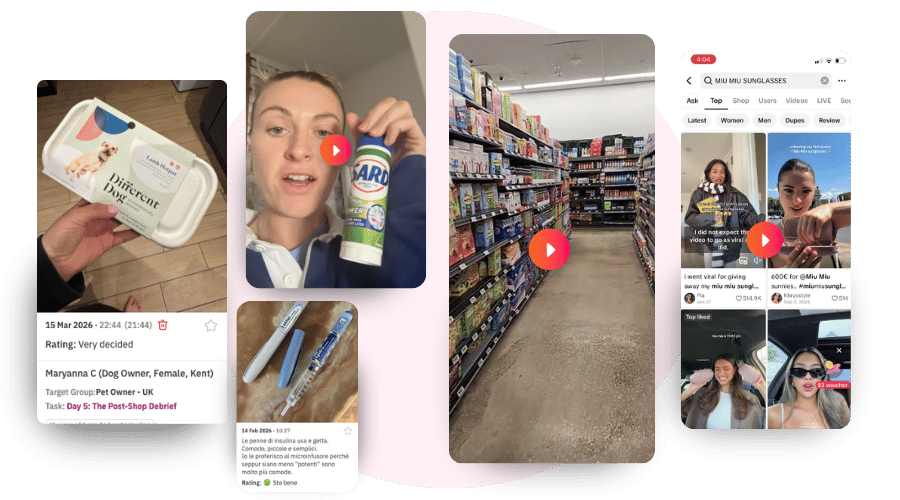
The Indeemo app uses a social-networking-style interface that participants already know how to use. They can capture videos, photos, screen recordings, and texts in the moment, with minimal friction. That means higher participation rates and richer data.
Contextual, real-time data collection
Researchers can collect data from participants as they go about their day, giving you immediate insight into the contexts and occasions that define different demand spaces. Because submissions land on your dashboard as they happen, you can start spotting patterns while fieldwork is still running.
Rich, qualitative data
You get more than numbers. Video captures emotion, environment, and situational nuance. Screen recordings show exactly how consumers navigate digital touchpoints. Photos capture what's on the kitchen counter or in the shopping basket. Together, these formats give you a multi-dimensional picture of how consumers actually live.
Interactive dashboards and analytics
Indeemo's dashboard lets you tag, filter, and synthesise submissions as they come in. Collage and journey mapping tools help you visualise patterns across participants and surface the occasions that matter.
Fast recruitment
Indeemo's recruitment features let you screen and recruit the right participants quickly. You can target the exact consumer profiles you need — whether that's based on category, usage, or occasion — so your studies get filled with people whose data actually answers the question.
Generative AI for analysis
Indeemo uses generative AI to speed up qualitative analysis. The platform automatically transcribes video in 30+ languages, identifies speakers, and assigns roles. AI-powered tools can summarise transcripts, detect themes, analyse sentiment, and extract key quotes quickly, so you spend less time on the mechanics and more time on interpretation.
Do you need to be a researcher to map demand spaces?
No. Whether you're an in-house insights team, a brand exploring qualitative research for the first time, or an agency running work for a client, Indeemo can support you.
Use the platform independently if you have the expertise in-house, or partner with our Catalyst team for study design, recruitment, moderation, and analysis. If you have research ambitions but not the capacity to run the project yourself, we can lend a helping hand.
Where do demand spaces fit in your strategy?
Understanding demand spaces helps brands move beyond demographic generalisations and into the specific moments where consumers make decisions. Qualitative research, particularly in-the-moment video, is the most effective way to capture those moments. It gives you the contextual, emotional detail that surveys and traditional segmentation miss.
With a clear picture of the demand spaces in your category, you can sharpen targeting, personalise experiences, and find innovation opportunities that competitors working from broader segmentation won't see.
Frequently asked questions
What's the difference between demand spaces and demographic segmentation? Demographic segmentation groups consumers by who they are (age, income, location). Demand spaces group consumer behaviour by the context in which it happens (morning routine, commute, weekend social, late-night snack). A single consumer operates across multiple demand spaces depending on the occasion.
Why are demand spaces better than psychographic segmentation? Psychographic segmentation groups people by attitudes or values. Demand spaces focus on situations and occasions. Both are useful, but demand spaces are often more actionable because they map directly to the moments where brands can make a difference in a consumer's experience.
What kinds of research methods uncover demand spaces? In-the-moment video research, mobile ethnography, diary studies, and journey mapping are all strong methods. They share the common thread of capturing real behaviour in context rather than relying on participant recall.
How many participants do you need to map demand spaces? It depends on the breadth of the category. A focused category study might work with 20 to 30 participants. A broader multi-market study could involve 100 or more. Because each participant contributes multiple data points across occasions, sample sizes can be smaller than in survey research.
How long does a demand spaces study take? Field time varies from one to three weeks depending on how many occasions you want to capture. Analysis can be accelerated significantly with AI-powered transcription, theme detection, and sentiment analysis, which means shorter end-to-end timelines than traditional ethnographic studies.