
Key takeaways
- Generative research is a set of qualitative techniques used to explore people's lives, behaviours, and experiences helping teams understand real problems before designing solutions.
- It is the natural research companion to stage 1 of design thinking (Empathise), because the goal of both is the same: build genuine understanding of the people you are designing for.
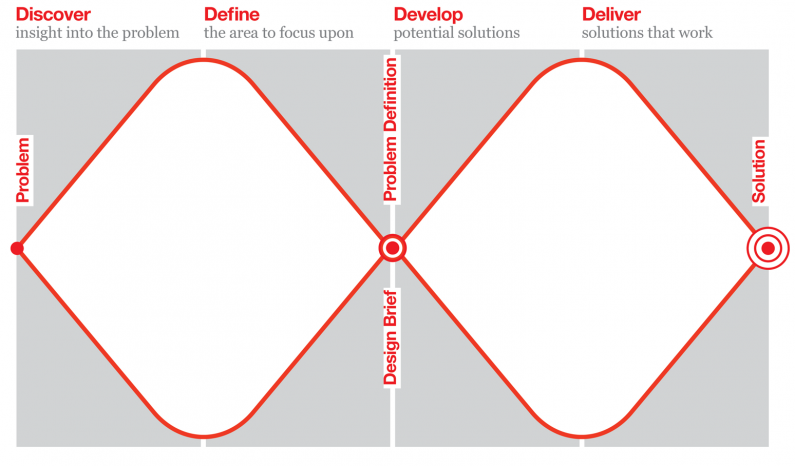
- The double diamond is a design process model with four steps: Discover, Design, Develop, Deliver and generative research methods apply at every stage, not just the first.
- The most common methods are in-depth interviews, focus groups, diary studies, and mobile ethnography with mobile approaches increasingly preferred because they capture behaviour in context, as it happens.
- Design-led companies have outperformed the S&P 500 by 219% over 10 years (Design Management Institute), and teams applying design thinking get to market twice as fast with 300%+ ROI (Forrester).
- With Indeemo you can recruit from a global panel, research in 30+ languages, analyse responses with AI, and share subtitled highlight reels with stakeholders all in one platform.
What is design thinking?
Design thinking developed from a mix of theoretical and practical disciplines, and its defining characteristic is this: every stage revolves around human experience. Human behaviour, human decisions, user journeys, everyday problems. The method is used in product design, service design, UX, and innovation work — anywhere the goal is to solve real problems for real people.
According to the Design Management Institute's Design Value Index, design-led companies outperformed the S&P 500 by 219% over the ten years from 2004 to 2014. Companies in that index including Apple, IBM, Nike, and Procter & Gamble – share one defining trait: design, and the human understanding that underpins it, is treated as a strategic priority, not an afterthought.
The process has five stages:
- Empathise
- Define
- Ideate
- Prototype
- Test
One important thing to understand before diving in: design thinking is not a linear checklist. It is iterative. Teams move between stages as the work demands, circling back to empathy when new information challenges their assumptions, or jumping ahead to prototype something quickly in order to learn from it.
What is the double diamond?
The double diamond is a design process model developed by the British Design Council in 2005. It is widely used across UX, product design, and customer experience as a practical map for moving from a problem to a solution.
Where design thinking describes a philosophy and a set of attitudes (be curious, be empathetic, prototype early), the double diamond describes a process. The two frameworks are complementary. Many teams use design thinking as the underlying mindset and the double diamond as the operational structure.
The model gets its name from its shape: two diamonds placed side by side, each representing a phase of the design process.
Each diamond has two modes of thinking:
- Diverging ¸ opening up, exploring, generating possibilities
- Converging, narrowing down, synthesising, making decisions
These map to four core steps:
- Discover (diverge) explore the problem space
- Design (converge) define the right problem and approach
- Develop (diverge) explore possible solutions
- Deliver (converge) test, refine, and launch
Why does the empathise stage matter?
Every stage of design thinking matters. But the empathise stage is where the whole process gets its foundation. Skip it, or rush through it, and you risk building the right solution for the wrong problem or the wrong solution entirely.
The goal of the empathise stage is to build genuine understanding of the people you are designing for. Not assumptions. Not data summaries. Real understanding of how people live, what they struggle with, and what matters to them. This is where you go into their world before you start shaping your own response to it.
There is a practical reason this matters. Problems that feel obvious from inside an organisation often look completely different from the outside. Teams that skip the empathise stage tend to design solutions that solve the problem they imagined rather than the one people actually have. Generative research is the discipline that closes that gap.
The cost of getting it wrong is real. Forrester Research's Total Economic Impact study of IBM's design thinking practice found that fixing defects post-launch costs 3–4 times more than catching them at the design stage. Teams that applied design thinking got to market twice as fast as those that didn't with an ROI of more than 300% over a three-year period.
What is generative research?
Generative research is the term used for research that explores and uncovers – as opposed to research that evaluates or measures. You may also hear it called exploratory research or discovery research; the terms are used interchangeably across the industry.
In practice, generative research means using qualitative methods to understand people's lives, experiences, motivations, and behaviours. The goal is not to test a hypothesis or measure performance. The goal is to understand the human territory you are working in – deeply enough that the right problems, and the right solutions, become clearer.
It is most commonly applied in UX research and design, but the approach is used across consumer insights, healthcare, service design, and any field where understanding real human behaviour matters more than collecting numbers.
What qualitative methods are used in generative research?
Because generative research is exploratory by nature, it calls for qualitative methods. You are trying to understand experience, context, and motivation – things that don't reduce to numbers. The most common approaches are:
In-depth interviews (IDIs)
One-to-one conversations that allow a researcher to probe deeply into a person's experiences, attitudes, and decisions. IDIs are strong for understanding the reasoning behind behaviour, but they depend on what participants can recall and articulate. Memory is imperfect. People rationalise. What someone tells you they did in an interview and what they actually did can be different things.
Focus groups
Group discussions that surface shared attitudes, reactions, and language. Useful for understanding how people talk about a topic and where there is common ground. The group dynamic can generate perspectives that a solo interview would not — but it can also suppress minority views or create social pressure to conform.
Diary studies
Participants document their experiences, behaviours, and feelings over a set period of time – a day, a week, a month. Traditional diary studies used pen and paper, which introduced a practical problem: participants often filled entries in retrospectively rather than in the moment, which compromises the quality of the data.
Mobile diary studies address this directly. Participants record videos, photos, screen recordings, and texts through a smartphone app, in real time, in their actual environment. Researchers can review submissions as they come in, follow up with questions, and observe context that a paper diary could never capture.
Mobile and digital ethnography
Ethnographic research has always been about observing people in their natural context rather than pulling them into a lab or discussion room. Mobile ethnography keeps that intent but removes the need for a researcher to be physically present.
Participants use a smartphone app to document their own experiences – recording a video while cooking dinner, photographing a product shelf in a supermarket, capturing a screen recording as they navigate a website. The researcher sees what the participant sees, in their own space, on their own terms. The researcher effect — the way people behave differently when they know they are being observed – is substantially reduced.
This is why mobile and digital ethnography have grown so quickly as methods. Smartphones are already part of daily life. Using one to document an experience feels natural rather than performative. For a deeper look at the method, see Indeemo's guide to ethnographic research.

How does generative research support the empathise stage?
Generative research fits the empathise stage for three interconnected reasons.
It gets at the "why"
Qualitative methods produce data that explains motivation and experience, not just behaviour. Survey data might tell you that 60% of users abandon a checkout flow. Generative research shows you a person hesitating over a shipping cost, switching to a competitor's app, then getting distracted by a message from a friend. The number is interesting. The story is what you design from.
It captures context
Context is what makes insight actionable. A person's behaviour at a supermarket shelf is shaped by what they ate for breakfast, how rushed they are, what they can afford this week, and whether they trust the brand based on a previous experience. Generative research – especially in-the-moment mobile methods – captures that surrounding texture. You see the environment, the competing stimuli, the moments of hesitation.
Without context, you are designing in the abstract. With it, you are designing for a real person in a real situation.
It builds empathy through real human media
Understanding something intellectually is different from feeling it. Teams that watch a participant video of someone genuinely struggling with a product respond differently than teams that read a summary slide. The emotional register changes.
This is one of the reasons visual, in-the-moment research methods have become central to design thinking practice. Videos, photos, and real-time recordings create the kind of empathy that actually changes design decisions — not just compliance with a process step.
How does generative research apply across the double diamond?
The connection between generative research and design thinking is usually framed around stage 1: the empathise stage, the first diamond, the diverging phase. That framing is right, but it's incomplete.
Generative research methods – and mobile ethnography in particular – are useful at every step of the double diamond. Here is how they apply at each stage.
Discover: opening up the problem space
The discover step is where you gather as much information as possible. You are not yet narrowing — you are trying to understand the full shape of the territory before you decide which part of it to work on.
Two methods work particularly well here.
Observation gives you behaviour without the filter of self-report. The challenge with traditional observation is scale: a researcher can only be in one place at a time, and sending researchers into the field is expensive and logistically complicated. Mobile ethnography changes that. Participants record their own experiences asynchronously, which means you can observe a much larger group across more locations and contexts than an in-person approach would allow – at a fraction of the cost.
Longitudinal diary studies capture how behaviour changes over time. A study might run for a week or a month, with participants recording regular entries about their activities, habits, or experiences. Mobile diary studies are particularly well suited to this phase because participants submit videos, photos, and texts through an app, making it easy to organise, filter, and analyse submissions as they come in. Learn more about diary study design.
Design: converging on the right problem
The design step is about synthesis. You take what you learned in discovery and work out what it means which problems are real, which are significant, and what the right focus is before you start building anything.
Customer journey mapping is the central activity here. A journey map takes participant data, synthesises it into the most common workflow, and plots it as a sequence of steps. The end result is a shared, concrete picture of who your team is designing for, including where the pain points are and where the opportunities lie.
Mobile ethnography supports journey mapping because emotional states are captured close to the moment they occur, rather than reconstructed from memory in a debrief. Metrics like CSAT and NPS can be collected at specific touchpoints during a study, giving journey maps both the narrative and the data. More on Indeemo's journey mapping capabilities.
Develop: exploring solutions
The develop step opens up again. You have defined the problem, now you explore how to solve it. For product and tech teams this is typically where development begins. For customer experience and service design teams, it is often where service blueprints are built.
A service blueprint layers the customer journey with the organisational touchpoints behind it, the front stage (what the customer experiences) and the backstage (the processes, systems, and people that support it). Building an accurate service blueprint requires understanding how employees as well as customers behave.
Mobile ethnography makes this practical. Employees can record their own workflows. capturing what they actually do, step by step, in the systems they use and the environments they work in. Those recordings are stored in one place, easy to filter and organise, and can be mapped directly onto the customer journey to show where organisational friction shows up in the customer experience.
Deliver: testing, iterating, and closing the loop
The deliver step has two phases: testing before launch, and gathering feedback after it.
Testing whether with a prototype or a small beta group benefits from the same principles as discovery research: you want real behaviour, not performed behaviour. Participants can record their experience using a mobile ethnography app, capturing what they notice, where they get stuck, and how they feel. Asynchronous workflows mean you can test with more people, in more contexts, than a traditional usability session would allow.
The feedback loop continues after launch. Products rarely land perfectly, and the teams that improve fastest are those with a reliable way to capture what is actually happening in the wild. Mobile ethnography lets you follow up with participants after a launch, gathering timely, organised feedback from a large group without requiring everyone to come to a facility or join a call.
How do you get started with generative research for design thinking?
Start with a clear research question
Before choosing a method, be clear on what you are trying to understand. Generative research works best when the question is open and exploratory: "How do people manage their finances day to day?" is a better starting point than "Do people like our app?" The former opens territory; the latter tests something specific, which is evaluative research.
A useful check: if you already think you know the answer and you're looking for confirmation, you're probably in the wrong mode. Generative research is for genuine exploration.
Choose the right method for the stage
Different methods suit different moments in the process. In-depth interviews are strong for understanding reasoning and context at the beginning. Diary studies are best when you need to understand behaviour over time or across repeated experiences. Mobile ethnography is best when context matters, when you need to see not just what people do, but where, when, and what surrounds it.
Many generative research programmes use more than one method. A diary study running over a week might be followed by IDIs that probe the experiences participants documented. The two methods complement each other: the diary captures behaviour; the interview unpacks it.
Use the right tools to recruit, research, and analyse
Running generative research across multiple participants, markets, or time periods takes real infrastructure. With Indeemo you can recruit from a global panel of 3 million+ participants, run studies in 30+ languages, and have participants share videos, photos, screen recordings, and texts through an app they pick up in minutes. AI-powered transcription, translation, and analysis means you can move from fieldwork to findings faster, and create subtitled highlight reels to share with stakeholders in a format that builds real empathy.
Get support if you need it
Whether you have an experienced research team or you're exploring generative methods for the first time, Indeemo can support you. Use the platform independently, or partner with our Catalyst team for study design, recruitment, moderation, and analysis. If you have a research ambition but not the internal capacity to run it, we can lend a hand — at whatever stage makes sense.
Frequently asked questions
What is the difference between generative research and evaluative research?
Generative research explores open territory. it is used when you want to understand people's lives, behaviours, and motivations before you have a solution to test. Evaluative research tests something specific. a design, a prototype, a product. Generative research typically comes earlier in the process, feeding into the empathise and discover phases. Evaluative research comes later, during prototype and deliver phases.
Is generative research only useful at the empathise stage?
No. Generative methods are most strongly associated with the empathise stage of design thinking and the discover step of the double diamond, but they have a role throughout. Diary studies can inform journey mapping during the design step. Employee observation supports service blueprint work during the develop step. Feedback loops after launch are essentially ongoing generative research in the wild.
What is the difference between design thinking and the double diamond?
Design thinking is a mindset and a set of values: be human-centred, stay curious, prototype early, learn from failure. The double diamond is a process model: a practical map of how design work moves from problem to solution across four steps (Discover, Design, Develop, Deliver). The two are complementary. Most teams use design thinking as the underlying philosophy and the double diamond as the operational structure.
How many participants do you need for generative research?
It depends on the method and the scope. In-depth interviews often work well with 15 to 25 participants for a single audience segment. Diary studies and mobile ethnography can scale larger, 30 to 50 participants is common, and multi-country studies may involve more. Because generative research captures rich qualitative data from each participant, you often need fewer people than you might expect from a quantitative background.
Can you run generative research remotely?
Yes. Mobile ethnography and mobile diary studies are designed for remote delivery. Participants use a smartphone app to document their experiences wherever they are, and researchers review and analyse submissions from a browser-based platform. This makes it practical to run generative research across multiple cities or countries at the same time, without travel costs or scheduling constraints.