

Key takeaways
- Human-centred healthcare research studies the lived realities of patients, caregivers, and clinicians, rather than treating them as data points in a clinical trial or a survey response.
- It uses contextual video, asynchronous diary studies, and ethnographic observation to capture real-world behaviour as it happens, producing more authentic evidence than retrospective interviews or questionnaires.
- Six recurring pathways describe how people experience health day to day: consumer and preventive health, digital health and devices, diagnosis and acute care, treatment and therapy journeys, caregiver experience, and the experience of healthcare professionals.
- Indeemo's platform is HIPAA-aligned, with facial blurring and PHI minimisation features that make qualitative healthcare evidence regulator-ready.
- Generative AI accelerates analysis across thousands of minutes of qualitative data, reducing analysis time by 40–90% while keeping human interpretation at the core.
Why does healthcare research need a human lens?
For decades, healthcare research has focused on systems, protocols, and outcomes, but often without the people those outcomes are meant to serve. Human-centred healthcare research flips that paradigm. Instead of studying patients, caregivers, and clinicians as data points, it studies their lived realities. This approach surfaces the emotional, social, and environmental factors that actually shape health outcomes, and is redefining what effective healthcare research looks like.
How do you move from data to human understanding?
At Indeemo, we believe that understanding people in context is where better healthcare begins. Every interaction, whether a caregiver's midnight routine, a patient navigating a digital portal, or a clinician balancing empathy with efficiency, holds evidence about how health is lived, not just managed.
Traditional research often captures claimed experiences through surveys or interviews. Human-centred healthcare research uses contextual video, asynchronous diary studies, and ethnographic observation to gather evidence as it happens. This produces a more authentic and auditable picture of real-world behaviour, the kind of insight that drives innovation, empathy, and regulator-ready evidence.
What's the difference between traditional and human-centred healthcare research?
Traditional and human-centred approaches answer different questions and produce different kinds of evidence. Both have a place in a healthcare research programme, but they should not be confused with each other.
The two are complementary. Quantitative trials answer questions about efficacy and frequency. Human-centred research answers questions about adherence, emotion, identity, and the messy realities of integrating treatment into a life.
What are the six pathways of human-centred healthcare research?
Through years of qualitative studies, six recurring pathways have emerged. Each one reflects how people experience health in everyday life.
Consumer and preventive health
Prevention is not clinical, it is cultural. People sustain health through rituals and micro-routines like vitamins beside kettles or post-workout smoothies. Observing these patterns helps researchers design interventions that fit naturally into daily life.
Digital health and devices
Health technology only works when it fits people's rhythms. From smartwatches to patient portals, human-centred healthcare research explores when digital tools empower and when they exhaust.
Diagnosis and acute care
Diagnosis is not a moment, it is a passage filled with uncertainty, emotion, and identity shifts. Capturing these lived experiences helps healthcare teams build communication and trust into every step of care.
Treatment and therapy journeys
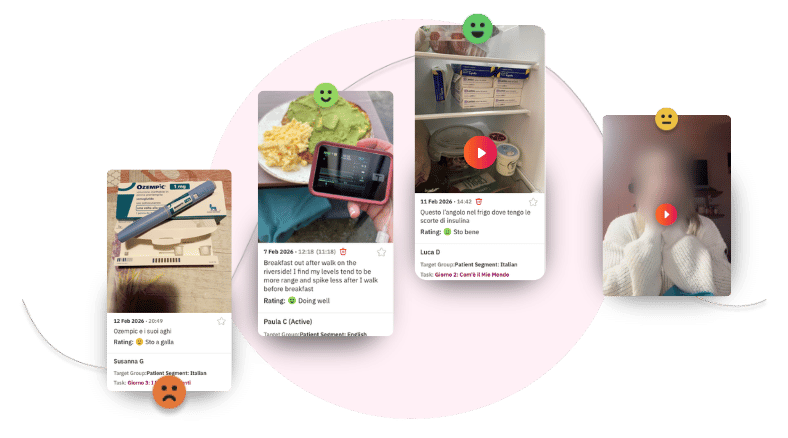
Treatment does not end at prescription. It is about coexistence and how people emotionally adapt to living with therapy. Indeemo's longitudinal diary studies, which capture videos, photos, screen recordings, and texts over time, make these unseen adjustments visible.
Caregiver experience
Caregivers are the hidden infrastructure of healthcare. Observing their routines and emotional load reveals how systems can better support those who support others.
Colleague and professional experience
Behind every act of care is a professional balancing empathy and overload. Human-centred methods bring visibility to their emotional and operational realities. When professionals are supported, patients benefit.
How does AI accelerate qualitative healthcare research?
AI helps researchers work faster. Indeemo's AI tools accelerate transcription, translation, thematic analysis, and pattern detection across thousands of minutes of qualitative data, while keeping human interpretation at the core. The result is faster, richer insights that remain grounded in authentic voices.
In practice, that means video and audio submissions are automatically transcribed and translated across 30+ languages, so a multi-country healthcare study can be reviewed almost as soon as it lands. AI-assisted theme detection and sentiment analysis cut analysis time by 40–90%, so research teams can spend their time on interpretation rather than admin.
Is human-centred healthcare research HIPAA-compliant?
Yes. With HIPAA-aligned privacy features, facial blurring, and PHI minimisation, Indeemo's platform makes sure every insight is regulator-ready and ethically sound. Healthcare researchers can confidently use human-centred evidence in submissions, studies, and product development without compromising participant dignity or data integrity.
How does mobile ethnography make qualitative healthcare research scalable?
Historically, qualitative research was dismissed as subjective or small-scale. Mobile ethnography breaks those barriers by combining feasibility, scale, and auditability. Large, diverse populations can now participate securely and asynchronously, turning qualitative insight into decision-grade evidence.
Participants self-document their health experiences using a mobile app that works like the social platforms they already use. They share videos, photos, screen recordings, and text entries from their own homes, clinics, pharmacies, and routines. Researchers observe and probe from a browser-based dashboard, asking follow-up questions where context needs unpacking. Studies that would have taken months of in-person fieldwork can now run across multiple markets at the same time.
“In healthcare, the human remains the most advanced sensor.”
— Eugene Murphy, CEO, Indeemo
The future of healthcare innovation depends on how deeply we understand the people it serves. When healthcare organisations design with people, not just for them, they don't just build products. They build empathy, trust, and lasting change.
Can Indeemo run a healthcare research study for me?
Yes. Whether you're a clinical research team, a pharma insights team, a MedTech product manager, or a healthcare provider exploring qualitative research for the first time, Indeemo can support you.
Use the platform independently if your team has the in-house expertise. Or partner with our Catalyst team for study design, recruitment, moderation, analysis, or the full project. If you have research ambitions but not the capacity or expertise to run the study yourself, we can lend a helping hand as and when you need it.
Indeemo can be more than a platform. It can be a partnership. Book a demo or connect with our team.
Frequently asked questions
What's the difference between human-centred healthcare research and traditional healthcare research?
Traditional healthcare research tends to study systems, protocols, and outcomes through surveys, interviews, and clinical trials. Human-centred healthcare research studies the lived experience of patients, caregivers, and clinicians, using contextual video, diary studies, and ethnographic observation to gather evidence as it happens. Both have a place in a healthcare research programme. Human-centred research is best suited to questions about adherence, emotion, identity, and how care fits into a real life.
Is mobile ethnography HIPAA-compliant?
Indeemo is HIPAA-aligned and supports Business Associate Agreements (BAAs) where required. The platform includes facial blurring and PHI minimisation features that protect participant identity and personal health information. Indeemo is also ISO 27001 and SOC 2 certified, and is independently penetration tested.
What kinds of healthcare studies can you run with mobile ethnography?
Common applications include patient journey research, treatment adherence and therapy adaptation studies, caregiver experience research, healthcare professional ethnography, digital health device usage studies, and preventive and consumer health research. The method works for short, focused studies of a few days, and for longitudinal studies that run over weeks or months.
How many participants do you need for a healthcare diary study?
Most healthcare diary studies work well with 15 to 30 participants, though larger programmes can involve hundreds across multiple countries. Mobile ethnography captures rich data from each participant over time, so smaller, well-recruited samples often produce stronger insight than larger but shallower datasets.
Do you need to be a researcher to run a human-centred healthcare study?
No. Brand and pharma teams without dedicated research departments use Indeemo all the time, with support from our Catalyst team for study design, recruitment, moderation, and analysis. Experienced research teams use the platform independently. Either way, support is available when you need it.