

Key takeaways
- Great UX, ergonomic, and human-centred product design require a deep understanding of the user and the context in which they interact with your product, service, or experience.
- Human factors research sits within UX but focuses specifically on how users interact with the components of a system — task performance, information retrieval, interface consistency.
- Qualitative methods can absolutely uncover human factors insight. Lab-based controlled testing isn't the only route.
- Three qualitative methods work particularly well for human factors research: diary studies, user journey mapping, and mobile screen recording.
- With Indeemo, human factors teams can run remote studies with 3 million+ recruitable participants, capture videos, photos, and screen recordings, and analyse submissions in 30+ languages with generative AI.
What is the difference between human factors research and UX research?
A common question is whether human factors research is the same as UX research. Not quite. UX research aims to understand everything about the user, which includes the human factors. But human factors is a specific lens within that broader scope.
User researchers often conduct research for user discovery. Through generative research, qualitative insight is drawn out from various techniques. The goal of discovery research is to understand the user, empathise with them, and put the spotlight on how they feel and perceive a system or service. It involves knowing about their lives, who they interact with, and how they behave in their own context and real-life environments. That understanding is essential to solving real-world problems.
Human factors, on the other hand, focuses primarily on the human and the system. UX is interdisciplinary, and human factors are often closely related to human-computer interaction (HCI). Human factors is also a field in its own right, strongly associated with ergonomics. Across the spectrum of UX, human factors focus on how users interact with the components of a system — the degree to which they can perform tasks, retrieve information, and how consistent the design and interface feels.
Can qualitative research methods uncover human factors insight?
Yes. User testing is often conducted through controlled experiments with a researcher present. That's effective, but it's not the only way.
UX is interdisciplinary, and so is user research and user testing. Qualitative methods — diary studies, journey mapping, mobile screen recording — can reveal human factors insight that lab-based testing alone would miss. The advantage is context: you see how real users interact with products in their actual environments, not in a sterile lab setting.
What are some qualitative human factors research methods?
Three methods stand out for human factors research, ergonomics work, and product testing.
How do diary studies support human factors research?
One way to conduct human factors research is through user diaries, often called UX diary studies.
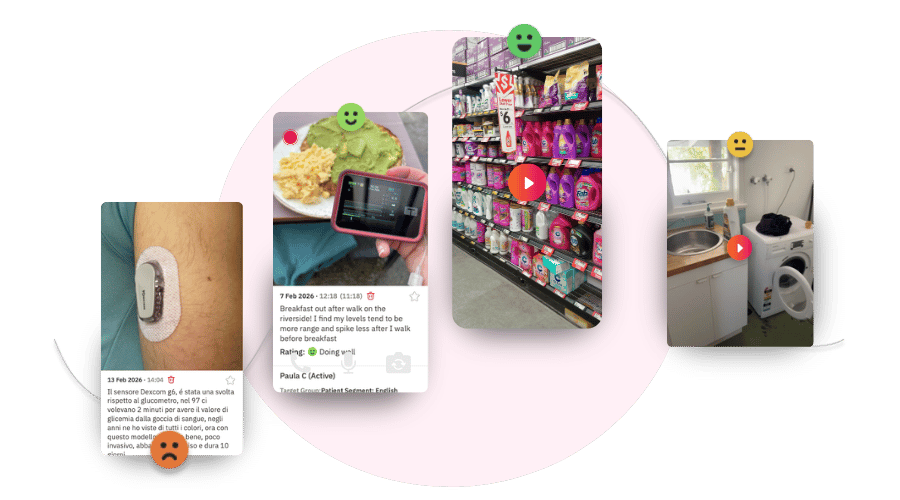
A user diary, or user log, is a descriptive account of user activities. Unlike quantitative surveys, diaries explore the thoughts, feelings, and behaviours that are central to UX and human factors design. Bringing real-world contextual insight into the design process is transformative for building empathy, which is the main reason UX diary studies have grown in popularity. Mobile and smartphone technology makes this practical — participants can document diary entries with photos, videos, and mobile screen recordings to build up a rich picture of their real-world and digital experiences.
For interactions with a product or system, and the human factors they surface, a video survey can also be a useful addition. Participants record short responses to specific prompts, giving researchers evidence grounded in real context rather than self-report in a questionnaire.
How does journey mapping support human factors research?
User journey mapping is another strong discovery method for human factors work.
Whether you're designing a physical device, a software application, or a combination of both (an IoT or smart device, for example), at some point you need to understand the end-to-end user journey.
As a user moves through the process of achieving a goal with a new product, application, or system, journey mapping tools let them capture every stage in context and in the moment. Smartphone-enabled journey mapping apps let users record every real-world and online interaction, uploading immediately to a researcher dashboard where the end-to-end journey is automatically mapped.
The benefit here is that human factors researchers don't need to be physically present with users. Participants don't need to travel to a central location or lab. You get contextual journey data without the logistical overhead.
How does mobile screen recording support human factors research?
As IoT devices become the norm in product design, there's a growing need to research both how people interact with physical products or prototypes and the smartphone apps that power them.
Mobile screen recording is a strong option here. When we talk about UX and human factors, the image that comes to mind is usually users interacting with a device or a mobile application. That's not surprising, given how much digital technology has grown. Mobile screen recording is a useful way to run user testing at scale, and it's one of the most effective ways for UX teams to draw insight on human factors for iterative design.
The benefits are similar to a diary study. You can conduct human factors research remotely, in the real context of HCI. It speeds up the research process and it's cost-effective. Users can test and interact with a system without a researcher present, which reduces intrusiveness and lets them behave more naturally.
Mobile screen recording also allows narration. That's more central to user discovery and understanding how people feel about a product design or service, but the ability to add descriptive insight on top of the screen capture means you can integrate qualitative reflection into the human factors process.
The broader takeaway: human factors research isn't restricted to direct observation of human-computer interaction. Aligning user perceptions with the components of human factors through qualitative methods produces a fuller picture than either approach alone.
How does Indeemo support human factors research?
Indeemo's human factors research tools have supported hundreds of projects, across medical devices, voice-assisted technology, smart home systems, and more. Alongside human factors studies, you can:
- Recruit B2C and B2B participants in hours from a panel of 3 million+ respondents
- Capture in-the-moment videos, photos, screen recordings, and texts in 30+ languages
- Use generative AI for summarisation, translation, thematic analysis, and sentiment analysis to speed up analysis significantly
- Import interviews from Zoom, Microsoft Teams, or your computer for analysis alongside your human factors data
- Create subtitled highlight reels to share findings with engineering, design, and stakeholder teams
Everything sits in one dashboard, so you can move from fieldwork to design decisions without juggling tools.
Do you need to be a specialist to run human factors research?
No. Whether you're a human factors engineer, a UX researcher, or a product team exploring the space for the first time, Indeemo can support you.
Use the platform independently if you have the expertise in-house, or partner with our Catalyst team for study design, recruitment, moderation, and analysis. If you have research ambitions but not the capacity to run the project yourself, we can lend a helping hand.
Frequently asked questions
Is human factors research the same as UX research? No. Human factors research sits within UX but is more specific. UX is broad — understanding the user and their context. Human factors focuses on the user's interaction with a system, product, or interface. Most good product teams need both perspectives.
Can you do human factors research without a lab? Yes. Qualitative methods like diary studies, journey mapping, and mobile screen recording can capture rich human factors insight in real-world contexts. Lab testing still has a role, but it's not the only option.
What industries use human factors research most? Medical devices, automotive, aerospace, consumer electronics, and any industry where ergonomics, safety, or complex user-system interaction matters. Smart home and IoT product teams use it heavily too.
How long does a typical human factors research project run? It depends on the method and the product. Short usability-focused studies might run for a week. Longer projects combining diary studies with prototype testing can run for four to six weeks.
Can human factors research include IoT and smart device testing? Yes. Testing IoT products often requires capturing both the physical product interaction and the accompanying app. Mobile screen recording alongside video or photo documentation of the physical device gives you both sides of the interaction in one study.