

Key takeaways
- Demographics alone won't tell you why people prefer and use products the way they do. Real insight comes from understanding individuals, their routines, the occasions that shape their choices, and their actual shopping behaviour.
- Video-based research lets you move beyond self-reported data into real context; seeing what people do, where they do it, and why.
- Daily routines and rituals reveal where your product genuinely fits into someone's life (and where it doesn't).
- Occasion segmentation surfaces the specific moments when consumers turn to your category. Understanding those moments is often more actionable than demographic segmentation.
- Shopping missions, captured through video and screen recording, show the real path to purchase across physical and digital environments.
How do you get closer to consumers at an individual level?
Connecting with your audience on a personal level is where effective market research starts. In-the-moment video research opens a window into the lives of your participants, letting you move beyond demographics and into the experience, emotion, and motivation that shape their behaviour.
The power of video tasks
Video tasks do more than collect data. They let you see and hear how a person lives with your category. That's the kind of context demographic data can't provide on its own. Someone who says they care about wellness is telling you one thing. Someone filming their kitchen counter and walking you through a supplement routine is telling you something considerably more useful.
Going deeper than demographics
Demographics are essential but they only scratch the surface. To really understand a customer, you need to explore the specifics of their life — the things that make them unique. Their passions, hobbies, and values. What they hold dear, what drives them, what they aspire to.
Imagine you're selling a fitness product. Demographics won't tell you why one customer prefers early morning workouts while another prefers late-night sessions. Understanding their underlying motivations lets you tailor your product to what actually drives them. One customer might be focused on overall wellness; another might be training towards a specific competitive goal. Those differences should shape product design, feature priorities, and how you talk about the product.
The influence of family dynamics
Families are microcosms of society, each with their own dynamics. Are your customers juggling family responsibilities? Balancing work and parenting? Or living a more independent, urban lifestyle? The role someone plays within their family and their place in the broader social structure, significantly shapes what they buy and how they use it.
For a home cleaning product, this matters a lot. A parent with multiple children might prioritise time-efficiency and safety. A single urban dweller might prioritise ease of use and a minimalist approach. The same product can serve both, but it needs to be positioned and designed differently for each.
How do daily routines and habits shape product preferences?
Understanding someone's daily routines is like looking at the fabric of their life. This is where you find not just what they do, but why and how they do it. That kind of insight often sparks real product innovation.
The power of daily rituals
Ask participants to do more than list their daily activities. Have them walk you through their day, from sunrise to sunset. Explore when and how they interact with products — the subtle moments you'd never capture in a survey. This isn't just about tracking product usage. It's about recognising the rhythm of someone's life and spotting the moments where your product could fit.
Consider a morning routine. If you understand what motivates someone to get out of bed, a refreshing skincare routine, a moment of self-care, something else you can design skincare products that match those motivations. When a product becomes an essential part of the morning ritual rather than just another item on the shelf, you've moved into a different relationship with the customer.
Qualitative insight into motivations
Go beyond surface-level observation. Capture what actually drives someone's daily routines. What inspires their actions? What motivates their decisions, for work, exercise, leisure, or anything else? Knowing this lets you align your product with their values and lifestyle rather than guessing at what might resonate.
For a skincare product, understanding why someone cares for their skin shapes both product design and marketing. Is it about radiant skin, relieving stress through a pampering ritual, or maintaining a youthful appearance? The "why" behind the routine is what tells you how to connect.
A day in the life
Build a clear picture of a customer's daily life. Identify not just which products they interact with, but when and how they do it. This isn't just usage data. It's a map that should guide both product development and marketing strategy.
For a skincare product, knowing when someone performs their routine, what inspires them to do it, and how they go about it can shape product design in ways that make their routine more effective or enjoyable. If you can address a specific skin concern or make the routine more convenient, your product becomes indispensable.
How do occasions influence product use?
Occasion segmentation is a practical way to understand consumer preferences and usage, especially for categories where context and moment really matter. Understanding the specific circumstances under which consumers use your products lets you build strategies that meet their actual needs.
The significance of occasions
Occasions are the pivotal moments in consumers' lives when they turn to specific products. These can be major holidays, special life events, or everyday moments like a morning coffee ritual. Understanding them means recognising both the emotional and functional dimensions of these moments and using that understanding to shape what your product does and how you talk about it.
Key occasions for your product
Start by identifying the key occasions that matter for your product. These are the moments when your product is more than a commodity, it's part of the experience. For a skincare product, that might be a morning routine, a weekly self-care session, or the prep before a special event.
The questions that unlock deeper insight
For each occasion, ask a set of specific questions in your tasks. These questions should peel back the layers of product usage.
- What products are integral to the occasion? Identify everything the customer uses during that moment; skincare, makeup, candles, music, whatever is part of the ritual.
- Where do they use them? Understand the physical location: the bathroom, bedroom, a corner of the home dedicated to self-care.
- When do they use them? Time of day and frequency. A morning skincare routine looks different from an evening wind-down.
- How do they use them? The process and rituals involved; cleansing, toning, moisturising, and the order it all happens in.
- Why do they choose these products for this occasion? The motivations behind the choices. Glowing skin, stress relief, confidence, pampering.
A deeper dive into behaviour
Design tasks that explore usage during key occasions. It's not enough to ask what products customers use, understanding why they chose those specific products over alternatives is what guides meaningful product decisions.
Take chocolates. Understanding why a customer reaches for a particular type during specific occasions can lead to product enhancements that match those needs. Maybe it's the balance of sweetness and richness that suits their moments of indulgence. Maybe it's the packaging that signals "special occasion" rather than "everyday treat." Tasks focused on chocolate consumption reveal both the choices customers make and the benefits they perceive in those choices.
How do shopping missions reveal preference drivers?
The shopping journey, whether physical or digital, is shaped by a wide range of factors. Understanding how customers actually make decisions is essential to understanding their preferences.
The in-store experience
In physical retail, shopping is a multi-sensory experience. Design research tasks that ask participants to document their in-store shopping journeys. You'll get insight into both what they choose and the path they took to get there.
What catches their eye? Have participants describe what grabs their attention on the shelves; packaging, displays, promotions. Understanding these visual cues shapes marketing strategy and product placement.
How does placement influence choice? Explore how product arrangement affects decisions. Do customers stick with familiar brands? Are they drawn to new products with eye-catching positioning? This knowledge informs your own shelf strategy.
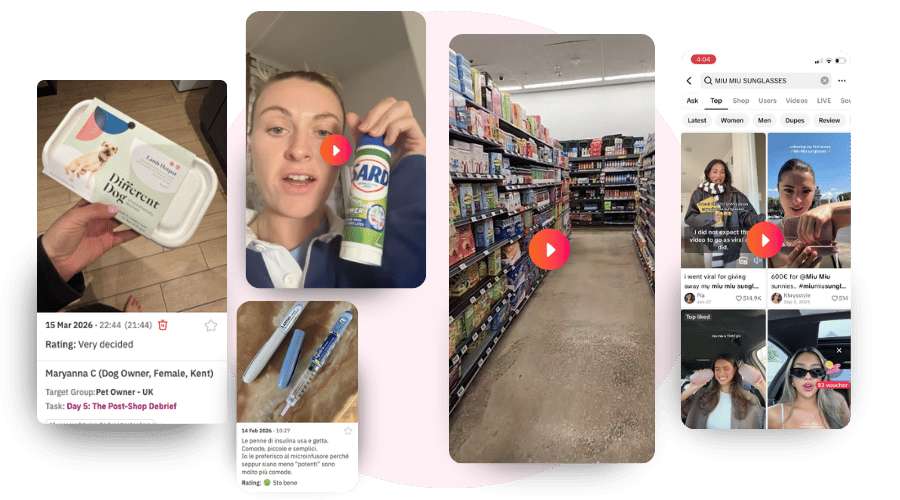
The role of video in shopping missions
Video is what makes shopping missions really work. It lets you see the entire shopping experience, not just the final decision. You see reactions, emotions, and interactions as participants explore the store.
For a confectionery brand, video-based shopping missions might show that chocolates with distinctive packaging attract more shelf attention. That's actionable insight for both product design and retail placement.
The e-commerce experience
Online shopping is virtual but no less complex. Ask participants to record their mobile screens while browsing websites. This creates a digital diary of their decision-making.
Articulating the thought process. Have participants narrate as they browse. What makes them click on a particular product? How do they navigate categories and filters? This narration reveals the mental pathways behind online purchasing.
For an online snack retailer, mobile screen recordings with narration might show that customers gravitate towards products featured on the homepage, or are more likely to buy when search filters clearly distinguish between categories. Both insights translate into concrete e-commerce improvements.
How can Indeemo support product preference research?
Indeemo is built for the kind of in-context qualitative research this article describes. Across individual studies, routines, occasions, and shopping missions, you can:
- Recruit B2C and B2B participants in hours from a panel of 3 million+ respondents
- Capture videos, photos, screen recordings, and texts from participants in their real environments, on mobile and desktop
- Run task designs tailored to the study - all at once, scheduled to specific times, or sequential
- Use generative AI for summarisation, translation, thematic analysis, and sentiment analysis to speed up analysis significantly
- Transcribe multimedia submissions in 30+ languages
- Create subtitled highlight reels to share the customer voice with stakeholders across product, marketing, and leadership
Because the whole workflow sits in one platform, you can move from recruitment to insight faster and keep closer to your customers over time.
Do you need to be a researcher to run this kind of study?
No. Whether you're a brand exploring qualitative research for the first time or a seasoned insights team, Indeemo can support you.
Use the platform independently if you have the expertise in-house, or partner with our Catalyst team for study design, recruitment, moderation, and analysis. If you have research ambitions but not the capacity to run the project yourself, we can lend a helping hand.
Why does real context matter for product preference research?
Numbers and statistics matter, but they only tell part of the story. The real insight comes from authentic connection with your audience - understanding their routines, the occasions that shape their choices, and how they actually shop. These are the insights that shape product preferences and usage patterns, and they're what lets businesses build products that people genuinely want to keep using.
Frequently asked questions
What's the difference between demographic segmentation and occasion segmentation? Demographic segmentation groups people by who they are (age, gender, income). Occasion segmentation groups behaviour by the context in which it happens (morning routine, weekend dinner, commute). Occasion segmentation is often more actionable because a single consumer operates across multiple occasions with different needs in each.
How long does a product preference study typically run? Most studies run between one and three weeks, depending on how many occasions you want to capture and how much depth you need per participant. Longer studies tracking routine changes over time can run four to six weeks.
How many participants do you need? Qualitative product preference studies typically work with 15 to 30 participants per segment. Because each participant provides rich, multi-format data across time, sample sizes can be smaller than survey research.
Can you run product preference research across multiple markets? Yes. Indeemo supports multi-market fieldwork with automatic transcription and translation in 30+ languages, so you can analyse preferences from multiple countries in parallel.
What's the best way to capture an in-store shopping moment? A mix of video, photos, and short voice or text reflections tends to work best. Video for longer moments of decision; photos and captions for quick in-store snapshots; reflections after the visit to capture the why. All three can sit alongside each other in a single Indeemo study.