
Key takeaways
- Mobile ethnography is a qualitative research method where participants use their smartphones to share videos, photos, screen recordings, and texts from their everyday lives, giving you a window into how people actually live, shop, and make decisions.
- Because participants record in their own environment, everything is captured before it's forgotten. Memory is unreliable and we all post-rationalise what we do. Mobile ethnography captures the nuance and subconscious behaviours that make all the difference.
- The method works as a standalone approach or alongside focus groups and IDIs, as pre-tasking, post-interview follow-up, or an independent study.
- With Indeemo you can recruit from a global panel, research in 30+ languages, analyse in minutes with AI, and create subtitled highlight reels for stakeholders.
- Common use cases include diary studies, path-to-purchase research, customer journey mapping, UX discovery, concept testing, and healthcare research.
What is mobile ethnography?
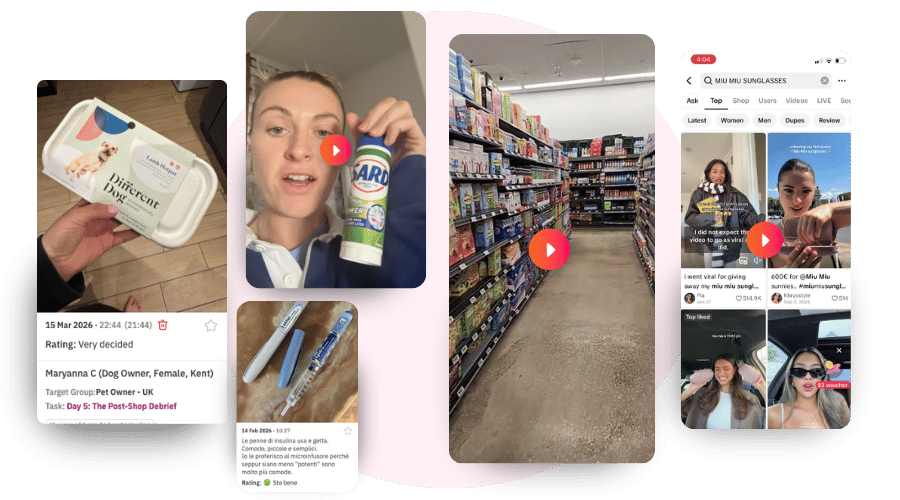
Mobile ethnography enables participants to self-document their behaviours, actions, and feelings in real time through a smartphone app. They record videos, photos, screen recordings, and texts that automatically upload, allowing researchers to observe and analyse immediately through a dashboard without travelling to participant locations.
The name might sound academic, but the practice is straightforward. The app works like social media that participants already know how to use. AI handles transcription, translation, and analysis. And if you need a helping hand, Indeemo's team can support you at every stage.
The roots go back to traditional ethnography, an anthropological approach where researchers spent extended time physically embedded in communities, observing and documenting daily life. The method produced rich, contextual understanding, but it was expensive, time-consuming, and difficult to scale. Studying even a small group of people could mean weeks of fieldwork and significant travel.
Mobile ethnography keeps that intent, helping you get closer to people and understand their reality on a deeper level, but removes the need to physically be there. Smartphones mean researchers can connect with participants anywhere, anytime, without getting on a plane.
Why does mobile ethnography work?
It works because smartphones are already part of daily life. People carry them everywhere. They use them to communicate, shop, bank, navigate, entertain themselves. Mobile ethnography takes advantage of this. The device participants use to record their experiences is the same one they use for everything else, so documenting a moment feels natural rather than performative.
There's also something called the "researcher effect." People behave differently when they know someone is watching. A researcher standing in someone's kitchen with a clipboard changes the dynamic, even with the best intentions. Mobile ethnography removes the physical observer entirely. Participants record on their own terms, in their own space, at their own pace.
What are the benefits of mobile ethnography?
The short answer: you see what people really do, as they do it, so everything is captured before it's forgotten. Because memory is unreliable, and we all post-rationalise what we do, mobile ethnography captures the nuance and subconscious behaviours that can make all the difference. But the benefits go further than that.
Authenticity and reduced recall bias
When someone records a video while unpacking a product at their kitchen table, you're seeing a genuine reaction, not a recollection of that reaction two weeks later in a discussion room. The immediacy removes post-rationalisation. People are remarkably good at constructing logical narratives after the fact. Catching them in the moment bypasses that entirely.
Contextual richness
You don't just hear about someone's morning routine. You see their kitchen, notice the competing brands on the counter, watch them juggle breakfast while checking their phone. Context reveals things that words alone can't.
The "why" behind the numbers
Quantitative data tells you that shoppers abandon their cart at checkout. Mobile ethnography shows you a person hesitating over shipping costs, switching to a competitor's app, then getting distracted by a message. It reveals the human behaviour behind the numbers.
Scalability
Without travel, you can run studies with larger sample sizes and across more locations than traditional ethnography allows. Fifty participants across five cities is straightforward.
Multi-country reach
Studies run across multiple markets at the same time, with automated transcription and translation in 30+ languages. Teams can start analysing submissions almost immediately rather than waiting weeks for external translation.
Inclusivity
Remote methods also open the door to people who might not make it to a focus group facility because of where they live, how they get around, or when they're available. You end up with a more representative picture.
What are the most common use cases?
Diary studies
The classic application. Participants document their routines, habits, and experiences over days or weeks, giving you a view of behaviour over time that a single interview can't provide.
Path to purchase and shopper research
Follow a participant from the moment they first consider a purchase through to the decision itself. Screen recording with voice-over lets you see exactly how someone navigates a website or app while hearing what they're thinking.
Customer journey mapping
Map real touchpoints across a customer's experience rather than hypothesising about them in a workshop. See how people actually interact with your brand across channels, online and offline.
UX and design research
Watch real users interact with your product in their actual environment. Someone navigating your checkout flow at their kitchen table behaves differently than they would in a usability lab.
Concept and product testing
Put a concept, packaging design, or prototype in front of participants and ask them to react in context. See how a new product fits (or doesn't) into their real routine.
Healthcare research
Understand patient experiences, treatment journeys, and health behaviours where they actually happen. At home, at the pharmacy, during daily routines. Not in a clinical setting.
Voice of customer
Video responses are harder to ignore than a slide deck. When a stakeholder watches a real person struggle with your product, it changes the conversation and helps teams innovate faster.
How does mobile ethnography fit into a research programme?
Mobile ethnography works well on its own. Many teams use it as their primary approach for diary studies, journey mapping, or discovery research. It also combines well with other qualitative methods when the research design calls for it.
As pre-tasking before interviews or group discussions
Ask participants to complete mobile diary tasks before a deeper conversation. They arrive having already reflected on the topic, and you have real-world video and context to reference during the discussion.
As post-interview follow-up
After an interview, send participants follow-up tasks to document what they actually do in their daily lives. This bridges the gap between what people say in a discussion and what they do afterwards.
Task design approaches
How do you run a mobile ethnography project?
Who is mobile ethnography for?
Traditional in-person ethnography is costly and time-consuming. Mobile technology has made qualitative research more accessible and scalable. Smartphones and 5G connectivity reduce previous limitations, enabling global reach beyond traditional face-to-face settings like focus groups.
The platform serves diverse clients, from research agencies and freelance consultants to major consumer brands and healthcare providers.
How does it work?
Clients commission ethnographers or qualitative researchers to design and conduct research using mobile ethnography. Recruiters source and screen respondents using questionnaires designed to identify target personas. Qualified respondents receive financial incentives and opt into projects. The participation period is called "fieldwork."
How to gain the most valuable insight
Mobile ethnography projects emphasise "show me, don't tell me." Respondents record authentic behaviours while completing designed tasks in realistic contexts. Using videos, photos, or text captures genuine in-the-moment experiences without researcher presence, eliminating potential distortions from observer effects.
The immediacy removes post-rationalisation. Researchers consistently report that self-recorded behaviours in familiar everyday contexts are more intimate, authentic, and revealing than other data collection techniques.
Getting started: the key steps
- Strategy call: Initial consultation with a strategist to discuss your requirements
- Project brief: Overview covering countries, respondent numbers, languages
- Quote and sign-off: Review and approve pricing
- Training: In-person or video library access for new users
- Task list creation: Draft discussion guide optimised for mobile (typically 4 days)
- Project setup: Platform configuration and moderator training (1–2 days)
- Add observers: Optional observer access configuration
- Manage respondents: Add and track participants
- Moderate responses: Encourage responses and request clarifications
- Analyse data: Use dashboard tools for analysis
- Report insights: Export findings from the dashboard
- Delete data: Remove data per security and privacy standards
Project setup lead times
Express service is available for urgent requirements.
How do you design your task list?
Projects contain target groups (respondent segments with similar characteristics). Each target group receives a task list with instructions for completion. Task lists can be identical across groups or customised per segment.
Tasks should be brief and easy to read on a phone. Avoid excessive scrolling. Tasks instruct respondents to upload photos, notes, videos, or screen recordings. The platform supports tasks in any language.
Keep prompts short and open-ended. Conversational language works better than formal instructions. You're asking someone to share a slice of their life, so the tone should feel more like a message from a friend than a questionnaire from a research department.
How do you recruit and manage respondents?
Recruiting respondents
Recruitment follows standard qualitative research practices. Recruiters source and screen participants using questionnaires. Recruitment timelines typically span two weeks. Screeners translate to local languages as needed.
The respondent experience
The app interface mirrors Instagram and Facebook, providing a familiar design for participants. Respondents receive tasks upon project launch and respond via videos, text entries, photos, or mobile screen recordings. Daily engagement typically ranges from 10–30 minutes.
Incentivising respondents
Incentive costs vary by market. The US is typically the most expensive market, followed by privacy-conscious markets like Germany. European markets tend to have similar rates. Southeast Asia shows wide variation.
The platform includes reminder functionality and submission audit trails to verify completion before payment.
Activating respondents
Researchers choose when to activate rather than automatic invitation. When ready, researchers email personalised invitations with Indeemo download instructions.
How does moderation work?
As respondents upload content, it appears directly on the researcher dashboard. Researchers can comment on entries and probe for additional context, similar to social media interaction. The private one-to-one format encourages participants to share additional context and emotions, creating a safe space for deeper insight.
How do you analyse and export results?
Analysis tools
AI-powered analysis means you can move from fieldwork to insight faster than ever. The platform includes:
- Automated video transcription and translation in 30+ languages
- AI-assisted theme detection and sentiment analysis
- Filters for swift searching through entries
- Keyword analysis and keyword cloud for identifying trends
- Tagging for data organisation
- Timeline, journey mapping, and collage visualisation tools
- Subtitled highlight reel creation for sharing with stakeholders
Exporting data
Upon fieldwork completion, researchers can export all media. Search functions generate exports in CSV (Excel-compatible) or Word document formats. Export links remain available for 48 hours.
How do you run mobile ethnography across multiple countries?
With Indeemo, you can run studies across multiple markets at the same time rather than one country at a time. Recruit from a global panel, set up tasks in any language, and manage everything from a single dashboard.
Automated transcription and translation in 30+ languages means your team can start reviewing submissions almost immediately, comparing across markets in real time. Tone localisation matters though. A direct translation might be grammatically correct but feel stiff. The goal is translating meaning, not just words.
If you don't have in-market expertise or international recruiter networks, our Catalyst team can help. We can handle recruitment, moderation, translation review, and cultural context so you can focus on the insight.
Do you need to be a research expert to use mobile ethnography?
No. Whether you're an experienced researcher or a brand team exploring mobile ethnography for the first time, Indeemo can support you.
Use the platform independently if you have the expertise in-house. Or partner with our Catalyst team for study design, recruitment, moderation, analysis, or the full project. If you have research ambitions but not the capacity or expertise to fulfil them, we can lend a helping hand as and when you need it.
Indeemo can be more than a platform. It can be a partnership.
What about security and data management?
Enterprise-grade security
The platform maintains multiple security certifications:
- GDPR compliant
- HIPAA certified with Business Associate Agreement (BAA) capability
- ISO 27001 certified
- SOC 2 certified
- Independently penetration tested using OWASP 10 guidelines
- Data deletion processes available to clients
- Infrastructure designed for security and redundancy
- Uses Amazon Web Services and Microsoft Azure as sub-processors
Data retention and deletion
Projects remain accessible for 6 weeks following fieldwork completion. Researchers can request bulk export or extended hosting. Email reminders occur during week 7 and before deletion.
Support
Dedicated support with named client contacts throughout your project. Questions can be directed to support@indeemo.com.
Frequently asked questions about mobile ethnography
What's the difference between mobile ethnography and traditional ethnography?
Traditional ethnography requires a researcher to be physically present, observing participants in person over extended periods. Mobile ethnography has the same goal (understanding real-world behaviour in context) but participants document their own experiences remotely using their smartphone. This removes the researcher effect, reduces cost, and makes it possible to study more people across more locations.
Can mobile ethnography replace focus groups?
It can work as a standalone method or alongside focus groups. Many research teams use mobile diary tasks as pre-work before focus groups, giving participants time to reflect and giving moderators richer material to work with. Mobile ethnography also produces rich enough data to stand on its own for diary studies, journey mapping, and discovery research.
How many participants do you need for a mobile ethnography study?
Most studies work well with 15 to 30 participants, though larger programmes can involve hundreds across multiple markets. Because mobile ethnography captures rich data from each participant over time, you often need fewer people than you'd expect.
How long does a typical mobile ethnography project take?
Field time ranges from a few days to a few weeks. A focused diary study might run for five days. A longer journey mapping study might run for two to four weeks. AI-powered transcription and analysis have shortened turnaround significantly on the back end.
What devices do participants need?
A smartphone with a camera and a reasonable internet connection. That's it. Participants download the app and complete tasks by recording video, taking photos, or writing responses. It works on both iOS and Android.