
Key takeaways
- Focus groups are a proven qualitative method, but their limitations – recall bias, group influence, a hard time cap, and logistics overhead – constrain what you can learn.
- Online focus groups solve the travel problem but not the fundamental ones: a fixed 1–2 hour window, connectivity risk, and the difficulty of generating real group energy.
- Mobile ethnography is asynchronous and longitudinal. Instead of asking participants to describe past behaviour in a group, you observe their real behaviour over days.
- Because the method works over time, knowledge, trust, and depth of insight all increase. You see what people actually do, not what they remember doing.
- With Indeemo, you can recruit from a global panel of 3 million+ participants, research in 30+ languages, analyse with AI, and create subtitled highlight reels for stakeholders — all from one platform.
What makes focus groups valuable and where do they fall short?
Focus groups have been a staple qualitative research method for good reason. Bringing representatives of your target audience into a central location lets you meet them face to face, hear about their needs, emotions, and attitudes directly, and watch how they respond to each other. A skilled moderator can read the room, work the group, surface insights, probe them, and validate them in real time. That is genuinely difficult to replicate.
They are also more time-efficient than individual interviews in some respects, meeting 6–8 participants in one session costs less than running the same number of separate conversations.
But there are real limitations, and they matter.
Recruitment and logistics
Getting participants to a focus group facility, usually in a major city, ,takes effort on both sides. Researchers need to block out days, book rooms, arrange catering, and manage travel. Participants need to get there.
Group bias
In any group, one confident voice can steer the discussion. Quieter participants hold back. People moderate their answers in front of strangers. The data reflects the group dynamic as much as individual truth.
Recall, not reality
Most focus group discussions are retrospective. Participants talk about what they remember doing, not what they are doing. Memory is unreliable and we all post-rationalise. The story someone tells about last week's shopping trip is a reconstruction, not a recording.
The public forum problem
Are participants being honest, or are they presenting a version of themselves they're comfortable with in front of strangers? For anything personal, sensitive, or habitual, the group setting works against you.
Time and value
Most groups run for two hours. You pay every participant for two hours but realistically get 15–20 minutes of useful contribution from each person. That is a lot of cost for a narrow window.
What about online focus groups?
Online focus groups move the discussion to a video call platform. Participants join from home, the researcher facilitates as usual, and no travel is required. This opens up more geographic diversity and makes recruitment easier.
It sounds like a natural upgrade. In practice, it is a compromise.
The problems are straightforward.
The window is still fixed. One to two hours. Any connectivity issues, late arrivals, or technical glitches eat into that time, and there is no recovery. If you do not cover what you need in the session, it is over.
The energy does not transfer. The spontaneous back-and-forth of a good in-person group, people finishing each other's sentences, reacting in real time, challenging each other, .rarely survives a grid of video boxes. The researcher's ability to read the room is severely limited.
The recall problem remains. Participants are still being asked to report on past behaviour and attitudes. The format has changed; the fundamental limitation has not.
Online focus groups are a practical response to a logistics challenge. They are not a richer form of insight.
What about in-depth interviews?
In-depth interviews (IDIs, user interviews, or “depths”) go further than focus groups in one important respect: the 1:1 dynamic produces better quality engagement. Without a group present, participants open up more. The interviewer can probe harder, follow threads, and spend real time on what matters.
But IDIs are still synchronous and still dependent on recall. A participant in a 60-minute interview is reconstructing past experiences from memory. Arranging, conducting, and processing them takes time. And you are still limited to what people tell you rather than what you can observe.
For some research questions, IDIs are the right tool. For understanding behaviour in context, how someone actually shops, uses a product, or navigates a decision — they have the same fundamental constraint as focus groups.
What is mobile ethnography and how does it work?
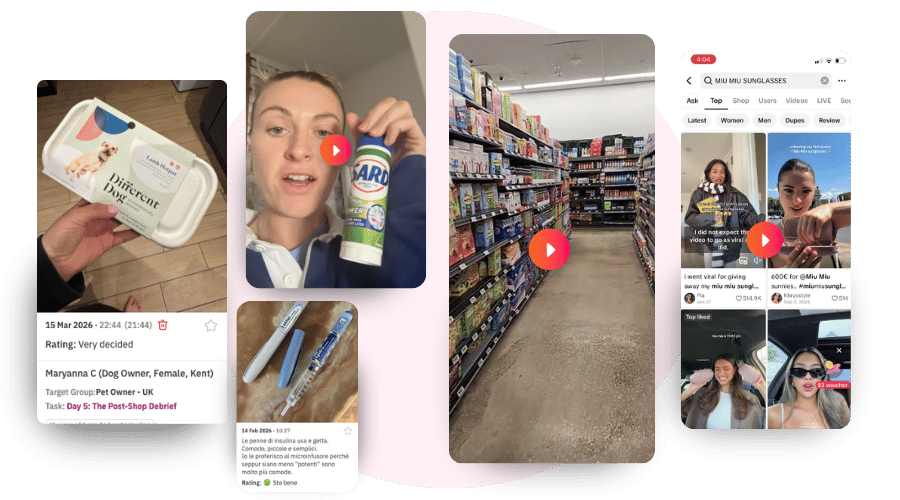
Mobile ethnography lets participants document their real behaviours, thoughts, and experiences using their smartphone, in the moment, in their own environment, over a period of days.
They download an app, receive tasks from the researcher, and respond by recording videos, taking photos, capturing screen recordings, or writing text entries. The researcher sees everything as it comes in through a browser-based dashboard, and can ask follow-up questions directly.
The app works like the social media apps participants already use every day, so there is no learning curve and no friction. Tasks are short, typically 15–20 minutes per day.
One useful frame: researchers doing in-person qual already assign pre-work before a meet-up. With mobile ethnography, that pre-work becomes the method. Instead of a brief warm-up exercise, you get days of in-context observation.
What are the real advantages of mobile ethnography over focus groups?
The core difference is time and context. A focus group gives you 15–20 minutes of useful data per participant, gathered retrospectively, in an artificial setting. Mobile ethnography gives you days of observed behaviour, gathered in real life.
Longitudinal depth
Knowledge increases with time. Trust increases with time. The insights you get from watching someone navigate a repeated behaviour over a week — their actual morning routine, their real decision at the shelf, their genuine reaction to a product – are different in kind from what you get by asking about it once.
“If you were making your next strategic business decision — which would you prefer: what a participant tells you about past events in front of a group of strangers in a 1-hour window, or contextual, in-the-moment data recorded over a period of days capturing real, repetitive behaviours?” – Eugene Murphy, CEO, Indeemo
No group influence
Participants complete tasks alone, in their own space, in their own time. There is no dominant voice, no social pressure, no performance for an audience. What they share is closer to what they actually think.
Context changes everything
You do not just hear about someone's morning routine. You see their kitchen. You notice the three competing brands on the counter. You watch them make a decision in real time. Context reveals things that words in a group room cannot.
Honest data on sensitive topics
Mobile ethnography works well for research where participants would not easily open up in a group setting – healthcare, finance, personal habits, anything involving real behaviour rather than stated preference. There is never anyone else in the room.
The multi-method advantage
This is not an argument for abandoning focus groups. At Indeemo, we are strong advocates of layering methods – remote mobile qual alongside in-person qual alongside quant. The more layers of data, the deeper the understanding. Many teams use mobile ethnography as pre-tasking before a group or IDI, sending participants diary tasks in the week before so they arrive having already reflected on real experiences. The conversation that follows is richer for it.
What kinds of research is mobile ethnography best suited to?
Mobile ethnography works across a wide range of qualitative objectives. It is particularly well-suited to:
Diary studies: Tracking habits, routines, or behaviours over time. Participants document what they actually do, day after day, giving you a longitudinal picture that no single session can match.
Path to purchase: Following participants from the moment they first consider a purchase through to the decision. Screen recording with voice-over lets you watch exactly how someone navigates a website or walks a store aisle while hearing what they are thinking.
UX and design research: Watching real users interact with your product in their actual environment. Someone navigating a checkout flow at their kitchen table behaves differently than they would in a usability lab.
Healthcare and patient research: Understanding patient experiences, treatment journeys, and health behaviours where they happen at home, at the pharmacy, during daily life, not in a clinical setting.
Concept and product testing: Seeing how a new product fits (or does not fit) into a participant's real routine, rather than their reaction to it in a group room.
Sensitive research topics: Any subject where honesty depends on privacy. Finance, personal health, relationships, habits that people would not describe to a group of strangers.
Is it difficult to switch from focus groups to mobile ethnography?
Less difficult than most researchers expect. The shift is mostly a change in mindset, not a change in process.
Recruitment works the same way
You use the same recruiter, the same screening process, the same criteria. The recruiter login in Indeemo lets them invite participants and track activity, most are up to speed within 30 minutes. If you prefer, you can recruit directly from Indeemo's global panel of 3 million+ participants and get started in hours.
Incentives are comparable
The average incentive for a week-long mobile ethnography study is similar to what you would pay a participant for a 1–2 hour focus group. Tasks run 15–20 minutes per day, around 2–3 hours across a week. Because participants do not need to travel, they can fit that time into their own day.
Setup is fast
Indeemo can have a project set up in a working day. You prepare a task list essentially a mobile-optimised discussion guide and we take it from there. For researchers doing this for the first time, the team will help adapt an existing guide to work on mobile.
Stakeholders can observe in real time
Indeemo's Observer login gives clients and stakeholders read-only access to the dashboard as submissions come in. They can watch participants' videos, read their responses, and experience their everyday lives directly –without attending a session. Nothing builds empathy with a target audience faster.
From fieldwork to insight with AI
Once fieldwork is underway, AI-powered transcription and translation work across 30+ languages, so you can start reviewing responses almost immediately. Theme detection and sentiment analysis cut analysis time significantly. When you are ready to share findings, you can create subtitled highlight reels for stakeholders directly in the platform.
Do you need to run it yourself?
No. Whether you are an experienced qualitative researcher or a brand team exploring mobile ethnography for the first time, Indeemo can support you.
Use the platform independently if you have the expertise in-house. Or partner with our Catalyst team for study design, recruitment, moderation, analysis, or the full project. If you have research ambitions but not the capacity to run them yourself, we can help at whatever stage you need.
Indeemo can be more than a platform. It can be a research partnership.
Frequently asked questions
What's the difference between mobile ethnography and an online focus group?
An online focus group is a synchronous session – everyone joins at the same time, for a fixed window, moderated in real time. Mobile ethnography is asynchronous and longitudinal. Participants complete tasks over days or weeks, in their own environment, at their own pace. You observe real behaviour as it happens rather than asking people to recall and describe it.
Can mobile ethnography replace focus groups entirely?
It depends on the research question. Mobile ethnography is better suited to understanding behaviour, context, and patterns over time. Focus groups are better for exploring group dynamics, reactions to stimuli, or generating discussion between participants. Many research teams use both – mobile ethnography as pre-tasking to enrich group conversations, or as a standalone study where in-context observation matters more than group interaction.
How long does a mobile ethnography study take?
Field time ranges from a few days to a few weeks, depending on the research design. A focused diary study might run for five days. A longer journey mapping study might run for two to four weeks. AI-powered transcription and analysis have shortened the time from fieldwork to insight significantly.
Is mobile ethnography suitable for sensitive research topics?
Yes — it is particularly well-suited to them. Because participants share data privately from their own homes, with no group present and no one watching in real time, they tend to be more candid about personal topics. Healthcare, financial behaviour, personal habits, and anything involving real rather than stated behaviour all work well.
How do I get started?
Talk to our team. We will discuss your research objectives, help you think through the right approach, and can have a project set up in a working day once you are ready to go.