
Key takeaways
- Shopping missions are the specific goals or tasks shoppers set out to accomplish — from a weekly grocery run to planning a holiday. Each mission has its own objectives, context, and decision drivers.
- Because shopping missions replicate real-life shopping scenarios, they surface the why behind purchases, not just the what. Surveys often miss this layer entirely.
- Shopping mission research supports product development, behaviour analysis, preference mapping, path-to-purchase understanding, and shopper segmentation.
- A strong shopping mission study blends realistic scenarios with video, screen recording, photos, and short text reflections to capture the full context.
- With Indeemo, you can recruit, field, and analyse shopping mission studies end to end — with AI-powered transcription and analysis in 30+ languages.
What are shopping missions?
Shopping missions are the specific goals or tasks consumers set out to accomplish when they shop. They mirror real-world scenarios and provide a window into shopper preferences, behaviours, and motivations. Studying shopping missions helps brands and marketers understand how shoppers actually navigate the marketplace, not how they describe it later.
Missions can range from everyday tasks like buying groceries or choosing a new gadget, to more complex ones like planning a holiday or shopping for a special occasion. Each mission is defined by a set of objectives and considerations that shape decisions.
Why do shopping missions reveal more than surveys?
Unlike generalised surveys, shopping mission studies replicate real-life situations, letting researchers see how consumer decisions actually play out. These scenarios provide context, so you can uncover not just what shoppers buy, but why they buy it.
A survey can tell you that 40% of your category's shoppers chose a competitor last quarter. A shopping mission study shows you a shopper comparing two brands in the aisle, hesitating over price, reading the packaging, and ultimately putting the competitor's product in the basket because their child liked the packaging colour.
How do shopping missions deliver richer shopper insights?
Shopping mission studies offer two advantages that brands, retailers, and marketers consistently find valuable.
A holistic view of shopper behaviour
Shopping missions consider the full journey, from identifying a need through to making a purchase. This perspective lets you understand the touchpoints, channels, and interactions that shape consumer decisions. You're not looking at a single moment; you're looking at a sequence.
A bridge from consumer insight to shopper motivation
Running shopping mission research quickly surfaces the underlying motivations that drive buying behaviour. That real-world understanding is valuable for tailoring marketing strategies and product offerings to what shoppers actually need in the moment.
What can you use shopping mission research for?
Five applications come up repeatedly.
Product category insight
Studying different shopping missions within specific product categories reveals trends, preferences, and emerging market demands. Useful for product development and inventory planning.
Behaviour analysis
Shopping mission studies let you analyse shopper behaviour in detail, from initial research through to final purchase. This helps identify pain points, improve experiences, and create more effective campaigns.
Consumer preference mapping
Understanding which brands, features, and attributes shoppers prefer for different missions helps businesses tailor offerings to specific demands. A shopper planning a dinner party values different things from the same shopper buying weekday lunch.
Path-to-purchase understanding
Shopping mission studies map the consumer journey, showing you the key decision points, influences, and channels that shape the purchase process. This is particularly useful in omnichannel categories where a single shopper might move across multiple touchpoints in one mission.
Shopper segmentation
Analysing shopping missions lets businesses segment their audience by behaviour and preference rather than by demographic alone. That segmentation informs more targeted strategies aligned to specific buyer contexts.
How do you conduct effective shopping mission research?
Good shopping mission studies follow a clear six-step process.
Step 1: Define clear objectives
Set specific objectives for the study. What insight are you trying to gather from different missions? Are you focused on preferences, behaviours, motivations, or a combination? The clearer the objective, the sharper the scenarios you'll design.
Step 2: Design realistic scenarios
Craft scenarios that closely mirror real-world situations. They should match the behaviours and decision-making processes of your target audience. A scenario that feels artificial will generate artificial responses.
Step 3: Recruit a diverse sample
Successful shopping mission projects often come down to recruitment. Choose a group of participants that accurately represents your target audience's demographics, preferences, and shopping habits. Over-recruit if you expect mission-based drop-off.
Step 4: Implement the right data collection methods
Use a mix of methods: video, screen recordings, photos, text reflections, and short follow-up surveys. The more angles you capture, the richer the picture. Video in particular fills gaps that text responses leave behind.
Step 5: Analyse for patterns and insight
Analyse the data for patterns, trends, and key insights. Look for commonalities, anomalies, and recurring behaviours that can guide strategic decisions. Thematic analysis across multiple missions often surfaces the decision drivers that a single mission in isolation wouldn't reveal.
Step 6: Translate insight into strategy
Turn what you learned into action. Use the findings to refine marketing campaigns, develop products, and create brand experiences that resonate with shoppers in the specific contexts you studied.
How does video research strengthen shopping mission studies?
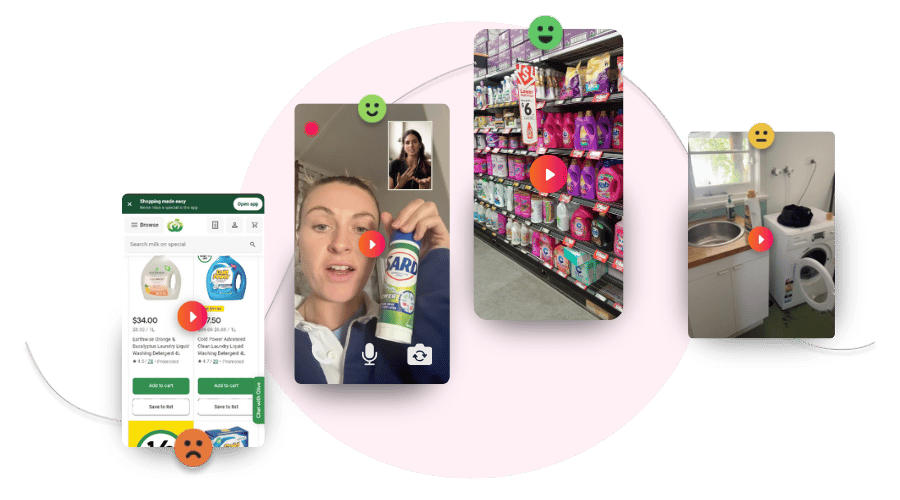
Video adds a layer of context that text responses can't capture. It gives you a window into the environments, behaviours, and emotions shoppers experience during their missions.
Visual context
Video shows you the kitchen cupboard, the shop aisle, the screen on the phone, the product in the hand. Context that shapes decisions but rarely gets described in words.
Shopper emotion and reaction
Video lets researchers read emotional cues — tone of voice, facial expression, hesitation, delight — that shape decision-making but are almost impossible to capture through surveys.
Rich qualitative data
Observing in-the-moment shopper interactions and seeing how they behave first-hand gives you a more complete understanding of their experience than any written feedback alone.
How can Indeemo support shopping mission research?
Indeemo is built for in-the-moment video research and is a strong fit for shopping mission studies. You can:
- Recruit B2C and B2B participants in hours from a panel of 3 million+ respondents
- Capture videos, photos, screen recordings, and texts as shoppers complete real-world missions
- Transcribe submissions automatically in 30+ languages
- Use generative AI for summarisation, theme detection, sentiment analysis, and quote extraction to speed up analysis significantly
- Import follow-up interviews from Zoom, Microsoft Teams, or your computer, and analyse them alongside the shopping mission data
All your data sits in one place, which makes it easier to spot patterns across missions and build a complete picture of shopper behaviour.
Do you need to be a researcher to run shopping mission studies?
No. Whether you're an in-house insights team, a brand exploring qualitative research for the first time, or an agency running work for a client, Indeemo can support you.
Use the platform as a self-service tool under annual licence, or partner with our Catalyst team for study design, recruitment, moderation, and analysis. If you have research ambitions but not the capacity to run the project yourself, we can lend a helping hand.
Frequently asked questions
What's the difference between a shopping mission study and a path-to-purchase study? Path-to-purchase focuses on the journey to a specific purchase. Shopping missions focus on the shopper's underlying goal and context, which may involve several touchpoints and products. Most path-to-purchase research is a subset of shopping mission research.
How long should a shopping mission study run? It depends on the mission. A grocery shop might be a single session of 20 to 40 minutes. A holiday planning mission might stretch across two or three weeks as the shopper considers options, books, and prepares. Match the fieldwork length to the natural shape of the mission.
How many participants do you need? Most shopping mission studies work well with 15 to 30 participants per mission type. Because each participant generates rich multi-format data (video, photos, screen recordings, reflections), sample sizes can be smaller than survey research.
Can you run shopping mission studies across multiple markets? Yes. Indeemo supports multi-market fieldwork with automatic transcription and translation in 30+ languages, so you can analyse submissions from multiple countries in parallel.
What's the best way to capture an in-store shopping mission? A mix of video, photos, and short voice or text reflections usually works best. Video or screen recording for digital browsing. Photos and captions for in-store moments where filming might feel intrusive. Short reflections after the mission to capture the why.