
Key takeaways
- Customer journey mapping captures every touchpoint a customer has with a brand, product, or service, along with the emotions they feel at each stage, usually shown as a visual map.
- Its real purpose is empathy: giving your whole organisation a shared, grounded understanding of what customers actually go through and why.
- Modern journeys are omnichannel and rarely linear, so qualitative, in-the-moment methods capture context that surveys on their own tend to miss.
- Common approaches include diary studies, mobile screen recording, and digital ethnography, with participants documenting their own journeys as they happen.
- With Indeemo, participants share videos, photos, screen recordings, and texts that build into a journey map on the dashboard, while AI handles transcription, translation, and analysis.
The customer journey is rarely a predictable series of interactions with a product or service. Digital transformation has made journeys increasingly omnichannel, spread across multiple contexts and platforms, which makes understanding how customers behave in the moment harder than it used to be.
Following a customer through every touchpoint is difficult using quantitative research alone. To deliver a better customer experience, you need the context behind each touchpoint and the "why" behind every positive and negative interaction. Indeemo helps you get closer to the moments that matter so you can empathise with the people you're designing for. The term might sound like something only a trained researcher can do, but the tool is mobile-first, uses an app participants already know how to use, and lets AI take care of the heavy lifting on transcription, translation, and analysis.
What is customer journey mapping?
Customer journey mapping is the process of capturing every touchpoint a customer has with a brand, product, or service, and the emotions they experience along the way. The result is usually a visual map of that journey, built to give your whole organisation a shared understanding of what customers go through and why.
At its heart, customer journey mapping is about developing empathy for your customer. It records each touchpoint a person experiences with a brand, product, or service, and the output is typically a visual representation of that journey: the customer journey map.
One of the main aims is to understand the emotions customers feel throughout their journey. The map then lets you and your wider organisation see the context your customer is in at each moment they interact with your brand, product, or service.
For any customer-centric organisation, a strong customer experience is essential. Marketing, CX, and UX teams are constantly expected to bring leadership and product teams meaningful insight about customers. Customer journey mapping gives those diverse teams a single, shared picture of the customer, and it's one of the more effective ways to build empathy and surface the real motivations behind what people do.
Customer journey mapping in a sentence: Capturing every touchpoint a customer has with a brand, product, or service, and the emotions they feel at each one, usually pulled together into a single visual map.
How do you do customer journey mapping research?
Start by clarifying your objective, then choose a method that captures real context, recruit the right participants, and pilot your tasks before fieldwork begins. Because journeys differ from one person to the next, an exploratory, qualitative approach usually reveals more than a fixed survey.
First, build a diverse team. CX, UX, and market research teams often work in silos, and although each has different goals, there is only one customer. A team with different perspectives helps you set an inclusive research strategy and objective, and a mix of personas will uncover more about the journey than any single viewpoint. A few things worth thinking through before you start.
Clarify your journey mapping research objective
Valuable customer journey mapping is insights-driven, informed by detailed qualitative data. To get there, identify your objective. What are the primary goals? What experiences do you need to understand? Who are your customers? You may not have answers to all of these yet, and if you don't, an exploratory approach to the project is the right starting point.
Choose your research method
Traditionally, quantitative methods like surveys were used to capture the customer journey. They have their place, but CX teams are often limited by what they can show. Quantitative methods might tell you what the touchpoints are, but they struggle to capture the true nature of a customer's journey and experience.
Exploratory research, or generative research, is qualitative by nature. Qualitative techniques such as diary studies, mobile screen recording, and digital ethnography deepen your understanding of the real-world, contextual journey considerably. Rather than asking people to recall a journey after the fact, you watch it unfold as participants share videos, photos, screen recordings, and texts from the moments that matter.
Recruitment and incentives
Recruitment can be difficult. Participants are sometimes reluctant to give up their time for qualitative research. If your organisation doesn't have quick access to the right people, specialist qualitative recruitment agencies can find participants, manage recruitment, and handle incentives. Incentives, monetary or otherwise, are essential for strong engagement, and the right amount varies significantly depending on your customer persona.
Fieldwork and pilot testing
A robust research strategy improves the quality and relevance of the insights you capture. You'll need a set of tasks that prompt customers to record the actions they take, the touchpoints they hit, and the emotions they feel along the way. The goal is tasks that capture the details that matter. But how do you know your design will actually work before you commit to fieldwork?
Get your own team to take the customer journey first, an exercise sometimes called a service safari. Let your researchers and CX teams document their own experience of your brand in real time. You'll quickly surface issues with the research design, and you'll often find the journey looks different for every customer. A trial run also hints at the personas that might emerge from an exploratory approach.
What are the challenges of customer journey mapping?
The biggest challenge is that journeys are no longer linear. Focus only on the physical journey from home to store and you risk excluding everything that happens in between.
For example, did the customer first search for your product online? Did they compare other channels before buying? These omnichannel paths add complexity to the map, but once you identify them, you can capture each possible route. One way to handle this is an exploratory approach: if you're unsure of the stages or touchpoints, start with an open-ended study where you ask the participant to record every touchpoint themselves, without prompting, then use tagging to code their uploads into stages or touchpoints afterwards.
Be mindful of how long your research runs and what you ask of people. Some journeys last hours; others, like an automotive path to purchase, can run for several weeks. Response rates are relative to the burden you place on participants. The journey mapping process should be designed so taking part never feels like a chore, which is another reason to test your protocol with your own team first. Sometimes less is more: the more you ask of participants, the less you tend to get back.
Missing behaviours and experiences are often blamed on customer journey mapping itself, when the real cause is the chosen method. Questionnaires generate a lot of quantitative data, but often at the expense of the insight a qualitative approach would surface. Letting customers document their experience across the journey as it happens, through videos, photos, screen recordings, and texts, captures each touchpoint across the various channels and buying journeys that a survey would flatten.
What are the benefits of customer journey mapping?
Customer journey mapping builds empathy, sharpens your personas, surfaces pain points and opportunities, grounds decisions in real context, gives teams a shared view of the customer, and can reduce research costs over time.
Building empathy
One of the key benefits is how journey mapping helps insights teams and decision makers build empathy for their customers. Empathy matters for innovation and for delivering a strong customer experience, and journey mapping can surface emotions you didn't know your customers were feeling as they interact with your product or service.
Emotions and motivations also shift across the journey. Empathy comes from the qualitative detail behind the map, and when customers document their own experience through video, photos, and screen recordings, you develop a deep understanding of the journey as they see it.
Develop user and customer personas
A persona can be defined before the journey mapping process if earlier insight already points to one. But qualitative techniques and real-time data capture often uncover the unexpected, and those surprises sometimes reveal a new persona you hadn't accounted for.
Uncover key pain points and opportunities
A holistic view of the experience surfaces the issues and gaps in the journey. Where you find pain points across multiple channels, you also find opportunities to innovate and improve the experience.
Identify contextual insights
Customer journey mapping should inform the right decisions for product innovation, service design, and quality improvements. It's one of the core processes organisations use to design and improve the customer experience on the basis of real insight rather than assumption.
Develop a shared understanding of your customer journey
Because customers move through so many channels, the journey map provides a single, unified description of the route a customer takes. UX teams, service designers, CX teams, and market researchers can all use it. Each team may focus on one part of the journey, but the map is universal to your organisation and gives everyone the same picture of the customer.
Reduced research costs
Finally, the insight from customer journey mapping can reduce costs over time. The richness of what you learn supports better decisions, and products and services adapt to put the voice of the customer first. Design with the customer in mind and the knock-on effect is often more referrals and sales through word of mouth.
What tools can you use for customer journey mapping?
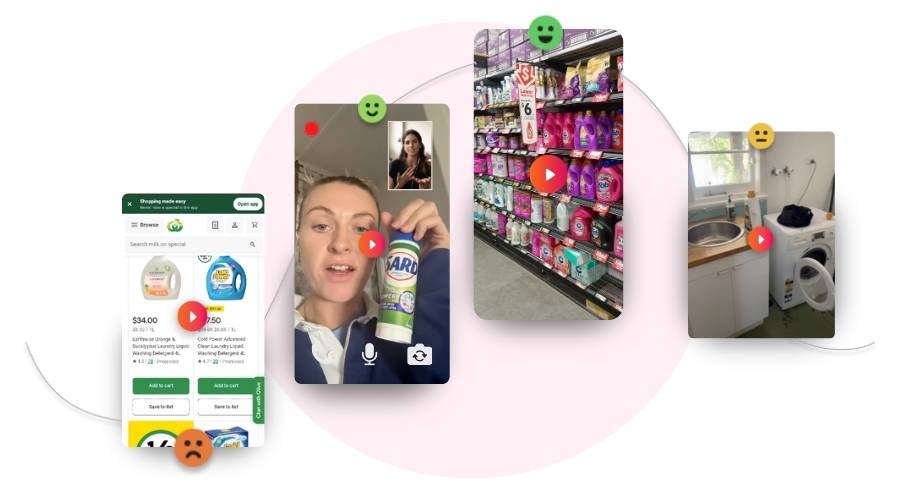
You can run customer journey mapping with a mobile research platform that captures video, photos, screen recordings, and texts in the moment and builds them into a journey map automatically. With Indeemo, the map takes shape on the dashboard as each participant documents their experience from beginning to end.
The platform uses video, mobile screen recording, automated transcription, and real-time qualitative data capture. As each participant's journey map builds on the dashboard, every piece of data is mapped against the touchpoints the research team has identified, so analysis can begin straight away. Combined with in-the-moment, multimedia capture and emotional ratings, CX and insights teams can build empathy quickly.
It works end to end. Recruit from a global panel, run your study in 30+ languages, and analyse in minutes with AI for transcription, translation, theme detection, and sentiment. You can also import existing interviews and focus groups from Zoom, Teams, or your computer and analyse them the same way, then create subtitled highlight reels to share the journey with stakeholders. The map becomes a shared empathy repository for the different teams across your organisation, with each touchpoint captured in its real context.
We've supported thousands of research projects, from mapping the path to purchase for aquarium filters, to mortgage buyer journeys, to the patient journey of kidney transplant patients.
Frequently asked questions
What is a customer journey map?
A customer journey map is a visual representation of every touchpoint a customer has with a brand, product, or service, along with the emotions they feel at each stage. It gives teams across an organisation a single, shared view of what the customer experiences and why.
Is customer journey mapping qualitative or quantitative?
It can use both, but the most revealing journey mapping is qualitative. Quantitative methods tell you what the touchpoints are; qualitative, in-the-moment methods capture the context and the "why" behind each one. Many teams combine the two, using qualitative research to understand the journey and quantitative data to size it.
What are the main challenges of customer journey mapping?
The biggest challenge is that journeys are rarely linear, so studies that follow only one path miss the omnichannel detours customers actually take. The other common pitfall is participant burden: ask too much and response quality drops. An exploratory design and careful task design address both.
How do you map a non-linear, omnichannel journey?
Start with an open-ended study and ask participants to record every touchpoint themselves, without prompting, then use tagging to code their uploads into stages or touchpoints afterwards. This lets the real journey emerge rather than forcing it into a path you assumed in advance.
What is the difference between customer journey mapping and user journey mapping?
Customer journey mapping covers the whole relationship a person has with a brand across every touchpoint, including before and after a purchase. User journey mapping is narrower, focusing on how someone interacts with a specific product or interface. The methods overlap, and the right one depends on the scope of what you're trying to understand.