
Key takeaways
- Ecological Momentary Assessment (EMA) is a research method where participants share data about their behaviours, mood, and experiences in real time through a mobile device, in their natural environment.
- Because data is captured in the moment, EMA avoids the recall bias that comes with asking people to remember what they did or felt days or weeks later.
- There are two main types: time-based EMA (prompts at set intervals) and event-based EMA (prompts triggered by specific behaviours or experiences).
- EMA is widely used in healthcare, psychology, education, social sciences, and sports research.
- With Indeemo, you can design and run EMA studies using scheduled, sequential, or all-at-once tasking, recruit from a global panel, and analyse responses with AI.
What is ecological momentary assessment (EMA)?
EMA is a research method where participants share data about their behaviours, mood, and experiences in real time using a mobile device, in their natural environment. Rather than asking someone to recall what happened last week, EMA captures what's happening right now.
The method can be used to study smoking, exercise, medication adherence, dietary habits, and more. It's used across healthcare, academic, and commercial research, and mobile data collection tools like Indeemo have made it practical to run at scale.
Where did EMA come from?
EMA has its roots in ecological psychology, which emerged in the mid-20th century as a reaction to the limitations of laboratory-based research. Ecological psychology emphasises the importance of studying behaviour in context, recognising that what people do is influenced by a complex mix of internal and external factors.
The first EMA studies were conducted in the 1970s and 1980s using paper-and-pencil diaries to collect data on daily experiences and behaviours. These early studies were limited in scope and lacked the technology that has since made EMA far more practical.
Smartphones and wearable devices changed everything. Today, EMA studies run on mobile apps like Indeemo, text messaging, and web-based surveys, reaching participants wherever they are.
EMA has become particularly popular in healthcare, with applications in psychology, psychiatry, public health, and medicine. Capturing real-time data on health-related behaviours and experiences makes it well suited to studying what's actually happening in people's lives between clinic visits.
Why is EMA becoming a leading methodology?
EMA offers several advantages over traditional research methods.
Accuracy and ecological validity. Because data is collected in real time and in the participant's natural environment, it provides a more accurate reflection of their behaviour and experiences. This leads to a better understanding of the factors that actually influence what people do day to day.
Participant engagement. EMA can be more engaging than traditional methods because participants are involved in the research process as it happens. They're sharing real moments, not filling out a retrospective survey.
Data quality. Collecting data more frequently and in more detail improves the quality and reliability of what you capture. You get richer, more granular data than a single interview or questionnaire can provide.
Flexibility. EMA can be tailored to the specific needs of the research question and the participant population. Time-based, event-based, or a combination of both. Short prompts or longer reflections. The method adapts to the study, not the other way around.
What are the main applications of EMA?
EMA has been applied across several fields. Here are some of the most common.
Psychology and mental health
EMA has been used widely in psychology and mental health research to study mood disorders, stress, and addiction. Researchers track participants' experiences of stress in real time, identifying the factors that contribute as they actually happen. EMA has also been used to study the onset and progression of depression and bipolar disorder by tracking moods and behaviours over time, rather than relying on periodic clinical assessments.
Healthcare and patient experience
EMA is well suited to understanding patient experiences outside clinical settings. Researchers can track medication adherence, symptom fluctuations, side effects, and daily coping strategies as patients go about their normal lives. This gives clinicians a view of the patient experience that clinic visits and retrospective surveys simply can't.
Education and learning
Researchers have used EMA to track students' engagement and motivation in real time, and to study the impact of learning interventions on performance. For example, researchers have studied the effects of feedback interventions on students' learning by tracking engagement and performance over time.
Social sciences
EMA has been used to study social interactions, media use, and environmental behaviour. Researchers have tracked participants' experiences of positive and negative emotions in social situations, and studied the effects of media use on behaviour, such as food cravings in response to advertising.
Sports and performance
EMA has been applied to study the factors that contribute to athletic performance. Researchers have used it to study pre-performance routines, tracking experiences of anxiety and confidence in the moments leading up to competition, and to study the effects of fatigue and recovery over time.
How does EMA work?
EMA typically involves participants carrying a mobile device throughout the day and responding to prompts or questions sent to the device at various intervals. These prompts (push notifications) can be programmed to occur at random times or at specific times of day, and can be tailored to the individual participant's schedule and routine.
Participants may be asked to respond to questions about their current mood, behaviour, or environment, or to provide information about their experiences throughout the day.
There are two main types of EMA.
Time-based EMA
Time-based EMA involves collecting data at specific intervals throughout the day, such as every hour or every four hours. Participants are prompted to respond to a set of questions or tasks at each interval, providing a snapshot of their behaviour and experiences in the moment.
This approach is useful for studying behaviours that occur throughout the day, such as physical activity, sleep, and dietary habits.
For example, a study might ask participants to report their current level of physical activity, mood, and stress every two hours. This data can reveal patterns in physical activity and their relationship to mood and stress across the day.
Event-based EMA
Event-based EMA involves collecting data in response to specific events or experiences, such as when a participant engages in a particular behaviour or experiences a specific emotion. Participants respond when the event occurs, providing information about the context and factors surrounding it.
This approach is useful for studying behaviours that happen less frequently or in response to specific triggers, such as smoking, substance use, or emotional experiences.
For example, a study might ask participants to report their mood and level of craving immediately before and after smoking a cigarette. This data can identify triggers for smoking and the relationship between smoking behaviour and mood.
Both types have their strengths. Many studies combine both, depending on the research question.
How do you design an EMA study with Indeemo?
Indeemo offers three tasking approaches to suit different EMA study designs.
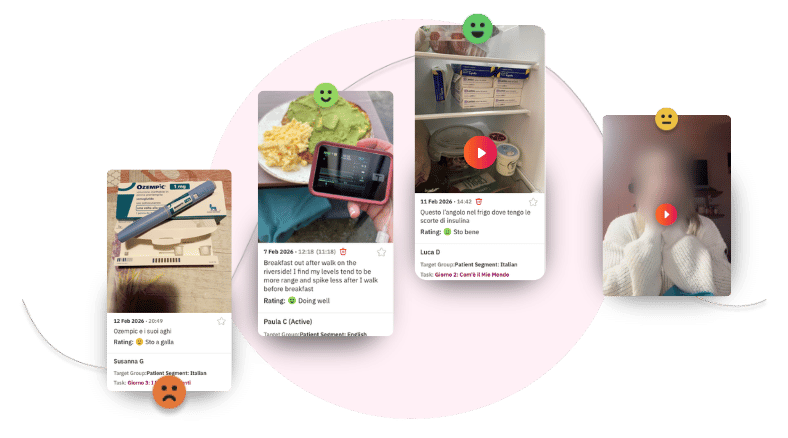
Beyond task design, Indeemo supports the full EMA workflow. Recruit participants in hours from a global panel of 3 million+ respondents. Capture responses as videos, photos, screen recordings, and texts. Then use generative AI for summarisation, translation, thematic analysis, and sentiment analysis, reducing analysis time by at least 40%.
Do you need to be a researcher to run an EMA study?
No. Whether you're an academic research team, a healthcare organisation, or a brand exploring behavioural research, Indeemo can support you.
Use the platform independently if you have the expertise in-house. Or partner with our Catalyst team for study design, recruitment, moderation, and analysis. If you have research ambitions but not the capacity to run the project yourself, we can lend a helping hand.
Frequently asked questions
What's the difference between EMA and a traditional survey?
Traditional surveys ask participants to recall their behaviours and experiences after the fact, sometimes days or weeks later. EMA captures data in the moment, in the participant's natural environment. This reduces recall bias and gives you a more accurate picture of what people actually do and feel.
What's the difference between time-based and event-based EMA?
Time-based EMA sends prompts at set intervals (e.g. every two hours). Event-based EMA asks participants to respond when a specific event happens (e.g. after smoking a cigarette or experiencing a craving). Many studies combine both approaches.
How long does a typical EMA study run?
It varies by research design. Some studies run for a few days, others for several weeks. The key is balancing data richness with participant burden. Shorter, more frequent prompts tend to get better compliance than long, infrequent questionnaires.
What devices do participants need?
A smartphone with a reasonable internet connection. Participants download the Indeemo app and respond to prompts by recording video, taking photos, or writing text responses. The app works on iOS and Android.
Is EMA only used in healthcare research?
No. Healthcare is one of the most common applications, but EMA is also used in psychology, education, social sciences, sports research, and commercial consumer research.