

Key takeaways
- An empathy program is an ongoing research initiative that helps teams get closer to the people they serve – customers, patients, users, employees – by capturing real-world experiences as they happen, not as they're remembered.
- Unlike a one-off study, an empathy program is continuous and built to be shared across teams. The goal isn't just insight, it's shared understanding.
- Empathy programs work best when they blend in-the-moment video, photos, screen recordings, and texts from participants' real lives, moderated and analysed by researchers in near real time.
- Common use cases include customer journey research, path to purchase, UX discovery, healthcare and patient experience, employee research, and long-term customer panels.
- With Indeemo, you can recruit participants from a global panel of 3 million+, capture research in 30+ languages, analyse faster with AI, and create subtitled highlight reels that bring the customer voice into every meeting.
What is an empathy program?
An empathy program is an ongoing research initiative designed to help your team genuinely understand the people you serve – what they do, how they feel, and why they make the decisions they make. Instead of commissioning a one-off study every time a new question comes up, you build a continuous way to listen to customers, users, or patients, and to share what you learn across the business.
The aim is to get past what customers say on a survey and closer to what actually happens in their lives. An empathy program treats qualitative research as a programme of work rather than a project. It typically combines methods like mobile ethnography, diary studies, video surveys, and in-depth interviews, run on a rolling basis with the same platform, the same team, and a shared pool of insight that everyone can reference.
Empathy programs are run by insights teams, UX researchers, CX leads, brand teams, product managers, and healthcare researchers. The common thread is a need to understand real behaviour in context – not just what customers claim they do when you ask them.
Why does empathy matter in research?
Because people don't behave the way they say they behave. They post-rationalise. They forget. They tell you what they think you want to hear. Empathy in research is about closing the gap between what people report and what they actually do, feel, and decide in the moment.
Empathy is a term worth defining precisely. In research and design, it means something more specific than everyday sympathy. Two working definitions capture it well.
"Empathy is the ability to fully understand, mirror, then share another person's expressions, needs, and motivations… In UX, empathy enables us to understand not only our users' immediate frustrations, but also their hopes, fears, abilities, limitations, reasonings, and goals."
– Nielsen Norman Group, Sympathy vs. Empathy in UX
"In the world of design thinking, empathy is a deep understanding of the problems and realities of the people you are designing for."
– IDEO, Human-Centered Design Toolkit (via Interaction Design Foundation)
Both point in the same direction. Empathy in research isn't about feeling sorry for someone. It's about understanding their world well enough to make better decisions on their behalf.
That understanding is easiest to build when the whole team has access to it. The problem with traditional research is that the insight often lives in a report, read by a few people, then filed away. An empathy program is designed to do the opposite. When a product manager can watch a one-minute video of a real customer struggling with their checkout flow, the conversation in the next meeting changes. The gap between the people making decisions and the people affected by them gets smaller.
How is an empathy program different from a one-off research study?
A one-off study answers a specific question at a specific moment. An empathy program builds a long-term relationship with a group of customers and turns their experiences into a shared resource for the whole team.
Both have a place. A project-based study is the right call when you need to answer a focused question – will this concept land, what's driving churn in this segment, how do users navigate this new flow. An empathy program is the right call when you want to build lasting understanding of a customer group and get better at the everyday decisions that shape their experience.
Here's how they differ in practice:
The distinction matters because the set-up is different. A one-off study is optimised for one answer. An empathy program is optimised for reuse, findings need to be easy to search, easy to share, and easy to re-analyse as new questions come up.
What are the benefits of running an empathy program?
An empathy program gives you three things a one-off study can't: continuity, breadth, and shared understanding. Here's what that looks like in practice.
A fuller picture of the customer
Instead of a snapshot from one study, you get a longitudinal view. You see how behaviour changes when a customer switches jobs, moves house, has a baby, or starts using a competitor. That kind of context is almost impossible to get from a single project.
The "why" behind the numbers
Dashboards and surveys tell you what's happening. They rarely tell you why. Empathy programs capture the reasoning and emotion behind behaviour, in people's own words and in their own environments. When cart abandonment spikes, you have a pool of real customer videos to help explain it.
Better decisions, faster
Because the insight is already there, teams don't have to commission a new study every time a question comes up. A PM who wants to understand how parents actually use the product in the kitchen can search the library, watch a few videos, and make a better decision that afternoon.
Innovation grounded in real unmet needs
The most interesting product opportunities usually come from watching people work around a problem the market hasn't named yet. Empathy programs put researchers in a position to spot these moments as they happen, rather than trying to uncover them in a retrospective interview.
Shared empathy across teams
This is the benefit most teams underestimate. When the whole organisation can see a real customer, the debates shift. Instead of arguing over assumptions, teams argue over what they've both watched. Product, design, marketing, and leadership start working from the same picture of the customer.
How do you run an empathy program?
Most empathy programs follow the same six stages, whether they run for three months or three years. The specifics vary by objective, industry, and audience, but the shape of the work is consistent.
1. Set clear objectives
Start with what you actually want to understand, and who needs to understand it. A programme designed to inform a product roadmap looks different from one designed to support brand positioning or clinical trial design. Decide early whether you're exploring (opening up new questions), tracking (watching behaviour change over time), or validating (testing specific hypotheses). Most programmes do a mix of all three, but one usually leads.
2. Recruit the right participants
Recruit for diversity within your target audience, not just for demographics. Think about life stage, category usage, attitudes, and context. For a long-running programme, consider a mix of short-term participants (weeks) and longer-term panel members (months or years) so you get both breadth and depth.
3. Capture videos, photos, screen recordings, and texts
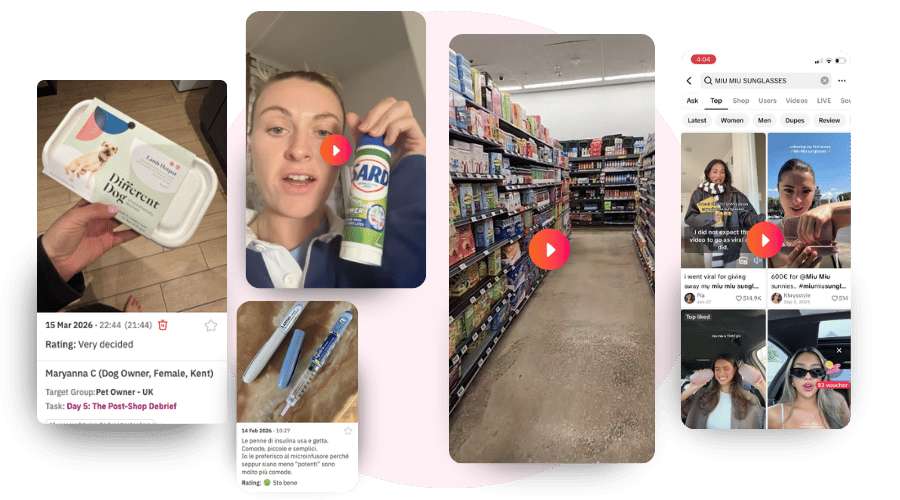
Mobile ethnography is the workhorse of most empathy programs. Participants record short videos, take photos, capture screen recordings, and write text entries from wherever they are — at home, in the store, mid-commute, during a medical appointment. Tasks can be sent all at once, in sequence, or scheduled to trigger at specific moments. The more the capture happens in context, the more revealing it tends to be.
4. Analyse with AI, then dig in as a team
AI handles the heavy lifting; transcription, translation, thematic analysis, sentiment detection, so researchers can spend time on the things only humans can do. Look for patterns across segments, pull out the moments that changed your mind, identify the quotes and clips worth sharing. A research team that used to spend two weeks on analysis can now do the first pass in an afternoon.
5. Turn findings into decisions
The output of an empathy program isn't a report. It's a set of decisions, reframings, and artefacts that change how other teams work. Subtitled highlight reels for leadership. Journey maps for design. Persona refreshes for brand. The programme is working when it changes what people do next.
6. Keep the loop open
Go back to participants. Share what you learned with them. Invite them into the next phase. An empathy program is an ongoing relationship, and the participants who feel heard tend to contribute better material the next time you ask.
How do video and mobile research build empathy?
Because video captures things words don't. A transcript tells you what someone said. A video tells you how they said it, where they were, what was happening around them, what was on the kitchen counter, whether their toddler was pulling at their sleeve while they tried to check out on their phone. That context is where empathy actually lives.
Seeing what people actually do, not what they say they do
There's a well-known gap in qualitative research between claimed behaviour and actual behaviour. People are genuinely trying to tell you the truth, but memory is unreliable and social dynamics shape answers. In-the-moment video closes that gap. A participant recording themselves while making dinner, unboxing a product, or navigating a website gives you a version of their behaviour that hasn't been filtered through recall or self-presentation.
Mobile screen recording: seeing the "how" of digital behaviour
Screen recording with voice-over is one of the most revealing things you can ask for. A participant walks you through a purchase, an app onboarding, or a comparison between two competitors — narrating what they're thinking as they go. You see the friction points they don't even notice. You hear the internal debate. You watch them give up and switch tabs. It's the closest thing to sitting next to them.
Highlight reels: the empathy multiplier
The most underused capability in empathy research is the subtitled highlight reel. A five-minute cut of participant moments, edited around a theme, is worth ten PowerPoint slides. It travels through an organisation faster than a report, it lands in stakeholder meetings in a way that numbers rarely do, and it keeps the customer voice present when decisions are being made. With Indeemo, reels are built into the platform –≠ subtitled automatically, branded, and ready to share.
What are the most common use cases for empathy programs?
Empathy programs show up across industries, but a few applications come up again and again.
Customer journey and path to purchase
Following real customers across the moments that lead to a purchase – awareness, consideration, comparison, decision, post-purchase reflection. Mobile ethnography captures the parts a retrospective interview misses, like the 2am category research on a phone in bed.
UX discovery and product design
Understanding how people actually use a product in their real environment, not in a lab. Useful for early-stage discovery, for benchmarking against competitors, and for catching friction points that only show up in context.
Consumer goods and shopper experience
In-store shops, pantry audits, ritual research, occasion studies. Empathy programs work particularly well for consumer goods teams because so much of the relevant behaviour happens at home or in the aisle, far from any research facility.
Healthcare and patient experience
Understanding what happens between clinic visits – medication adherence, symptom fluctuations, daily coping, caregiver dynamics. Healthcare empathy programs are HIPAA-capable and typically run for longer periods so researchers can see how experiences evolve with treatment.
Employee experience and workplace research
Ethnographic research inside the organisation. How do people actually experience the onboarding process, the new office layout, the hybrid schedule, the latest internal tool. Empathy programs help HR, facilities, and internal comms teams design for the workforce they have, not the one they imagine.
Long-term customer panels
A standing panel of customers who contribute to multiple studies over months or years. Useful for brands that want to build real depth of understanding in a priority segment, and for innovation teams who need a reliable group to test ideas with.
How do research platforms support empathy programs?
A platform makes an empathy program viable at scale. Without one, you're stitching together recruitment, capture, transcription, analysis, and reporting across four or five tools. With one, everything lives in a single place, and the team spends more time on the research and less on the logistics.
With Indeemo, the workflow runs end-to-end in one platform.
Recruit participants in hours from a global panel of 3 million+ B2C and B2B participants. You brief the audience, our recruitment team sources and screens candidates, and your study is ready to launch within days.
Research in the moment through an app that participants use like Instagram. Tasks can be scheduled, sequenced, or sent all at once. Participants record videos, take photos, capture mobile screen recordings, and write text entries – all uploading in near real time to a dashboard you can moderate from a browser.
Analyse faster with generative AI. The platform transcribes and translates videos in 30+ languages, detects themes and sentiment, and reduces analysis time materially.
Create subtitled highlight reels in minutes, branded and ready to share. This is the bit that changes stakeholder meetings.
The platform is enterprise-grade – SOC 2 certified, ISO 27001 certified, HIPAA capable with BAA, GDPR compliant, and independently penetration tested. Full security documentation is available on request.
Do you need to be a research expert to run an empathy program?
No. Whether you're an experienced insights team or a brand that's never commissioned qualitative research before, Indeemo can support you at whatever level you need.
Use the platform independently if you have the expertise in-house. Or partner with our Catalyst team for study design, recruitment, moderation, analysis, or the full programme end to end. If you have research ambitions but not the capacity or specialist experience to fulfil them, we can lend a helping hand as and when you need it.
Indeemo can be more than a platform. It can be a partnership.
Frequently asked questions
How long does an empathy program typically run?
There's no fixed answer, but most run for at least three months, and many run for a year or more. Shorter programmes make sense when you're validating a specific idea; longer programmes are better for building lasting understanding of a customer group. Some teams run multi-year panels with rolling waves of research.
What's the difference between an empathy program and a diary study?
A diary study is a method. An empathy program is a programme of work that usually includes diary studies alongside other methods like video surveys, in-depth interviews, and journey mapping. You might run several diary studies over the course of an empathy program, each focused on a different question.
How many participants do you need?
It depends on the scope. A focused wave of research might involve 15 to 30 participants. A standing long-term panel might have 100 to 500 members, with different sub-groups activated for different studies. Quality beats quantity — a smaller, well-recruited group usually produces richer material than a large, loosely recruited one.
How do you share empathy program findings with stakeholders who weren't in the research?
Video is the answer here, and specifically subtitled highlight reels. A five-minute cut of real customer moments, organised around a theme, communicates more in a leadership meeting than any deck. Written reports still have their place, but they shouldn't be the main artefact – the video should be.
Can you run an empathy program across multiple countries or languages?
Yes. Indeemo supports 30+ languages for automated transcription and translation, and our recruitment network covers all major markets. Multi-country programmes typically run in parallel – one study, several markets, comparable outputs – rather than sequentially.