

Key takeaways
- User journey mapping is the research process of documenting every touchpoint a person encounters with a brand, product, or service. It results in a user journey map, a visual record of that journey.
- It works best when participants document their own experiences, behaviours, and emotions in the moment and in context, rather than relying on historical data or asking people to remember weeks later.
- User journey mapping and customer journey mapping overlap heavily. User journey mapping tends to focus more tightly on how someone uses a specific product or interface.
- A strong study starts with a clear objective, well-defined personas, and a realistic scenario, then uses tasks that capture actions, touchpoints, and emotions across the journey.
- With Indeemo, participants capture videos, photos, screen recordings, and texts, and each journey map builds automatically on the dashboard as responses come in.
What is user journey mapping?
User journey mapping is the process of documenting the journey a person takes with a brand, product, or service. It results in a user journey map: a visual record of each touchpoint the user interacts with along the way, from the first moment of awareness through to the goal they're trying to reach.
A journey map is the visual output. The mapping is the research that produces it. More user researchers and UX design teams are looking for quick, agile ways to study the real, contextual user experience, and journey mapping has become a practical way to do it.
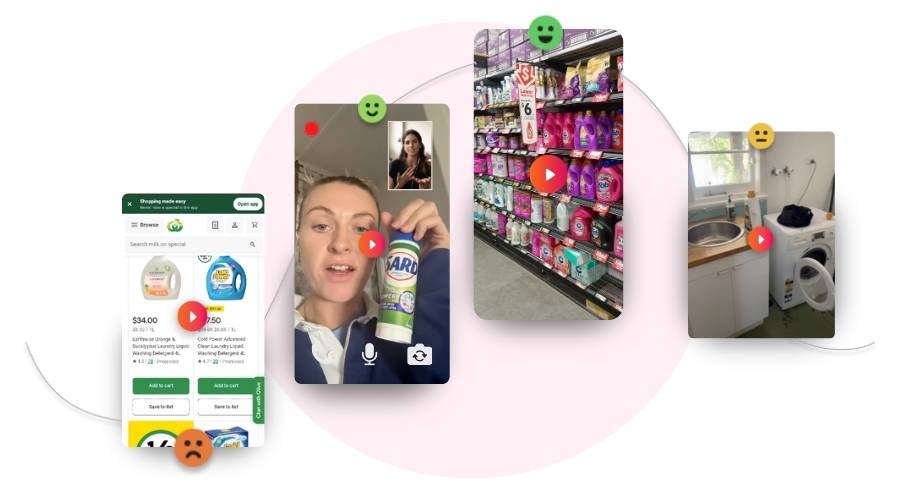
Sometimes a journey map is built from data and insights compiled earlier by marketing or research operations teams. Relying on historical data like this can overlook how behaviours, personas, and touchpoints have shifted since. Increasingly, insights teams want to capture the true experiences and behaviours of their users in the moment and in context, which is where journey mapping research comes in.
User research carried out during the discovery phase of product or service design is complemented by journey mapping, and UX design draws on the insights the map produces.
User journey mapping is often associated with digital experiences: the interactions someone has with your website or mobile app. But a real journey rarely stays in one channel. The same person might research on their phone, buy in store, and get support over email, so the journey often spans online and offline touchpoints. A strong study documents people’s real experiences, behaviours, and emotions across all of them, so the insights and design teams end up with a shared, empathetic understanding of the user.
User journey mapping in a sentence: It's qualitative research where people document their own actions, touchpoints, and emotions as they move through an experience, so you can map what really happens, in context, rather than what you assume happens.
What's the difference between user journey mapping and customer journey mapping?
The two terms are often used interchangeably, and in practice they overlap a lot. The simplest way to think about it: user journey mapping tends to focus on how someone uses a specific product, service, or interface, while customer journey mapping takes a broader view of the whole relationship a person has with a brand over time.
The distinction matters less than the method. Whichever lens you take, the goal is the same: understand the real experience, in context, from the person’s point of view.
What goes on a user journey map?
A user journey map usually lays out the stages a person moves through, the touchpoints they hit at each stage, what they're doing, and how they feel along the way. Most maps capture a version of the following:
The emotions matter as much as the actions. Motivations and feelings change across a journey, and capturing those shifts is what turns a flat list of steps into something a team can empathise with.
How do you conduct user journey mapping research?
Good journey mapping research comes down to a handful of decisions made well: a clear objective, the right personas, a realistic scenario, and tasks that capture the journey as it happens. Here's how we help clients design a strong study.
Clarify your research objective
Define the scope and identify the objective first. It's tempting to try to capture everything about your users, but that often works against the specific insight you need for the next phase of improvement. Pinning down the scope and the objective up front makes everything that follows easier.
Identify your user personas
Personas are your users. A retail chain might have one persona who buys online, another who goes to the store, and another whose journey involves both. You might not start with a defined list, and that's fine. You can run exploratory research through journey mapping to identify the different types of user as you go. An exploratory approach often produces a variety of maps with diverging and converging touchpoints, and personas frequently turn out to depend on channel preference: one only uses your app, another only your website on desktop.
Define the research scenario
Alongside the scope, define the use case, or scenario. A scenario usually involves a goal for the user. In the retail example, that might be searching for a product, adding it to the cart, and getting through the online checkout. Take a more exploratory view and you can let users document every interaction with your brand, which helps you define future scenarios you hadn't thought of.
Empower your participants
We strongly encourage researchers to design a qualitative methodology that genuinely empowers participants. Let people describe the journey in their own words. Quantitative techniques like questionnaires can cause UX and research ops teams to miss the real, contextual experience, so choose a qualitative technique that gets you the closest version of the truth.
Let participants express their emotions at each interaction, positive or negative. You'll quickly build a deeper understanding of your users and a shared sense of empathy across the research and design team. That happens when the tasks are designed well.
Design meaningful research tasks
To empathise with your users, design tasks that generate the insight you actually need. Tasks let participants document their experiences across multiple touchpoints, and when they're built with the journey at the forefront, the real experiences start to surface.
For example, you'll want a series of tasks covering the actions people take, each interaction, and the emotions and difficulties they hit along the way. It can be hard to know whether the design suits your participants, which is why testing it matters. Many UX teams find sequential tasks work well, letting participants respond at their own pace.
Indeemo supports three tasking approaches, so you can match the design to the journey:
Test your research design
Get your own team to take the journey. Have your researchers and UX teams capture and document their experience with your brand in real time before you launch. You'll quickly uncover issues with the study design, and you may find the journey differs for every user. A trial run also hints at the personas that might emerge from an exploratory approach.
Plan recruitment and incentives
Recruitment can be difficult. Participants are sometimes reluctant to give up their time for qualitative research. If you don't have quick access to the right people, specialist recruitment can find participants, manage the process, and handle incentives for you. Incentives, monetary or otherwise, are essential for strong engagement, and the amount varies significantly by persona and market.
What are the challenges of user journey mapping?
Like any qualitative research, journey mapping comes with challenges. The main ones are the diversity of user behaviour, participant burden, the limits of the wrong methodology, and over-reliance on a single map. None of them are dealbreakers, but it helps to plan for them.
Not every user follows the same journey. People have their own behaviours and habits when they use websites and apps, and that variety makes journey mapping research harder to design. A generative research approach helps here. Like exploratory research, it's qualitative in nature, and it lets you build a methodology that doesn't restrict the true behaviours of different personas.
Be mindful of how long your study runs and how much you ask of participants. Response rates are tied to the burden you place on people. If participation starts to feel like a chore, engagement drops, which is another reason to test your protocol with your own team first. The more you ask, the less you tend to get back.
Missing behaviours and experiences are often reported as a challenge, but that’s frequently a result of the methodology. Questionnaires produce plenty of quantitative data, often at the expense of the qualitative insight you actually need. Letting people document their experiences as they happen is far more revealing.
Finally, watch out for over-reliance on a single map. The insights are valuable, but behaviours change and new personas emerge. Treat journey mapping as iterative and build it into your research ops strategy. Revisit and update the map, and run fresh research to surface what the last study missed.
What are the benefits of user journey mapping?
The biggest benefit is empathy: journey mapping helps teams understand their users as people, not data points. Beyond that, it develops personas, uncovers hidden issues and opportunities, captures context-rich insight, gives diverse teams a shared view of the experience, and ultimately helps reduce cost.
Building empathy
One of the key benefits is how journey mapping helps insights teams and decision makers build empathy for their users. Empathy is essential to innovation and to designing an experience people enjoy. Mapping can surface emotions you didn’t know users were feeling as they interact with your product or service, and those emotions and motivations shift across the journey. When participants document their experiences through videos, photos, screen recordings, and texts, you develop a deep understanding of the journey as seen through their eyes.
Developing user personas
You can develop personas before you start mapping. But qualitative techniques and real-time capture often surface unanticipated insights, and those can reveal a new persona you hadn't accounted for.
Uncovering unknown issues and opportunities
A holistic view of the experience helps you find issues and gaps across the journey. Spot pain points across multiple channels and you've found opportunities to innovate and improve.
Capturing context-rich insights
Journey mapping should inform the right decisions about product innovation, service design, and quality. It’s one of the core processes that helps organisations design and improve an experience grounded in real insight rather than assumption.
Building a shared understanding of the experience
Because users move through so many channels, a journey map gives everyone a single, unified description of the journey. UX teams, service designers, CX teams, and market researchers can all use it. Each may focus on a different part of the journey, but the map is universal to the organisation.
Reducing cost
The insight from journey mapping supports better decision-making, which reduces cost over time. When products and services are designed with the user first, organisations tend to see the benefits ripple out, including more referrals and word-of-mouth growth.
Frequently asked questions
What's the difference between user journey mapping and customer journey mapping?
The terms are often used interchangeably and overlap heavily. In general, user journey mapping focuses on how someone uses a specific product, service, or interface, while customer journey mapping takes a broader view of the whole relationship a person has with a brand over time. The method is the same; only the lens changes.
Do user journey maps only cover digital touchpoints?
No. Journey mapping is often associated with websites and apps, but real journeys rarely stay in one channel. A single journey can move between online and offline touchpoints, like researching on a phone, buying in store, and getting support by email, and a good map captures all of them.
How many participants do you need for a user journey mapping study?
It depends on the scope and how many personas you're studying. Qualitative journey mapping captures rich data from each person, so you often need fewer participants than you'd expect. A focused study can work with a small group, while broader, multi-persona research may involve more.
How long does a user journey mapping study take?
It varies with the journey you’re mapping. Some studies run for a few days, others for a few weeks if the journey unfolds over time. The key is balancing the depth of insight against participant burden: the more you ask of people, the lower your response rate tends to be.
What's the best way to capture emotions during the journey?
Let participants document their experiences in their own words, in the moment. In-the-moment video, screen recordings, and emotional ratings capture how people feel as they go, rather than how they remember feeling later. That immediacy is what makes the emotional side of the journey visible.