

Key takeaways
- Customer closeness research is the practice of building ongoing, qualitative understanding of your customers as real people, not just data points in a segmentation or analytics dashboard.
- Traditional data sources (surveys, analytics, CRM data) tell you what customers did. Customer closeness research tells you why, by capturing behaviour, context, and emotion in the moment.
- One-off research projects give you a snapshot. Continuous discovery programmes, where you maintain a panel of participants over weeks or months, give you an ongoing relationship with your audience.
- Practical considerations covered in this guide: how to recruit, how many participants you need, what to pay them, how to structure your tasking, and how long to run your programme.
- With Indeemo, you can recruit from a global panel of 3 million+ participants, capture videos, photos, screen recordings, and texts in 30+ languages, analyse with AI, and create subtitled highlight reels to share with stakeholders.
What is customer closeness research?
Customer closeness research is the practice of developing a deep, ongoing understanding of your customers through qualitative methods that go beyond what surveys and analytics can tell you. Rather than relying on third-party data, segmentation reports, or purchase history, customer closeness research puts you in direct contact with the people who buy and use your products.
The goal is straightforward: understand customers as people, not data points. What does their morning routine look like? How do they actually make purchase decisions? What frustrates them about your category? What do they care about that has nothing to do with your product but everything to do with how they experience it?
These are questions that a Net Promoter Score or a quarterly survey can't answer. They require watching, listening, and staying connected over time.
"Brands need to shift from viewing their customers as personas to understanding their customers as people."
— Eugene Murphy, Founder & CEO, Indeemo
Why does customer closeness research matter now?
Because the assumptions brands hold about their customers go stale faster than ever.
Brand loyalty is harder to earn and easier to lose
Knowing your customers well and giving them the right products doesn't guarantee they'll stay. Competition is fierce across every category. Cultural relevance shifts at the speed of social media. And pricing transparency means a consumer can switch to a competitor with a double tap. Brand loyalty is no longer something you build once and maintain. It's something you earn continuously through relevance, value, and understanding.
Customer behaviour is increasingly omnichannel
Consumers move between channels constantly: browsing on their phone, comparing prices on a laptop, buying in store, returning online. Analytics and transaction logs will tell you what someone did, but they'll never tell you why. Why did they abandon the cart? Why did they switch brands? Why did they drive to a physical store instead of ordering online? Understanding the "why" requires getting closer to the actual experience.
Generational shifts are rewriting the rules
Younger consumers, particularly Gen Z, are less brand-loyal than previous generations and more likely to make purchasing decisions based on shared values. According to research from Alter Agents, only 37% of Gen Z consumers bought from the same brand they were initially considering. For brands trying to build loyalty with these audiences, understanding who they are and what they care about is more important than any single campaign.
The "why" behind the numbers
This is where customer closeness research fits. Quantitative data tells you what's happening. Segmentations tell you who your customers are in broad strokes. But only qualitative research, particularly in-context methods like diary studies and mobile ethnography, can tell you why people behave the way they do. And "why" is what you need to make good decisions about products, services, and experiences.
What's the difference between one-off research and continuous discovery?
Most qualitative research is project-based. You have a question, you commission a study, you get answers, and the project ends. That works well for specific decisions. But between projects, your understanding of customers is frozen in time while their lives keep changing.
Continuous discovery takes a different approach. Instead of running isolated projects, you maintain a panel of participants over weeks or months. You stay connected to them. You assign tasks as new questions arise. You build a relationship with your audience rather than parachuting in and out.
An increasing number of research teams are using digital ethnography as an alternative to traditional Market Research Online Communities (MROCs) for exactly this reason. The multimedia nature of the data, with participants sharing videos, photos, screen recordings, and texts from their real lives, produces richer context than text-based community platforms.
How do you recruit participants for a customer closeness programme?
Great research starts with great recruitment. There are three main approaches.
Use a qualitative recruitment agency
This is how most Indeemo clients recruit. You provide your recruiter with a screener specifying your target customer personas or consumer segments, and they source participants from their own panel or go out and find them.
Depending on how niche your target audience is, recruitment costs start at around US$100–200 per participant for consumers in the US, $200–500 for harder-to-reach B2B participants, and higher for specialist populations like rare disease patients in healthcare research.
Recruit from Indeemo's global panel
If you need to move fast, you can recruit directly from Indeemo's global panel of 3 million+ participants. This is particularly useful for multi-country studies or when you need participants onboarded quickly.
Tap into your own CRM or user list
For UX and CX teams, recruiting actual customers or users can produce more relevant and engaged participants. The trade-off is that your own customers may be less experienced with research and need more guidance. You may also find yourself holding back on probing questions because you don't want to push them too hard.
A practical workaround: give your user list to a recruitment agency and let them handle the relationship as a neutral third party. Or, if you have a Research Ops team, they can manage participant relationships internally.
How many participants do you need?
For a continuous research programme, aim for 8–12 participants per persona or consumer segment. The total depends on how many segments you're tracking:
- 2 segments: Recruit 24 (12 per group) to allow for some natural churn over a longer study.
- 4 segments: Recruit at least 8 per group (32 total). Even with churn, you'll maintain a cohort of 20–25+.
- More than 4 segments: You can reduce the number per group. Once you go beyond about 30 active participants across all groups, the incremental learning tends to diminish relative to the analysis effort.
The sweet spot for most programmes is somewhere between 25 and 50 participants total. Because participants share videos, photos, screen recordings, and texts rather than just written responses, the data is richer per person than you'd get from a traditional text-based community. That means you can work with smaller numbers and still get the depth you need.
How do you design a tasking strategy for ongoing research?
How you structure and schedule your tasks will determine how engaged your participants stay and how useful the data is. Indeemo offers three tasking approaches:
For continuous customer closeness programmes, scheduled tasking is almost always the right choice. It lets you programme the start and end time of every task, vary topics over time, and control how much participants see at any given moment.
Build rapport in the first week
The first week or two is about establishing trust. Record an intro selfie video and include it in your task list introduction. Tell participants who you are, what the project is about, what you expect from them, and when they'll get paid. Then ask them to introduce themselves back and complete a few light, fun icebreaker tasks. This gets them comfortable with the approach before you move into the real research.
Set a research cadence
Once the introductions are done, settle into a rhythm. Some teams assign tasks weekly, others fortnightly. Either way, the cadence should feel predictable for participants.
One practical tip: even if you want participants to complete a single ongoing activity over four weeks, set it up as four separate one-week tasks ("Activity A — week 1", "Activity A — week 2", and so on). Participants get a push notification each time a new task goes live, which keeps them engaged. And on your end, you can analyse responses week by week on the dashboard.
Alternate the intensity
Not every week needs to be heavy. Alternate between intensive weeks (several tasks to complete) and lighter weeks. Whether you use one-week or two-week cycles, keep the pattern consistent so participants know what to expect.
Keep an always-on diary task open
Even with a structured cadence, keep one open-ended "general feedback" or "daily diary" task running at all times. This gives participants a space to share things that don't fit neatly into your scheduled tasks but might be valuable. A new trend they've noticed, a frustration they experienced, a moment that felt relevant. Some of your best data will come from these unprompted entries.
Blend in live conversations
Consider scheduling monthly IDIs (in-depth interviews) alongside the asynchronous diary tasks. Even a short 30-minute conversation keeps the relationship warm, gives you a chance to probe deeper on themes you've noticed, and provides a milestone for participants to work towards. Timing these alongside incentive payments reinforces the rhythm.
How should you handle incentives for longitudinal research?
The maths is simpler than it sounds. Work out how many minutes per week or hours per month each participant will genuinely need to invest, then calculate the hourly equivalent for your market. For most community-style programmes, participants are active for around an hour a week, split across two or three short sessions.
Because the engagement per week is lighter than an intensive one- or two-week study, the incentive you'd normally pay for a short project can stretch further in a longitudinal programme. The total amount over the full duration will be higher, which means it's meaningful enough to hold attention.
Pay in tranches, with the largest portion at the end. For a three-month programme, a structure like 25% at the end of month one, 25% at the end of month two, and 50% for anyone who completes all three months works well. Regular payments keep participants active, and the larger final tranche incentivises them to stay the full duration.
How long should a customer closeness programme run?
The sweet spot is around three months per cycle.
Three months gives you enough time to build genuine rapport with participants, observe how their behaviour changes, and surface themes you wouldn't find in a shorter study. Go much beyond three months and you'll start to see diminishing returns: participants become attuned to your research, the novelty wears off, and the surprises stop coming.
Refresh and repeat
Rather than trying to sustain a single community indefinitely, run in cycles. Three months on, then take a break to analyse, reflect, and plan. A realistic cadence is three community cycles per year. This gives your team time to process what you've learned and decide what to explore next, while also accounting for natural downtime around holidays and busy periods.
One Indeemo client has been running a digital ethnography community continuously for over four years, refreshing their participant cohort regularly. That's an outlier, but it shows what's possible when continuous discovery becomes part of how a team operates.
How do you analyse and share customer closeness insights?
The data from a customer closeness programme is rich: hours of video, hundreds of photos, screen recordings of real digital behaviour, and written reflections. Making sense of it all quickly enough to act on it is the real challenge.
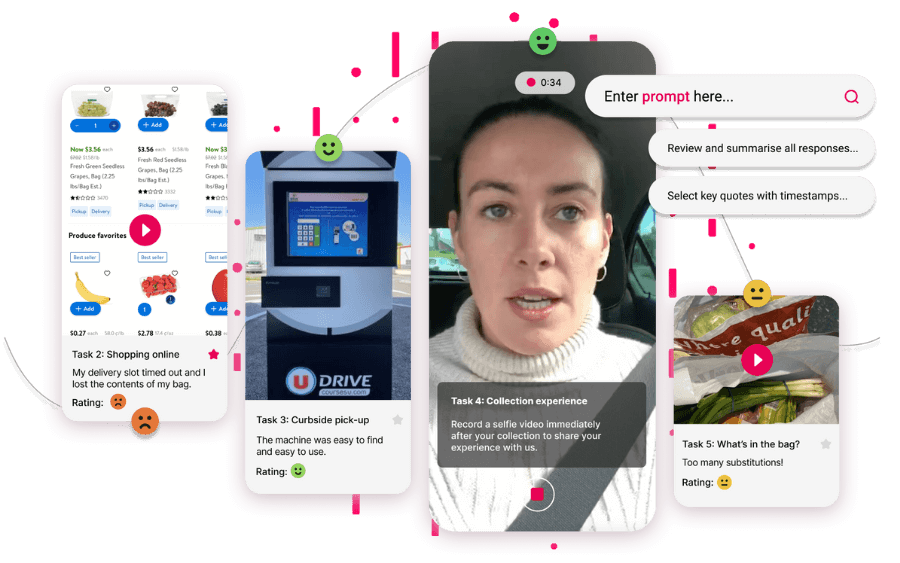
AI-powered analysis helps here. Indeemo's platform includes automated transcription and translation in 30+ languages, AI-assisted theme detection and sentiment analysis, and keyword analysis tools. What used to take weeks of manual transcription and coding can now happen in a fraction of the time.
But the most powerful output from customer closeness research isn't a report. It's video. When a product director watches a two-minute clip of a real customer struggling with the checkout flow, or a brand manager sees how a family actually uses their product at the kitchen table, that's harder to dismiss than a slide deck. You can argue with a data point. You can't argue with someone's face.
With Indeemo, you can create subtitled highlight reels in minutes and share them directly with stakeholders. This is often the fastest way to build empathy across a team and get buy-in for customer-centric decisions.
How does Indeemo support customer closeness research?
Customer closeness programmes are one of the most common ways our clients use Indeemo. Here's what that looks like in practice.
Get closer to your customers
Participants share videos, photos, screen recordings, and texts directly through the Indeemo app. You see their world from their perspective: their kitchen, their commute, their shopping trip. When a team watches a two-minute video of someone showing them around their home office, or a screen recording of a teenager navigating a new app, there's an immediate connection that no survey or analytics dashboard can replicate.
Move faster with agile research
Because Indeemo supports diary studies, mobile ethnography, path-to-purchase research, and shopper experience research on a single platform, you can shift between research methods without switching tools. Scheduled tasking means you can add new questions or activities as they arise, without waiting for the next research project to be scoped and approved.
Build understanding that compounds
Each cycle of research adds to what your team knows. The themes you spot in month one inform the questions you ask in month two. The video clips you share with stakeholders don't just answer a single question; they build a cumulative picture of who your customers are and how they live. That kind of depth doesn't come from a single project, no matter how well-designed it is.
Do you need to be a research expert to run a customer closeness programme?
No. Whether you're an experienced research team or a brand exploring qualitative research for the first time, Indeemo can support you.
Use the platform independently if you have the expertise in-house. Or partner with our Catalyst team for study design, recruitment, participant management, moderation, analysis, or the full project. If you have research ambitions but not the capacity to run the programme yourself, we can lend a helping hand as and when you need it.
Customer closeness research doesn't have to be a massive undertaking. Projects can run from a single week to several months. You can produce meaningful findings with as few as 10 participants. The important thing is getting started and building the habit of staying connected to your customers.
Frequently asked questions
What's the difference between customer closeness research and customer experience (CX) research?CX research typically focuses on specific touchpoints and interactions with your brand, often measuring satisfaction at defined stages of a journey. Customer closeness research is broader. It's about understanding your customers as people, including the context around their lives that influences how they relate to your brand. The two are complementary: customer closeness builds the empathy that makes CX improvements more informed.
How many participants do I need for a customer closeness programme?Most programmes work well with 25–50 participants total, split across your key customer segments (8–12 per segment). Because participants share rich multimedia data over time, you get more depth per person than traditional methods, so you can work with smaller samples than you might expect.
How long should a customer closeness programme run?The sweet spot is about three months per cycle. This gives you time to build rapport and observe real behaviour patterns. After three months, refresh your participant cohort and start a new cycle. Running three cycles per year is a sustainable and effective cadence.
Can I combine customer closeness research with other qualitative methods?Yes. Many teams blend diary studies with monthly in-depth interviews, use mobile ethnography as pre-tasking before focus groups, or run journey mapping alongside ongoing diary tasks. The asynchronous and synchronous methods reinforce each other.
What kinds of data do participants share?Participants capture videos, photos, screen recordings, and written responses through the Indeemo app. They record from their own environment: their home, their commute, a store, wherever the research takes them. Everything uploads automatically to a researcher dashboard for review and analysis.
Frequently asked questions
What's the difference between consumer feedback and customer feedback?
They're closely related. Customer feedback comes from people who have already bought from you or used your service. Consumer feedback is broader and includes potential customers, lapsed customers, and people in your target market who may never have interacted with your brand. In market research, the terms are often used interchangeably, but "consumer feedback" typically signals a wider scope.
How many participants do you need for a consumer feedback study?
Most video-based studies work well with 15 to 30 participants. Because video captures rich, detailed data from each person, you often need fewer participants than you'd expect. Larger programmes can involve hundreds across multiple markets.
How long does a consumer feedback project take?
It depends on the method. A focused video survey can be completed in a few days. A diary study tracking daily routines might run for one to four weeks. AI-powered transcription and analysis have shortened the back-end significantly, so you can go from fieldwork to insight much faster than traditional methods allow.
Can you use video feedback alongside surveys and focus groups?
Yes. Many research teams use video diary tasks as pre-work before focus groups or interviews. Participants arrive having already reflected on the topic, and moderators have real-world video to reference during the discussion. Video feedback also works well as a follow-up after a quantitative study, adding depth and context to the numbers.
What devices do participants need?
A smartphone with a camera and a reasonable internet connection. Participants download the Indeemo app and complete tasks by recording video, taking photos, capturing screen recordings, or writing text responses. The app works on both iOS and Android.