

Key takeaways
- A long-term panel is a recruited group of participants who agree to take part in research over weeks, months, or years. The same people, returned to again and again.
- The value is longitudinal: you see how behaviour, perception, and preference change over time, not just where they sit on a single day.
- Long-term panels reduce sample bias, lower per-study recruitment costs, and let you mobilise new studies in days rather than weeks.
- Two complementary approaches work well together: always-on (continuous data collection) and micro studies (short, focused bursts with a subset of the panel).
- With Indeemo, you can recruit panellists from a global panel of 3 million+ participants, run studies in 30+ languages, capture videos, photos, screen recordings, and texts, and analyse responses with AI.
What is a long-term panel?
A long-term panel is a group of participants who agree to take part in research studies over an extended period. Rather than recruiting a fresh sample for every project, you go back to the same people again and again, building a body of insight that compounds over time.
These participants share information about their demographics, lifestyles, attitudes, and behaviours across multiple studies. That continuity lets researchers track trends, spot patterns, and see how consumer preferences shift over time.
"Long-term" is flexible by design. Some panels run for a few weeks across a focused programme of work. Others run for months as part of an ongoing tracker. Some are kept warm for years, with studies dipping in as questions arise.
Why do long-term panels work?
The short answer: continuity. When the same participants share data over time, you see things a one-off study can't show. Change, drift, inflection points, the why behind shifting numbers.
Beyond that, long-term panels offer five practical advantages.
Longitudinal data
The headline benefit. You can observe how consumer behaviour changes over time, in response to market trends, product launches, or external events. That makes long-term panels well suited to studying the lasting effect of marketing campaigns, product changes, or category shifts that play out over weeks or months rather than days.
Reduced sample bias
A pre-recruited and engaged panel cuts the sample bias that often comes with one-off studies. Panellists are already invested in the research process, which tends to lift response rates and the reliability of the data. Research summarised by the University of Connecticut's Neag School of Education puts online survey response rates anywhere from 2% to 30%, with pre-recruited participants tending to fall at the higher end of that range.
Faster turnaround
When a question comes up that needs answering quickly, the panel is already there. No screener, no recruitment lead time, no waiting for the agency to come back with sample. You can mobilise a study in days rather than weeks.
Cost-effectiveness
Setting up a long-term panel takes an upfront investment in recruitment and screening, but the cost amortises across every study you run with that panel. The more studies you run, the lower the per-study recruitment cost. Industry publication Greenbook reports that long-term panels make ad-hoc qualitative work cheaper too. Once participants are profiled and engaged, scheduling them for additional studies costs significantly less than recruiting from scratch each time.
Deeper insight
Over time, you build a real understanding of panellists' preferences, motivations, and decision-making. That goes beyond what a single study can show. You start seeing the why behind the behaviour, not just the what.
What are the most common use cases?
Long-term panels are flexible by design. Five of the most common applications:
Brand and category tracking
How perception of your brand or category shifts over time. What people associate with you in Q1 versus Q4. How a campaign has registered, faded, or stuck.
Product usage over time
How participants actually use a product across weeks or months. What changes as the novelty wears off. Where friction shows up. What they tell their friends about it after three months that they didn't say after three days.
Customer journey research
Tracking real touchpoints across a customer's experience, from awareness through purchase to renewal. You see the journey as it happens rather than asking participants to reconstruct it from memory later. Long-term panels are particularly suited to customer journey mapping projects that play out over weeks or months.
Healthcare and patient experience
Patient journeys, treatment experiences, and adherence behaviours over the natural course of a condition. What happens at home, between clinic visits, where a lot of the real story sits.
Innovation and concept testing
Returning to the same panel to test concepts, packaging, and prototypes through development. Faster feedback, no re-recruitment, and a panel that knows your category well enough to give grounded reactions.
What's the difference between always-on and micro studies?
Always-on and micro studies are two ways of working with a long-term panel. They're different in shape, but most teams who run panels well use both at the same time.
Always-on research
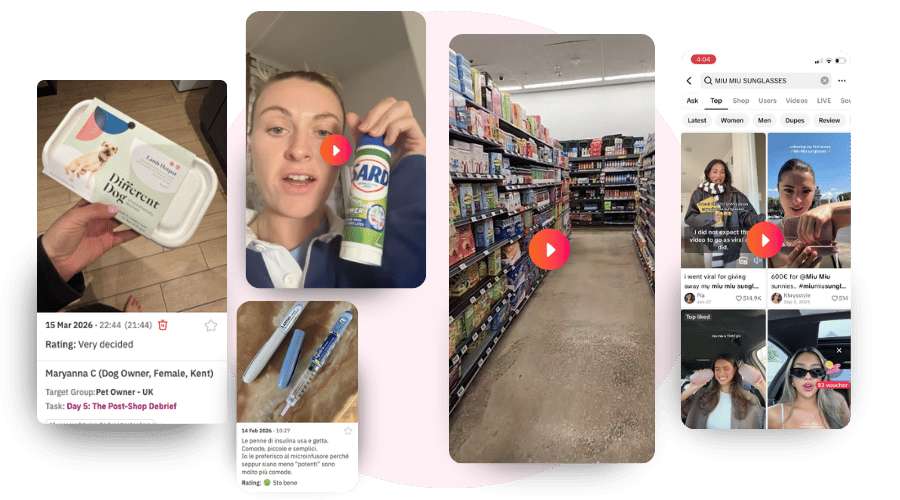
Always-on research keeps a steady flow of data coming in. Participants complete short, regular tasks: a video about their morning coffee routine each Monday, a photo of what they're shopping for this weekend, a quick reaction to a piece of news. The output is a constant read on what's happening, which means you spot changes as they happen rather than three months after the fact. The mechanics are similar to running an ongoing diary study, just stretched across a permanent panel rather than a single project.
Micro studies
Micro studies are the opposite shape. You pick a subset of the panel, design 3 to 5 focused tasks, and get usable findings in a few days. Useful when something specific has come up and you need a fast read: a competitor launch, a packaging tweak, a piece of feedback you want to dig into.
Many panels run both at the same time. The always-on track gives you the trend line, and micro studies let you investigate specific moments along it.
How does Indeemo support long-term panel research?
Indeemo is an end-to-end qualitative research platform built for in-the-moment data collection. For long-term panel research, you can recruit panellists from a global panel of 3 million+ participants, run studies in 30+ languages, capture videos, photos, screen recordings, and texts from across the panel, and analyse responses with AI. All from one platform.
A few capabilities that work particularly well for long-term panels:
Multimedia capture in context
Panellists share videos, photos, screen recordings, and texts from wherever they are. At home, in store, mid-purchase. You see behaviour as it happens rather than a recalled version of it days later. This is the foundation of mobile ethnography research, and it works just as well across a long-term panel as a single study.
A familiar mobile experience
The Indeemo app uses social-networking-style UX that participants already know how to use. That matters more than it sounds. Lower friction means higher completion rates, especially over long programmes where engagement can otherwise drop off.
Flexible tasking for always-on and micro studies
Tasks can be sent all at once, sequentially, or scheduled for specific times. The same panel can be running a continuous brand tracker while a subset works through a one-week micro study on a new concept. You're not picking one approach over the other. You're running both at once.
AI-powered analysis
Generative AI helps you transcribe, translate, summarise, and detect themes across submissions. Indeemo's AI reduces analysis time by at least 40%, which matters most for long-term panels where the data accumulates fast.
Subtitled highlight reels
Pull short, subtitled reels from across the panel to share findings with stakeholders. Real participants in their own words tend to land harder than a slide deck. Useful when you're trying to keep a long-running panel front of mind across the business.
Do you need to be a research expert to run a long-term panel?
No. Whether you're an experienced qualitative researcher or a brand team exploring consumer panels for the first time, Indeemo can support you.
Use the platform independently if you have the expertise in-house. Or partner with our Catalyst team for panel design, recruitment, moderation, analysis, or the full project. If you have research ambitions but not the capacity to fulfil them, we can lend a helping hand as and when you need it.
We've supported thousands of research projects covering everything from mapping the path to purchase for aquarium filters to mortgage buyer journeys to mapping the patient journey of kidney transplant patients.
Frequently asked questions
How long does a long-term panel typically run?
It varies. Some panels run for a few weeks across a focused programme of work. Others run for months as ongoing trackers, and some run for years with studies dipping in as questions arise. The length depends on the research objectives, not a fixed rule.
How is a long-term panel different from a one-off study?
A one-off study recruits a fresh sample for a single project. A long-term panel returns to the same recruited participants across multiple studies. Because you're tracking the same people, you see how their behaviour evolves rather than just a single point on the curve.
How do you keep panellists engaged over the long term?
Task variety, fair incentives, and a light touch on frequency. A common reason engagement drops is over-tasking: asking too much, too often. A well-run panel mixes short check-ins with deeper studies and gives participants enough breathing room between them.
Should I run an always-on programme or micro studies?
Both, usually. Always-on gives you the trend line. Micro studies let you investigate specific moments along it. Most teams use the two together rather than picking one.
How many panellists do I need?
It depends on the research design. Some panels run with 30 to 50 participants for in-depth qualitative work. Others run with several hundred for broader tracking. Smaller and deeper, or larger and lighter, both work, depending on what you need to learn.