
Key takeaways
- Asynchronous qualitative research is a method where participants share videos, photos, screen recordings, and texts on their own time, over days or weeks, using a smartphone app or online platform. There's no scheduled session and no researcher in the room.
- Because everything is captured in the moment, you avoid the recall bias that comes with asking people to remember what they did or felt days later. You see real behaviour, not a polished retelling of it.
- The main async methods are mobile ethnography, diary studies, and pre-tasking before interviews or focus groups. Each captures rich, contextual data that synchronous methods on their own can miss.
- Async research scales easily across markets and time zones, costs less than facility-based research, and opens participation to people who couldn't attend a scheduled session.
- With Indeemo, you can recruit from a global panel, run studies in 30+ languages, analyse responses in minutes with AI, and create subtitled highlight reels for stakeholders.
What is asynchronous qualitative research?
Asynchronous qualitative research is a method where participants share their experiences, behaviours, and feelings on their own schedule rather than in a live session. Instead of gathering everyone in a room (or on a Zoom call) at the same time, you give participants tasks to complete over days or weeks using a smartphone app or online platform. They respond when the moment is right for them.
It's a longitudinal approach. Where a traditional interview gives you a two-hour window into someone's life, an async study gives you daily insight over five, ten, or even twenty days. You still gather hours of feedback from each participant, but it's spread across real moments rather than compressed into a single conversation.
Three things make it work:
- Participant-led. The research fits around people's lives, not the researcher's calendar. Participants share when they're actually experiencing something relevant, not when they're scheduled to talk about it.
- In-the-moment. Responses are recorded as things happen, before memory reshapes them. A video of someone unpacking a product at their kitchen table is very different from that same person recalling the experience a week later in a discussion room.
- Tech-enabled. Smartphones and research platforms make it practical. Participants record videos, take photos, write text entries, or capture screen recordings. Everything uploads automatically for the researcher to review.
How does asynchronous research differ from synchronous research?
The core difference is who controls the timing. In synchronous research (focus groups, in-depth interviews, live Zoom sessions), everyone is present at the same time and the researcher leads the conversation. In asynchronous research, participants contribute when it suits them, and the researcher reviews and probes on their own schedule too.
Synchronous methods have real strengths. They let you read body language, follow up in real time, and create group dynamics that can spark unexpected ideas. But they also come with constraints that many researchers find limiting:
- Scheduling is difficult, especially across time zones
- Poor internet connections disrupt online sessions
- You get a narrow window of time with each participant
- Group settings can be dominated by one or two confident voices
- It's a single-context method: you hear what people say about their behaviour, but you don't see it
- You have to rely on claimed behaviour and recalled experience
Asynchronous methods flip most of these constraints. Participants respond in their own environment, on their own time, without an observer present. The data you get back tends to be more honest and more grounded in real life.
What are the benefits of asynchronous qualitative research?
The short answer: you see what people really do, as they do it, before memory has a chance to tidy it up. But the benefits go further than that.
In-the-moment capture and reduced recall bias
With a mobile research app, participants record their videos, photos, or text entries in real time. Everything they share is contextual and in-the-moment. When someone records a video while trying a new skincare product at their bathroom mirror, you're seeing their actual reaction, not a polished account of it two weeks later in a group discussion.
Memory is unreliable, and we all post-rationalise what we do. Research consistently shows just how far self-report can drift from reality. A study published in the New England Journal of Medicine found that participants underreported their food intake by an average of 47% compared to objective measurements. Another study in Public Health Nutrition found that dietary recall accuracy dropped from 68% on day one to just 55% by day three. The pattern holds across domains: the longer people wait to report what they did, the less accurate the account becomes. Async research bypasses that entirely by recording behaviour as it happens.
No observer or group bias
Because the researcher isn't in the room, participants aren't exposed to external influences that might affect their thoughts, behaviour, or honesty. There's no moderator steering the conversation. No other participants to perform for. No two-way mirror.
This matters for sensitive topics especially. Health behaviours, financial habits, personal care routines: people are more candid when they're alone in their own space with only a phone in their hand.
Richer behavioural patterns over time
The extended time frame of an async study lets you observe patterns and spontaneous behaviours that participants aren't even aware of themselves. A participant might unconsciously pick up a snack every time they buy their morning coffee. That's not something they'd ever mention in a focus group because they don't know they're doing it. But over a week of daily video entries, the pattern becomes clear.
This is what gets you beyond claimed behaviour. You stop relying on what people tell you they do and start observing what they actually do.
Scalability and global reach
Without the constraints of scheduling and travel, you can run studies with larger groups across more locations. Fifty participants across five countries is straightforward. You can engage people who would be difficult to recruit for a facility-based session: shift workers, rural populations, time-poor professionals, parents with young children.
With Indeemo, you can recruit from a global panel and run studies in 30+ languages. Automated transcription and translation mean your team can start reviewing responses across markets almost immediately.
Cost and time efficiency
No facility hire. No travel. No catering. Async studies cost less to run and compress timelines because data arrives continuously. You can start analysis while fieldwork is still ongoing, rather than waiting until all sessions are complete.
This matters for teams under pressure to move quickly. If your product launch is in six weeks and you need consumer feedback, an async diary study can be in the field within days.
What are the main asynchronous qualitative research methods?
Several research methods fall under the asynchronous umbrella. They share the same principle (participants contribute on their own time, in their own environment) but differ in structure and purpose.
Mobile ethnography
Mobile ethnography uses smartphones to document real-world behaviour over time. Participants record short videos, take photos, or write text entries as they go about their daily lives. The researcher sets tasks ("Show us your morning routine" or "Record yourself the next time you visit the pharmacy") and participants respond when the moment happens.
It's the closest thing to being in someone's home, shop, or commute without physically being there. You see the context, not just the words.
Diary studies
Diary studies ask participants to document their experiences, routines, or habits over a set period, typically five days to four weeks. They're particularly useful for understanding behaviour that unfolds over time: how someone adapts to a new product, how a patient manages a treatment regimen, how a consumer's shopping habits shift across a month.
Each entry builds on the last, giving you a longitudinal view that a single interview can't provide.
Pre-tasking before interviews and focus groups
Pre-tasking is where asynchronous and synchronous methods work together. You send participants mobile diary tasks to complete before a focus group or in-depth interview. They arrive having already reflected on the topic. You have real-world video and context to reference during the live discussion.
The difference is noticeable. Rather than spending the first 20 minutes of an interview getting participants to recall their experiences, you can start with the rich context they've already shared and go deeper from there. Many research teams find that pre-tasking doesn't just supplement their live sessions but changes them entirely.
Online communities and discussion boards
Online research communities create private spaces where participants share thoughts, complete activities, and respond to prompts over days or weeks. Moderators can adapt questions as themes emerge. This approach works well for extended engagement and sensitive topics where trust builds over time.
Unlike mobile ethnography and diary studies, online communities are typically text-based and group-oriented rather than individual and multimedia-rich. Both approaches have their place depending on the research design.
When should you use asynchronous vs synchronous research?
Neither approach is inherently better. The right choice depends on what you need to learn and how behaviour unfolds.
In practice, a lot of research designs combine both. An async phase captures real-world behaviour and context. A follow-up sync session digs deeper into the patterns and themes that emerge. The async data gives the moderator something concrete to work with rather than starting from a blank slate.
Online qualitative research doesn't have to be one or the other. The question is which combination fits your research question and your timeline.
How do you run an asynchronous qualitative research study?
Here's what a typical async study looks like from setup to analysis.
Design your tasks
Start with your research questions and work backwards. What do you need participants to show you or tell you about? Write short, conversational prompts that are easy to read on a phone screen. Avoid long instructions or formal language. You're asking someone to share a slice of their life, so the tone should feel more like a message from a friend than a questionnaire from a research department.
Tasks instruct participants to upload videos, photos, screen recordings, or text entries. You can also embed images or video stimuli for concept testing.
There are three ways to structure when participants receive their tasks:
Recruit your participants
Recruitment follows standard qualitative practices. Screen for the right people, set clear expectations about what they'll need to do and for how long, and offer appropriate incentives. With Indeemo, you can also recruit from a global panel of 3 million+ participants, which is especially useful for multi-market studies or hard-to-reach audiences.
Launch and moderate
Once participants download the app and you activate the project, responses start arriving on your researcher dashboard. You can see uploads as they come in, comment on individual entries to ask follow-up questions, and send push notification reminders to encourage completion.
The one-to-one format of the interaction (private, between researcher and participant, similar to a social media messaging thread) encourages people to share additional context and emotion. People tend to open up more when they're not performing in front of a group, which is particularly valuable for sensitive topics like health, finances, or personal care.
Capture screen recordings
For studies that involve online behaviour, Indeemo's screen recording capability lets participants record their phone or computer screen with a voice-over. You can watch exactly how someone navigates a website, app, or checkout flow while hearing what they're thinking. This is especially useful for path-to-purchase research, UX discovery, and journey mapping.
Analyse with AI
Once responses start coming in, AI handles a lot of the heavy lifting on analysis. Indeemo's platform includes automated video transcription and translation in 30+ languages, AI-assisted theme detection and sentiment analysis, keyword analysis and keyword cloud for spotting patterns across participants, and tools for creating subtitled highlight reels you can share directly with stakeholders.
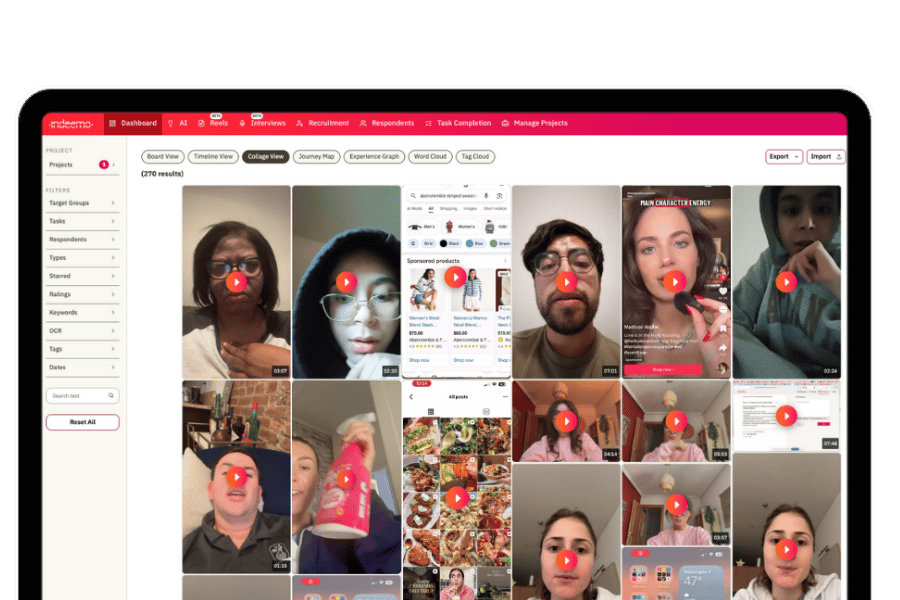
The dashboard's visual layout lets you quickly spot patterns across many participants. From the language people use to describe an experience to what elements draw them in, you can identify themes without manually coding every response.
Do you need to be a research expert to run an async study?
No. Whether you're an experienced research agency, a brand team exploring qualitative research for the first time, or an academic researcher, Indeemo can support you at whatever level you need.
Use the platform independently if you have the expertise in-house. Or partner with our Catalyst team for study design, recruitment, moderation, analysis, or the full project end to end. If you have research ambitions but not the capacity or expertise to run them yourself, we can lend a helping hand.
We've supported thousands of research projects, from consumer diary studies to healthcare patient journeys. Indeemo can be more than a platform. It can be a partnership.
FAQs about Mobile Ethnography
Synchronous research happens in real time: everyone is present at the same time for a focus group, interview, or discussion. Asynchronous research lets participants contribute on their own schedule over days or weeks, using a smartphone app or online platform. Async captures behaviour in the moment and in context, while sync is better for live conversation and group interaction.
It can work as a standalone method or alongside focus groups. Many teams use async diary tasks or mobile ethnography as pre-work before a live discussion, giving participants time to reflect and giving moderators richer material to reference. For some research questions, particularly those focused on real-world behaviour over time, async methods may be all you need.
Most studies work well with 15 to 30 participants. Because async methods capture rich, detailed data from each person over multiple days, you often need fewer participants than you'd expect. Larger programmes can involve 50 to 200+ participants across multiple markets.
A smartphone with a camera and a reasonable internet connection. The Indeemo app works on both iOS and Android. Participants can also use screen recording on tablets and iPads.