

Key takeaways
- The consumer purchase journey is the complete path someone takes from first becoming aware of a need to making a purchase and beyond. It's rarely linear, people move between online and offline channels, compare options across platforms, and make decisions over days or weeks.
- Traditional research methods like interviews, focus groups, and analytics each capture only part of this journey. Interviews rely on recall. Analytics show what people did but not why. In-person observation catches a single moment in a multi-touchpoint process.
- Mobile ethnography fills the gap by letting participants document their real purchase journey as it happens, using videos, photos, screen recordings, and texts from their smartphone.
- Understanding the full path to purchase helps brands identify pain points, optimise touchpoints, and improve conversion across every channel.
- With Indeemo, you can recruit participants from a global panel, run studies in 30+ languages, analyse responses in minutes with AI, and create subtitled highlight reels for stakeholders.
What is the consumer purchase journey?
The consumer purchase journey is the complete path a person takes from the moment they recognise a need or desire through to making a purchase, and the experience that follows. It includes every touchpoint, every channel, and every decision along the way.
The term "omnichannel" describes how this journey actually plays out. People don't stick to one channel. They move between search engines, social media, review sites, physical stores, e-commerce platforms, and messaging apps, often within the same purchase decision. A person might discover a product on Instagram, read reviews on Google, visit a store to try it, then buy it from a competitor's website because the delivery was faster. That's one journey among thousands of possible variations.
The purchase journey is where brands win or lose customers. Every touchpoint either builds confidence or creates friction. If you don't understand the full journey, you're optimising blind.
A purchase journey in practice
Consider someone buying a new mattress. They wake up with a sore back and decide it's time. They do a quick Google search to learn about brands and styles. They narrow options based on budget, features, and delivery. While browsing a brand's website, they accept cookies. Soon they're seeing mattress ads in their social media feeds.
They compare options on their laptop, read third-party reviews, and ask a friend for a recommendation via WhatsApp. Because a mattress is a high-consideration purchase, they visit a local store to test their top choice. But the in-store experience is underwhelming, limited stock, no convenient delivery, so they go back online. They're swayed by five-star reviews and next-day delivery from an online-first brand. They order, it arrives, and the old mattress goes out.
That's one scenario. With so many platforms and channels accessible at any moment, the number of possible paths is enormous. And every one of them involves decisions that brands need to understand.
Why has the purchase journey become so complex?
Because digital put the internet in shoppers' hands. Smartphones mean people can search on the move, compare products while standing in a store, and buy from a competitor without leaving the aisle. Where someone shops no longer dictates where they buy.
This shift has been accelerating for years. E-commerce was growing steadily before 2020, and the move to online-first shopping habits only sped things up. Global e-commerce sales reached $6.4 trillion in 2025 and are projected to hit $6.9 trillion in 2026, accounting for over 21% of all retail (Shopify/eMarketer, 2026). Mobile devices now account for 59% of all e-commerce transactions worldwide, and 78% of retail website traffic comes from smartphones.
Social platforms have added another layer. TikTok, Instagram, and YouTube are now discovery and shopping channels in their own right. US social commerce sales reached $87 billion in 2025 and are projected to surpass $100 billion in 2026 (eMarketer). Over half of Gen Z and millennial shoppers completed a purchase through a social platform in 2025, and TikTok Shop alone now commands nearly 20% of US social commerce.
The result is what researchers call the omnichannel purchase journey: a non-linear, multi-platform process where the same buyer weaves in and out of online and offline channels, often over days or weeks. For brands, this creates a problem. Many still operate their digital and physical channels as separate divisions, serving the same customer through disconnected experiences. The buyer moves freely between platforms. The brand treats them as two different people.
What are the stages of the purchase journey?
The purchase journey is often described in stages, though in practice people don't move through them neatly. They jump back and forth, skip stages entirely, or spend weeks in one before moving on. Still, the framework is useful for understanding what's happening at each point and what researchers need to capture.
Each of these stages can play out across multiple channels and platforms. A person might become aware of a product through a TikTok ad, consider it by reading blog reviews, evaluate it in-store, and purchase it from a different retailer's app. Understanding what happens at each stage, and across which channels, is what path-to-purchase research is designed to uncover.
Why do traditional research methods miss most of the journey?
Because the journey happens across too many channels, over too much time, for any single traditional method to capture it whole. Three common approaches each have the same fundamental limitation: they only see part of the picture.
Interviews rely on recall
A face-to-face interview can establish a customer's motivations, but it relies on memory. People forget how they first came across a product, which sites they visited, and at what point they decided to buy from one brand over another. Research by the US Bureau of Labor Statistics found that reported recall of purchases dropped by 47% when people were asked to remember over a 12-month period compared to a 3-month window. We're all remarkably good at constructing logical narratives after the fact. The real sequence of events, the impulse clicks, the ads that caught their eye while scrolling at midnight, gets smoothed over or forgotten entirely.
That's a particular problem when you consider the scale of what needs to be remembered. Google research found that the average purchase journey involves between 20 and 500+ touchpoints depending on the product category. Asking someone to accurately recall that many interactions in a post-purchase interview is asking the impossible.
Analytics show what, not why
Web analytics and point-of-sale data can tell you where shoppers came from, what pages they visited, how long they stayed, and when they converted or churned. That's valuable. But analytics can't explain why someone abandoned their cart, why they spent ten minutes on a competitor's site before coming back, or what they were feeling when they decided to visit a physical store instead of buying online. You see the behaviour. You don't see the human behind it.
Research from the Baymard Institute has consistently found that average online cart abandonment rates hover around 70%. Analytics can tell you that people are leaving. They can't tell you the moment of hesitation, the comparison that changed their mind, or the frustration that tipped them over the edge.
In-person methods capture a single moment
Accompanied shop-alongs, in-store observation, and usability labs give you a detailed view of one interaction. But that interaction is just one touchpoint in a journey that might span weeks and dozens of channels. What you observe in-store or in a lab represents a snapshot, and people behave differently when someone is watching. The researcher effect changes the dynamic, even with the best intentions.
Mapping the full online and offline path to purchase into a single, coherent timeline is difficult to achieve using any of these methods alone.
"Where you shop no longer dictates where you buy." - Eugene Murphy, Founder & CEO, Indeemo
How does mobile ethnography help you research the purchase journey?
Mobile ethnography puts the research tool in the participant's hands. Instead of asking people to remember their journey after the fact, or observing a single moment in a lab, you follow them through the real thing as it happens.
Participants download a smartphone app and complete tasks by recording videos, taking photos, capturing screen recordings, and writing texts at each stage of their purchase journey. Every upload goes straight to a researcher dashboard, where you can observe, comment, probe for context, and analyse in real time.
The result is research that captures the journey as it actually happens. There's no recall gap because participants record in the moment. You hear the why because they narrate as they go. And you see the full journey across channels, because the smartphone goes wherever the shopper goes.
Screen recording is particularly useful for purchase journey research. You see exactly how someone navigates a website or app, what content they engage with, what makes them hesitate, and what they tap on, while hearing their voice explaining what they're thinking. It's the closest you can get to sitting next to someone while they shop, without actually being there.
How mobile ethnography compares to traditional approaches
What does a path-to-purchase study look like in practice?
Why run a P2P study?
Brands and research teams commission path-to-purchase studies for different reasons, but they tend to fall into a few common categories:
You don't fully understand your customer's journey. If you haven't walked in their shoes (or watched them walk through it on video), you're working from assumptions. A P2P study shows you the real journey: which channels matter, where people get stuck, and what influences their decisions.
You need to find pain points and drop-off points. Cart abandonment, channel-switching, and purchase delays all have causes. A P2P study reveals the specific moments where friction occurs, so you can fix the right things.
You're optimising for omnichannel. If your online and in-store experiences feel disconnected to customers, a P2P study shows you exactly where the joins break down. You see how the same person moves between your channels and where the experience falls apart.
You want to understand what influences decisions. Social media, reviews, word of mouth, in-store displays, price comparison sites. A P2P study captures which of these actually matter to your customers and when they come into play.
How a study works
Path-to-purchase studies on Indeemo are task-based. Participants receive tasks through the app and respond by uploading videos, photos, screen recordings, and text at each relevant stage of their journey. You can design tasks to capture specific moments (e.g. "record a video next time you're comparing products online") or leave them open-ended (e.g. "document every step of your journey to buying [product]").
Three tasking approaches are available:
An in-built journey mapping feature lets participants rate their experience on a scale at every touchpoint. This gives you a visual map of highs and lows across the journey, alongside the rich qualitative data from their uploads.
What you get out of it
Here's what a P2P study typically produces:
- In-the-moment videos and photos from every stage of the journey, online and offline
- Screen recordings with voice narration showing exactly how participants browse, compare, and buy
- An interactive purchase journey map with experience ratings at each touchpoint
- AI-generated transcriptions, theme analysis, and sentiment analysis across all submissions
- Subtitled highlight reels you can share with stakeholders to bring the journey to life
What industries use path-to-purchase research?
Path-to-purchase research applies to any industry where people make buying decisions. Indeemo has supported P2P studies across many sectors. Here are some of the most common.
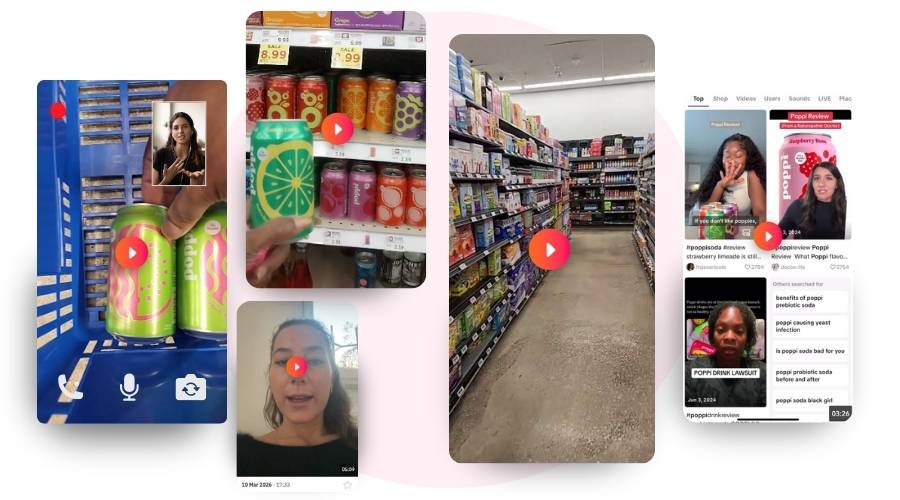
Retail and FMCG. Follow shoppers from the first trigger through to the shelf (or the checkout page). See how they compare brands, respond to promotions, and make split-second decisions at the point of purchase. Screen recording captures their online browsing; video captures the in-store moment.
Automotive. Car buying involves weeks or months of research. Participants document their journey from the initial search through online configurators, dealer visits, test drives, and the final purchase. Indeemo's all-at-once tasking works well here, letting participants report touchpoints as they happen over an extended period.
Financial services and insurance. Insurance is a high-consideration, high-complexity purchase. Mobile screen recording shows exactly how customers navigate comparison sites, read policy documents, and evaluate providers online, while narrating what they find confusing or reassuring.
Travel and hospitality. From the moment someone starts dreaming about a trip to the post-stay review, the travel purchase journey spans dozens of touchpoints. P2P studies capture how travellers research destinations, compare booking platforms, and document their experiences along the way.
E-commerce and direct-to-consumer. For online-first brands, understanding the digital purchase journey is everything. Screen recording reveals how shoppers navigate your site, what content they engage with, and where they drop off.
Healthcare. Patients and caregivers make purchasing decisions about treatments, insurance, devices, and wellness products. These journeys involve difficult decisions, long timescales, and real anxiety. Mobile ethnography captures the experience at home, at the pharmacy, or during daily routines, without requiring people to travel to a research facility.
How does Indeemo support purchase journey research?
Indeemo is an end-to-end qualitative research platform. For purchase journey studies, you can do everything in one place: recruit participants, run the fieldwork, analyse the data, and create outputs for stakeholders.
Recruit from a global panel of 3 million+ participants, or bring your own. Get the right shoppers for your study without the usual recruitment delays.
Research in 30+ languages. Run multi-country P2P studies from a single dashboard, with automated transcription and translation so your team can start reviewing submissions almost immediately.
Analyse in minutes with AI. Generative AI helps you surface themes, detect sentiment, and identify patterns across all your video and text submissions, cutting analysis time so you can spend more of it understanding what people are actually telling you.
Create subtitled highlight reels for stakeholders. A product team reading a slide about cart abandonment is one thing. Watching a real customer hesitate at checkout, switch to a competitor, and explain why on camera is something else entirely. Highlight reels turn research data into something people remember.
The platform also includes:
- Mobile screen recording with voice narration for capturing online journeys
- Journey mapping tools that convert participant experiences into interactive, multimedia journey maps
- Experience rating at every touchpoint, so you can see the highs and lows at a glance
- A dashboard that aggregates all uploads across participants, markets, and channels in one place
- Keyword analysis and tagging for organising and synthesising data across journeys
Do you need to be a research expert to run a purchase journey study?
No. Whether you're an experienced researcher or a brand team exploring path-to-purchase research for the first time, Indeemo can support you.
Use the platform independently if you have the expertise in-house. Or partner with our Catalyst team for study design, recruitment, moderation, analysis, or the full project. If you have research ambitions but not the capacity or expertise to run the study yourself, we can lend a helping hand as and when you need it.
The app uses a social-networking-style interface that participants already know how to use. AI handles the heavy lifting on transcription, translation, and analysis. And our team is there if you need us.
Indeemo can be a platform when you want independence, and a partner when you don't.
FAQs about Mobile Ethnography
Path to purchase focuses specifically on the buying journey, from the initial trigger through to the transaction. Customer journey mapping is broader and can cover the entire relationship with a brand, including post-purchase experiences, support interactions, and loyalty. In practice, the two overlap significantly, and Indeemo supports both.
Most P2P studies work well with 15 to 30 participants, though larger programmes can involve more. Because mobile ethnography captures rich data from each participant over time (videos, photos, screen recordings at every touchpoint), you often need fewer people than you'd expect. If you're studying multiple segments or markets, you'll want enough participants in each to see meaningful patterns.
It depends on the purchase cycle. A study on grocery or food delivery purchases might run for a few days. A study on car buying, insurance, or home furnishings might run for several weeks. The study should match the natural timeline of the decision you're researching.
Yes. That's one of the main advantages of mobile ethnography for P2P research. Participants use video and photos to capture offline moments (in-store visits, conversations, product interactions) and screen recording to capture online moments (browsing, comparing, purchasing). Everything appears in a single timeline on the researcher dashboard.
A smartphone with a camera and a reasonable internet connection. The Indeemo app works on both iOS and Android. Participants can also use screen recording on tablets and iPads.