Key Takeaways
- A patient diary study asks patients to document their own condition in their own home, over days or weeks, using videos, photos, screen recordings, and texts from a phone.
- In a recent asthma study, four patients aged 70 to 76 filed over 200 videos, photos, and written entries in a single week. Half of it was video, a quarter was free text. It was a seamless week for this age demographic.
- Self-documentation surfaces context that no discussion guide would think to ask for: where medication is kept and why, which household objects belong in an asthma tool kit, which of a friend's perfumes will end a visit early.
- Four patients said, without being asked, that the act of journaling changed what they noticed about their own health. One confirmed three weeks after fieldwork closed that the change had stuck.
- Journaling changes what patients pay attention to. That makes a diary strong for behaviour and context work, and it means any measurement belongs in short bracketed instruments at each end rather than in the diary itself.
What is a patient diary study?
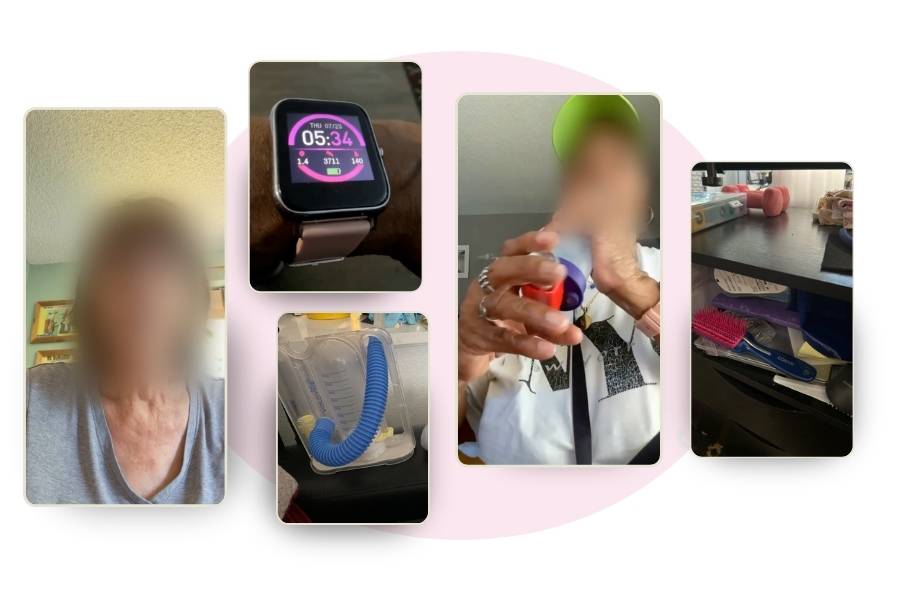
A patient diary study asks patients to document their own experience of a condition, in their own environment, over a period of days or weeks. They record videos, take photos, capture screen recordings, and write notes on their phone. Researchers watch it arrive on a dashboard, ask follow-up questions in the thread, and analyse it as it comes in.
The difference from an interview is not just the setting. In an interview, a patient answers the questions you thought to ask, in the order you thought to ask them, from memory, in a mood created partly by being interviewed. In a diary study, the patient decides what matters enough to film, and films it while it is happening. You get the tight chest at seven in the morning rather than a description of it, given calmly, ten days later.
The difference from a patient-reported outcome questionnaire is depth. A PRO instrument tells you a symptom score moved. A diary tells you the score moved because the neighbour was cutting grass, the weed killer went down the day before, and the patient had already decided not to mention it to her pulmonologist because she wheezes most of the time anyway.
Why does self-documentation reach things an interview never gets to?
Because patients film what an interviewer would never think to ask about, and they film it in the room where it happens.
Everything that follows comes from a week-long asthma diary study our Catalyst team ran earlier this year alongside a global healthcare research partner. Nine patients took part across two segments: four English-speaking patients aged over 70, and five Spanish-speaking patients aged 20 to 50. Day 0 covered consent and baseline. A daily journal then ran for seven days, open from 08:00 to 23:00 in each patient's local time, with five deeper "spotlight" tasks layered over specific days. Between them, nine patients produced 404 responses in a week.
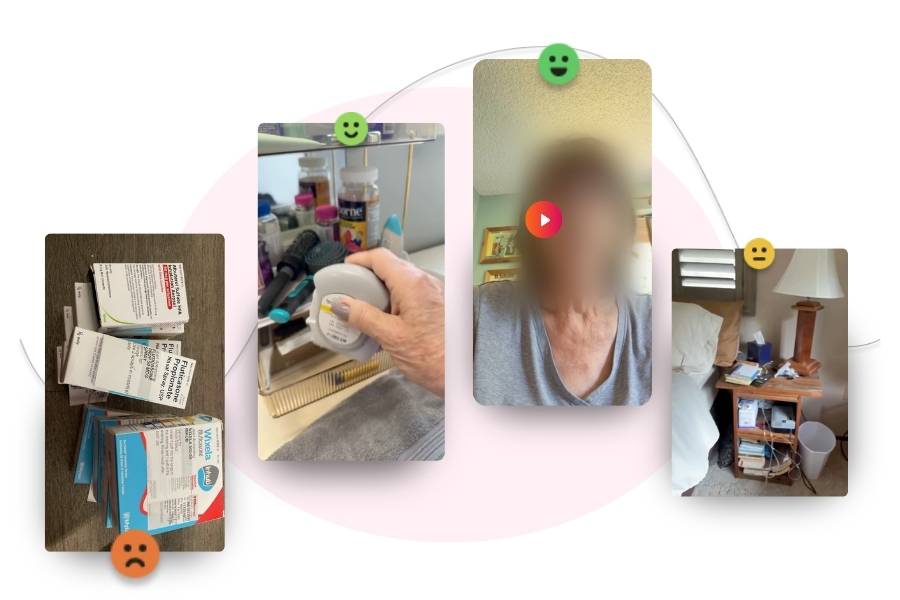
One patient gave a tour of her home and opened the cabinet under her bathroom sink. Inside was a black bag holding every medication refill and spare inhaler she owns. She explained the reason it lives there: if she is ever too ill to explain herself, she can tell whoever is with her that it is in the black bag under the sink. That is not a symptom, a preference, or an attitude. It is a piece of household infrastructure built around a fear, and it exists in a lot of homes.
Asked to show the tools that matter most for managing her asthma, the same patient picked up a cat brush first. Not an inhaler. A cat brush, because dander is the trigger she can actually control, and because the cheapest object in the house was doing more work than anything with a prescription attached.
Another patient described her reordering system. She receives inhalers in 90 day supplies and opens them one at a time, and the moment she opens the last 30 day inhaler she orders the next 90 days. She has run that system for years without ever being asked about it. In the same recording she raised what would actually improve her life, in order: a lower price, and a pill that did what the inhaler does.
A third patient answered a question about social life one day, then came back the next day unprompted to finish her answer. She had remembered the part that mattered. It is difficult to tell friends that their perfume will end the visit, and there are two scents she cannot be near at all. She named them.
A fourth filmed the commercial plant nursery that runs the length of the property outside her living room window, to explain why she keeps that window shut, and why Thursdays are worse. Later in the week she filmed herself blowing into a peak flow meter and reading the numbers out, then filmed the moment she realised she had picked up the meter instead of the medication she had left at home.
None of that came from a question. It came from handing someone the camera for seven days. Patients also proved willing to film the parts that are not tidy. One home tour opened with the patient saying it was embarrassing, but honest.
What happens to a patient who journals their own condition for a week?
They start paying attention. This was the clearest pattern in the study and none of it was prompted.
On day 4, one patient opened her journal and wrote a note that began by stepping outside the task entirely.
"One thing that participating in this study is doing is making me think more about my asthma." Patient, 76
She said it again on camera the following day, wondering aloud whether the scratch in her throat was asthma, pollen, or a cold coming on, and adding that she was probably noticing it because of the journal.
By the end of the week the same theme had arrived independently from three more patients, through a different instrument. Asked in the closing evaluation whether they would recommend taking part, they answered in terms of what it had done for them rather than what it had done for the research.
"It gives the patient an opportunity to reflect on their total asthma history and how their journey has changed." Patient, 74
"It provided me with positive motivation to persevere. Often times when I have felt well I have bypassed using my medications until I didn't feel well. Participating has motivated me to be more diligent and consistent in my respiratory treatment routine." Patient, 70
"Some other questions that were asked prompted me to dig deeper and to consider looking into other available options I had not previously given thought to." Patient, 70
Three weeks after fieldwork closed, we interviewed one of them to understand her experience. She described starting to use a peak flow meter consistently rather than sporadically, taking her preventer medication as prescribed instead of waiting until she was wheezing, and reading about her condition online for the first time. Asked whether any of it had lasted, she said she was still keeping it up. Then she explained why the study had worked on her in a way that clinical contact had not.
"This kind of pushed me, which was good because there's no doctor around to push you. All they can do is write the prescription. It's up to you to do what you need to do." Patient, 70
Asked whether she would take part in a six month version, she said she would, because a long study "puts your feet to the fire for real".
This is the patient voice arriving without being extracted. Nobody asked these patients to evaluate their own adherence. They volunteered it, in a journal, because they had spent a week looking at their own behaviour.
There is a design consequence in that, and it is worth being plain about. Asking someone to record a behaviour tends to change the behaviour, which is exactly why self-monitoring turns up inside so many behavioural interventions. It makes a diary a strong instrument for understanding behaviour, context, and how a patient makes sense of their own condition. It also means that if you need a stable measurement, it belongs in a short validated instrument at each end of the study rather than in the diary itself.
Can patients in their seventies take part in asynchronous research?
Yes, and in this study they were the segment that used more of the toolkit rather than less.
The assumption that older patients need a moderator on the phone is one of the most persistent reasons chronic condition research skews younger than the patient population does. It did not survive this study. Four patients aged 70 to 76 completed a seven day diary, five layered consent gates, an intro selfie, five spotlight tasks, six survey items, and an eight question evaluation.
Here is what they filed.
And here is how they rated the experience afterwards.
Three details make this more than a set of satisfied ratings.
The first is the format mix. This cohort filed 32 free-text notes over the week. The 20 to 50 cohort filed none at all. The older patients were the ones typing out long, considered entries at midnight about a difficult night's sleep, alongside their videos and photos. Had video been mandatory in the task design, roughly a quarter of what this group gave us would never have existed. Format freedom carried the study, and it carried it for the older segment specifically.
The second is recruitment friction, which is real. Two of the four registered late and had to be cloned into a fresh target group and started at Day 0 behind the others. They went on to be among the most active patients in the segment. The barrier was getting them in, not keeping them going. Budget three to four times the effort to recruit a 70+ cohort, then expect them to stay the course.
The third is support. Across the entire study, including four patients aged 70 to 76 using the app for the first time, platform support was contacted zero times.
There is a caveat worth stating. Four patients is four patients, they self-selected into a research study, and one of them noted that screen recording was the part she found confusing. This is not evidence that age is irrelevant to research design. It is evidence that age is a recruitment and onboarding problem rather than a participation problem, which is a different thing to solve.
How do you design a patient diary study that gets this?
Most of what made this study work was in the task design, and most of the lessons are about asking for less rather than more.
Let the journal carry the study. The daily journal produced 131 responses. The five spotlight tasks produced 77 between them. The journal is where the real-time capture happens, which is the whole reason the method exists. Two or three spotlights would have done the same job as five.
Accept any format. The single most load-bearing decision in the study. Video, photo, or text, patient's choice, every day. One cohort chose video almost exclusively and the other split its content three ways.
Never put your key task on day one. Days 1 and 2 were the weakest of the week and days 3 and 4 the strongest. Patients need three or four days to get comfortable, and one patient's day one coincided with a family funeral. Life continues during fieldwork.
Keep the quiet days. Days 3 and 4 carried the journal only, with no spotlight layered on top, and still drew a healthy volume of responses. Quiet days are not wasted days.
Rank rather than rate when the question is about trade-offs. Asked to rank what matters most in a medication, eight of nine patients put fast relief first and everything else clustered indistinguishably behind it. A rating scale would have returned "all important" and told you nothing.
Expect a five point scale to behave like a four point one. Patients selected a mood rating before each upload. Across 129 ratings the bottom point was never chosen once, including on days when patients described being unable to breathe. Ratings are captured per upload rather than per day, so one patient can log "difficult right now" in the morning and "completely at ease" that evening. Both are true.
Budget for the calendar, not the design. An eight day design occupied fifteen calendar days once late joiners, close-down, and the evaluation survey were included. Moderation and project management time need to cover the real window.
Agree your probes before fieldwork opens. Where two segments are moderated by different people, one can end up probed far more heavily than the other, and any comparison between them has to account for it. A probe bank per task, with licence to depart from it, keeps that consistent.
Ask for consent in layers, and say the uncomfortable parts plainly. This study used five separate gates rather than one blanket permission, including an explicit disclosure that AI would transcribe and tag patients' health data. All nine patients granted all five, and every patient in the older cohort said they were at least very comfortable sharing health video. Granular consent and plain language cost nothing in recruitment or completion. There is more to say about this than fits here, and we will come back to it in a piece of its own.
Running a study like this in-house is realistic if you have the research capacity. If you do not, that is what our Catalyst team is for. This study was designed, moderated, and analysed with Catalyst alongside the client's own research team, and the same support is available in whatever shape you need it: study design, recruitment from a global panel of 3 million+ participants, moderation in 30+ languages, or the full project from question to insight. Automated transcription and translation means analysis starts while fieldwork is still running, and subtitled highlight reels give the patient voice a route to stakeholders who will never read the report.
Frequently asked questions
How long should a patient diary study run? Seven days is enough to see a condition move through good days and bad days, which is usually the point. If you are studying a treatment journey, a decision, or seasonal triggers, a longer study with lighter daily asks works better than a short, dense one. Patients in this study said they would commit to six months if the daily burden stayed where it was.
How many patients do you need? Fewer than you would need for an interview study, because each patient produces far more material. Nine patients generated 404 responses in a week here, each one arriving with a transcript and a timestamp. Scope your analysis from the expected response count rather than the patient count.
Do patients find daily video burdensome? Not at the level this study asked for. All nine reported no more than slight burden, and all four patients in the older cohort chose "no burden at all" while filing over 200 responses between them. Most spent under 10 minutes a day. Burden comes from rigid scheduling rather than from filming, so keep the daily window wide and let patients post when the moment happens.
Does journaling bias the results? It changes what patients notice, and in intensive longitudinal research that is a known effect rather than a surprise. Design for it. Use the diary for behaviour, context, and the patient's own account, and keep any validated measurement to short bracketed instruments at each end of the study.
What do older patients need to take part? A smartphone and a reasonable connection. The app works like the social apps they already use, and in this study four patients aged 70 to 76 completed a full week without contacting support once. Plan for more recruitment effort rather than more hand-holding, keep task instructions short and readable on a phone, and do not make video the only accepted format.