
Key takeaways
- World Patient Safety Day 2026 (17 September) marks the seventh year of the WHO campaign, with the theme "Safe care for noncommunicable diseases" and the slogan "Safe care for life!"
- Noncommunicable diseases account for roughly three quarters of deaths worldwide, and globally 1 in 10 patients are harmed while receiving care, with about half of that harm considered preventable.
- Xeltis, a biomedical company running cardiovascular device trials, replaced sporadic clinic visits with weekly patient-submitted video and caught developing complications before they became critical, across all 28 of its US trial sites, with zero missed critical events.
- The pattern points to three things: safety risk lives in daily routine, so research needs to run over time; video shows what interviews miss; and patients notice problems that never make it into an incident report.
- Indeemo's Catalyst team can help build patient safety questions into NCD-focused research design.
On 17 September, landmarks around the world will glow orange in support of the seventh World Patient Safety Day, including the Jet d'Eau in Geneva, WHO's flagship illumination this year. This year's WHO theme is "Safe care for noncommunicable diseases," with the slogan "Safe care for life!" The framing matters. Noncommunicable diseases account for roughly three quarters of deaths worldwide, and globally one in ten patients is harmed while receiving care, with about half of that harm considered preventable.
WHO, World Patient Safety Day 2026: Globally, 1 in 10 patients is harmed while receiving care, and about half of that harm is considered preventable.
What makes NCD safety different from other patient safety challenges is duration. A person with osteoarthritis, COPD, lupus or type 2 diabetes is not passing through the health system once. They are living inside it for years, across multiple settings, mostly on their own. WHO is explicit that safety risks arise at every stage, from prevention and diagnosis through treatment and long-term management, and that they arise in homes and communities as well as in clinics. The campaign asks stakeholders to engage people living with NCDs as partners in identifying those risks.
That last point is where qualitative research earns its place in the conversation. If most of the risk sits in the space between appointments, the evidence has to be gathered there too.
What does patient safety look like away from the clinic?
It looks like the gap between scheduled check-ins, where a problem either gets caught early or doesn't get caught at all. One of the clearest examples of this comes from Xeltis, a biomedical company running clinical trials for cardiovascular devices across 28 sites in the US.
Xeltis's devices rely on the body regenerating its own tissue after implantation, which means the clinical team needs to track healing over time. The traditional model, sporadic in-clinic appointments, left a gap: complications like a pseudo-aneurysm could develop between visits without anyone noticing until it had already become serious.
Xeltis partnered with Indeemo to close that gap. Patients captured and uploaded visual evidence of their own healing progress every week, replacing a handful of in-clinic appointments with 52 structured check-ins a year, the same principle behind a longitudinal diary study. Across all 28 US trial sites, the result was zero missed critical events. Problems that would previously have gone undetected between appointments were caught in their earliest stages, because someone was looking every week instead of every few months.
That's the argument for NCD safety in one case study. The risk doesn't announce itself during a scheduled visit. It shows up on a Tuesday afternoon, and somebody has to be watching.
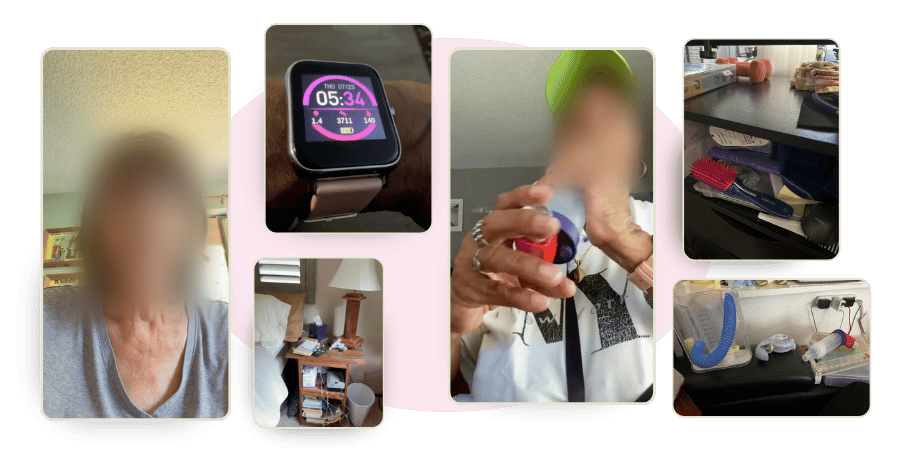
The same pattern shows up in less clinical settings too, in the small, self-reported details people share when they're documenting their own condition day to day rather than answering questions in an appointment. In an earlier demo study Indeemo ran with people living with asthma, one patient described reordering her next prescription the moment she opened her current one, so she'd never risk running low, a habit that only came up because she was showing her routine, not describing it in the abstract. In a separate demo study with people living with type 1 diabetes, one participant's recording paused mid-task because her blood sugar dropped while she was filming; she noted it, treated it, and picked the video back up once she'd stabilised. Another mentioned, in passing, that she keeps her insulin somewhere other than the fridge shelf it's meant to sit on, because it's the one spot in a small kitchen that actually fits her routine.
None of these moments were captured for patient safety purposes. They surfaced because people were asked to show their day rather than describe it.
What does this pattern mean for NCD safety research?
Three things stand out. Safety research needs to run over time, not stop at a single sitting. It works better on video than it does on paper. And it needs to ask about things no incident report would ever capture.
Risk lives in the routine, so the research has to be longitudinal
Xeltis's model works because it replaced a handful of appointments with 52 weekly check-ins: a problem gets 52 chances to be seen instead of four or five. The same logic played out in a separate study Indeemo ran with the design team Humanly: a live dashboard surfaced a usability issue with one of two respiratory health products under review partway through an eight-week study, in time for the product team to release a fix and see the change play out in the same participants' behaviour before the study closed. A single round of interviews would have captured the first impression and missed the fix entirely. A single interview also asks someone to summarise months of self-management from memory, the kind of gap a longitudinal patient journey study is built to close.
Show, do not tell
The strongest safety signals in this kind of research are visual, or they hinge on a detail someone wouldn't think to mention unless they were showing rather than telling: where insulin actually goes when the fridge is too small, when a reorder happens relative to running out, what someone does in the sixty seconds after a scheduled interview would already have ended. None of it shows up in a self-report questionnaire, because none of it feels worth reporting to the person living it.
Patients notice safety problems that systems do not log
Across studies like these, participants repeatedly describe confusion at handover, contradictory advice, appointments that were never followed up and symptoms they did not know were worth reporting. None of that appears in an incident report, because no incident was recorded. It appears in a video diary because someone was asked what their Tuesday was like.
Running research with people living with NCDs? Talk to our team about building patient safety questions into your next study.
[Talk to our team]
What does "safe care for life" mean in practice?
It means treating patients living with NCDs as partners who help spot risk, not just people who receive care. It means building research to match. That's exactly the brief WHO set for 2026.
WHO's working group on this year's campaign made a point of describing people living with NCDs as partners rather than patients, and of positioning safe care as something that belongs to everyday life rather than only to clinical settings. That is a research brief as much as a communications one.
If you are planning work around NCD care, prevention, adherence or health system experience, the methods are already proven. The question is whether patient safety is written into the discussion guide.
That's where we can help. Indeemo's Catalyst team works with healthcare and pharma teams to design studies exactly this way: longitudinal, visual, and built around the questions patients actually raise, whether you're running the fieldwork yourself or want us to lend a hand with study design, recruitment, or analysis. If you're planning research for World Patient Safety Day or the wider NCD agenda, get closer to what your patients are already trying to tell you. Learn more about how Indeemo works, or talk to our team.
Frequently asked questions
What is World Patient Safety Day 2026 about?
World Patient Safety Day is a WHO campaign held every year on 17 September. The 2026 theme, the seventh year of the campaign, is "Safe care for noncommunicable diseases," with the slogan "Safe care for life!" It focuses on reducing preventable harm for people living with long-term conditions like cancer, diabetes, and cardiovascular and respiratory disease.
Why are noncommunicable diseases a patient safety concern?
NCDs account for roughly three quarters of deaths worldwide, and people living with them interact with the health system repeatedly over years rather than once. That repeated, mostly unsupervised contact, across clinics, pharmacies and home, creates more opportunities for things to go wrong at any single point.
How does qualitative research help identify patient safety risks?
Much of the risk in NCD care happens between scheduled appointments: missed doses, storage workarounds, symptoms that never get reported. Continuous, patient-documented research captures what happens in that gap. Xeltis, for example, replaced sporadic clinic visits with weekly patient-submitted video and caught developing complications before they became critical, across every one of its 28 US trial sites.
Why does patient safety research need to be longitudinal?
A single interview asks someone to summarise months of self-management from memory, which tends to smooth over the exact moments where safety breaks down. Research that runs over weeks or months, like Xeltis's weekly check-ins, catches the week the routine actually broke.
Can Indeemo help with NCD-focused patient safety research?
Yes. You can run studies independently on the platform, or partner with Indeemo's Catalyst team for study design, recruitment, moderation, or the full project, whether you're a healthcare provider, a pharma team, or a public health organisation.