
Key takeaways
- Patient journey mapping captures the touchpoints, pain points, and emotions a patient experiences across their healthcare journey, from first symptoms through diagnosis, treatment, and recovery.
- Traditional methods like focus groups and satisfaction surveys rely on recall and post-rationalisation. Mobile ethnography captures experiences in the moment, in the patient's own environment, through videos, photos, screen recordings, and texts.
- The method works for chronic condition journeys, medical device research, patient-caregiver dynamics, HCP research, pharma studies, and UX research across digital health and telehealth.
- With Indeemo you can recruit from a global panel of 3 million+ participants, research in 30+ languages, analyse in minutes with generative AI, and build subtitled highlight reels that bring the patient voice into stakeholder rooms.
- Whether you have an in-house research team or need support, Indeemo can run the study for you through the Catalyst team, from study design and recruitment to moderation and analysis.
What is patient journey mapping?
Patient journey mapping examines the touchpoints a patient encounters across their healthcare experience. That includes everything from first symptoms and diagnosis, through treatment and interactions with healthcare providers, to recovery, ongoing management, and follow-up care.
The goal is to understand the journey from the patient's perspective, not the provider's. By mapping it out, researchers and brands can uncover:
- How patients experience pain, symptoms, and the effects of treatments over time
- Key moments of frustration or satisfaction along the way
- Gaps and friction in telehealth, digital health, and omnichannel healthcare experiences
- The emotions, routines, and coping strategies patients rely on between appointments
- The role of caregivers, family, and support networks in decisions and outcomes
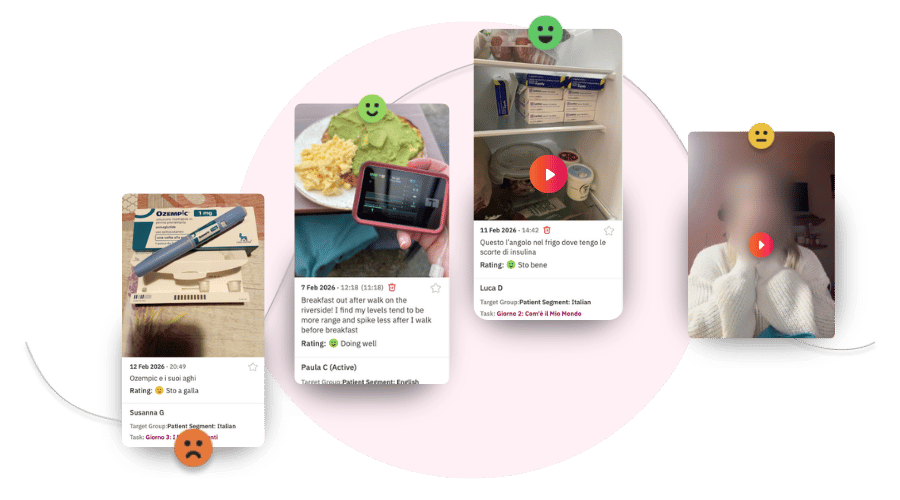
Photos and videos carry the narrative. Rating systems add a quantitative layer on top: patients score their pain, mood, or experience on a scale, so you get both the story and the numbers that go with it.
The stages of a typical patient journey
Every condition and every patient is different, but most healthcare journeys move through a recognisable sequence of stages. Mapping helps you see where friction lives and where your product, service, or care pathway can do more.
You don't have to cover every stage in every study. Many projects focus on one or two specific moments. The diagnosis experience, the first month on a new medication, the recovery from surgery. Scope the study to the decisions you need to inform.
Why does patient journey mapping matter?
The short answer: the patient journey is becoming less linear, more digital, and harder to see from the inside of a clinic. If you want to understand it, you have to follow patients into their homes, their cars, their pharmacies, and their conversations with family.
Healthcare has become non-linear
The path from noticing a symptom to finishing treatment used to follow a predictable route. It doesn't anymore. Digital health services, telehealth appointments, at-home diagnostics, medication apps, online pharmacies, and patient forums have turned a linear journey into a complex web. Telehealth alone is now a routine way patients access healthcare services, and it's only one strand of a broader shift. A patient might book a GP visit on their phone, do their own research on WebMD, video-call a specialist, pick up their prescription via an app, and manage their condition with wearables and self-recorded data. Satisfaction surveys can't see any of that.
Recall is unreliable
When you ask someone in a focus group how they felt during their diagnosis three months ago, you're getting a reconstruction, not a memory. People post-rationalise. They smooth out the messy parts. They give you the version of the story that makes sense now, not the confusion they felt at the time. Recall bias is a well-documented problem in retrospective research methods, and it's one of the main reasons in-the-moment capture matters. In-the-moment mobile research (sometimes called ecological momentary assessment) catches the raw version: the frustrating phone call, the worry on the drive home, the text to a family member, before it gets polished.
Privacy unlocks honesty
Healthcare topics are among the most sensitive a researcher can work with. Focus groups work against you here. A patient isn't going to share their real concerns about medication side effects, intimate symptoms, or family dynamics in front of a room of strangers. A private, one-to-one mobile connection gives them the space to be honest in a way group research rarely does.
Caregivers are part of the story
Caregivers aren't just background to a patient's experience. One in five US adults is a caregiver to a family member or friend with a chronic health condition or disability, and their involvement shapes decisions, adherence, and long-term outcomes. They're part of the decision-making, emotional support, and care coordination. Their stress, their exhaustion, their small daily negotiations with the person they care for. All of it shapes the journey. Mobile ethnography lets you understand patient-caregiver dynamics from both perspectives, separately or together, without putting them in the same room.
The researcher effect disappears
A UX researcher standing in a clinic changes the behaviour they're trying to observe. So does a moderator in a focus group. Remote, in-the-moment capture removes the observer from the room. Patients record on their own terms, in their own space, at their own pace. What you see is closer to what actually happens.
What are the benefits of mobile ethnography for patient journey mapping?
Mobile ethnography works for patient journey mapping because it solves the problems that in-person qualitative methods can't. Focus groups aren't private enough. Clinic visits aren't contextual. Interviews rely on recall. Here's what you get instead.
Private and one-to-one
Research happens through a private connection between the researcher and each participant. Patients feel more comfortable sharing sensitive health information through a self-recorded video from their own home than they ever would in a group setting. For sensitive topics, this is the difference between getting real insight and getting what patients think they're supposed to say.
Safe and remote
Patients can take part completely remotely, without travelling to a clinic or facility. For vulnerable patients, immunocompromised patients, or anyone managing a chronic condition, this removes a barrier that used to exclude them from research entirely.
Asynchronous by design
Patients and healthcare professionals complete tasks in their own time, at their own pace. For time-pressed HCPs who can't clear an afternoon for a focus group, this is often the only realistic way to get them involved. For patients, it means they respond when the moment happens, not when a calendar invite tells them to.
Contextual
Responses come from the place the experience is actually happening. The kitchen where they take their morning medication. The car on the way to the hospital. The pharmacy counter. The bedroom during a flare-up. Context reveals things that an interview in a clinic room never will.
Longitudinal
Studies run for days, weeks, or months, not a single sitting. You see how symptoms fluctuate, how adherence drifts, how side effects emerge, how moods shift across a treatment cycle. Over time, rapport builds between researcher and participant, and the insights get deeper.
Mobile ethnography vs patient satisfaction surveys
The two methods aren't in competition. Many teams use journey mapping insights to design better satisfaction surveys, and use survey data to identify which parts of the journey need qualitative follow-up.
What are the most common use cases for patient journey mapping?
Patient journey mapping is used across healthcare, pharma, medical devices, and digital health. The common thread: someone needs to understand what happens outside the clinic.
Chronic condition journeys
Patients living with diabetes, heart disease, cancer, multiple sclerosis, inflammatory bowel disease, or mental health conditions have journeys that play out over months and years. Daily routines, medication adherence, symptom flare-ups, mood, diet, exercise, and the people around them all shape outcomes. Longitudinal diary studies capture this in a way a single interview can't.
Medical device research
For medical device design and prototype testing, patient feedback in context is critical. Mobile ethnography lets patients record their first impressions, everyday use, adherence struggles, and usability issues in the environment where the device is actually used. Video captures ergonomic problems and interface friction that patients can't always articulate in words.
Patient-caregiver dynamics
When the caregiver is as central to outcomes as the patient, you need to understand both sides. Mobile ethnography lets patients and their caregivers document their experiences separately or together. You see the moments of coordination, the conflict, the emotional support that shape the journey, from both points of view.
Healthcare professional (HCP) research
HCPs are among the hardest participants to recruit. They don't have time for focus groups. They can't discuss patient-facing scenarios in open settings. Mobile ethnography fits around their shift patterns and clinic hours, and lets them share perspectives privately on concepts, new protocols, marketing materials, or treatment decisions.
Pharma and vaccine journeys
Pharmaceutical teams use journey mapping to understand the full path from awareness to adherence: how patients first hear about a condition, what drives them to seek diagnosis, how they decide between treatments, how they handle the ongoing reality of medication. Vaccine journey diaries, for example, capture the emotional and practical journey from hesitation through to boosters.
UX research in digital health and telehealth
With telehealth, digital health apps, remote monitoring, and online pharmacy now a core part of healthcare, UX research has moved outside the clinic. Mobile ethnography with screen recording lets UX researchers watch patients actually use digital health products. Navigating a portal, booking an appointment, interpreting lab results, interacting with a chatbot. You see where users get stuck, not just where they say they got stuck.
Recovery and long-term management
Some of the richest journey mapping work happens after active treatment ends. Mapping the recovery journey of kidney transplant patients, for example, reveals months of adjustment, ongoing medication management, follow-up anxiety, and gradual returns to routine. These are stories that would be invisible from the clinic.
How do you design a patient journey mapping project?
Running a patient journey mapping project well comes down to five principles.
Define clear objectives
Establish what you aim to understand or improve. Do you want to find the pain points in the treatment process? Assess a new digital health tool? Understand why adherence drops off at week four? Clear goals guide your research design. Don't try to map the whole journey in a single study unless you have months of field time. Focus on the moments where the answers will change what you do next.
Most journey mapping studies segment patients into personas, based on condition, stage, demographics, or any other dimension that matters for your decision. Design the study to surface differences between personas, not just to describe one average journey.
Focus on empathy
Put yourself in the patient's shoes. Understand their emotions, motivations, and frustrations. Design tasks that encourage them to share openly, in their own words, without feeling like they're filling out a form. Empathetic communication, respect for their experience, and reassurance that their feedback matters all encourage honest sharing.
Use the right tools
Run the study on a mobile ethnography platform so patients can document their experiences in real time. Smartphones, video, screen recording, and AI-powered analysis turn what used to be months of fieldwork into days. This also minimises recall bias, capturing moments before they get smoothed over.
Iterate and refine
Regularly review the data being collected and adjust tasks as you go. If participants are missing the point of a task, rewrite it. If a question isn't surfacing what you hoped, change direction. Mobile research gives you the flexibility to iterate without waiting for fieldwork to finish.
Combine quantitative and qualitative data
Pair video and photo diaries with in-app rating scales. A 5-point pain scale captured three times a day alongside a short video of what the patient was doing at the time gives you both the number and the story behind it. Neither tells you as much on its own.
Designing good tasks
Task design is where most journey mapping projects succeed or fail. The main tip: think about the what, how, why, who, where, and when of each task. A binary question ("Did you take your medication today?") gives you a data point. An open prompt ("Show us where you took your medication this morning and tell us how you were feeling as you did it") gives you insight.
Keep tasks short and conversational. Avoid technical jargon. Each task should map to a specific research objective. If you can't say what decision the response will inform, the task probably shouldn't exist.
Pilot and iterate
Test your protocol before you launch. A pilot study catches the tasks that don't make sense, the questions that are overburdensome, the prompts that patients interpret differently than you intended. If a full pilot isn't possible, ask a diverse team internally to review the research design. Their input will surface issues you missed.
Tasking approaches
Different journey mapping studies need different tasking rhythms:
Most journey mapping studies use a combination.
How does Indeemo support patient journey mapping?
Indeemo's mobile ethnography platform gives healthcare researchers the tools to run patient journey mapping studies end-to-end, from recruitment through to stakeholder-ready highlight reels.
Design tailored tasks
Create personalised activities that encourage patients to document their experiences through videos, photos, screen recordings, and written reflections. Tasks can be sequenced, scheduled, or sent all at once, depending on the rhythm of the journey you're studying.
Capture real-time insights
Patients use their smartphones to record authentic moments in their own environments. The app works like social media that participants already know how to use, so onboarding is quick and engagement stays high through long studies.
Quantify with rating capabilities
The in-app rating system lets patients score their pain levels, mood, satisfaction, or any other dimension on a 5-point scale. Pair ratings with video entries to get the number and the story together, and visualise the highs and lows of the journey over time.
Communicate privately and securely
Moderators interact with patients one-to-one through secure push notifications, private comments, and follow-up prompts. There's no group forum, no shared feed. Every conversation is between one researcher and one participant.
Recruit from a global panel
Recruit patients and HCPs from Indeemo's panel of 3 million+ participants, with screening support for specific conditions, treatments, and demographics. For hard-to-reach populations, our recruitment team can handle it for you.
Research across markets and languages
Journey mapping studies run across multiple countries at the same time, with automated transcription and translation in 30+ languages. Compare journeys across markets in real time rather than waiting weeks for external translation.
Analyse with generative AI
The insights dashboard consolidates all data (videos, photos, ratings, transcripts) into one interface. Generative AI assists with transcription, translation, sentiment analysis, thematic breakdown, and pattern recognition across participants. Tagging, filters, and keyword analysis make it easy to navigate hours of video.
Create highlight reels for stakeholders
Export subtitled highlight reels that bring the patient voice directly into stakeholder meetings, design reviews, and board presentations. A five-minute reel of real patients talking about their treatment experience moves conversations in ways a slide deck never will.
How do you combine journey mapping with other research methods?
Mobile ethnography journey mapping works on its own, and it works alongside other methods. Pairing it with in-depth interviews (IDIs) or focus groups lets you triangulate: rich in-context video footage on one side, open-ended conversation on the other.
Journey mapping as pre-tasking
Ask patients to complete a week of journey-mapping tasks before an IDI or focus group. Participants arrive with real footage of their experience to reference. You arrive with a grounded understanding of each person's actual journey, rather than a blank page. The quality of the conversation is transformed.
Journey mapping as follow-up
After an interview, send participants targeted follow-up tasks. A patient who mentioned struggling with their morning injection in an IDI can document the reality of it over the following week. Claims get tested against context. Abstractions get grounded in real footage.
Unified analysis across methods
Indeemo's video import capability lets you bring focus groups and IDIs from Zoom, Teams, or your computer into the same platform as your journey mapping data. Generative AI analyses diary entries, interview transcripts, and focus group discussions together, so themes, sentiment patterns, and correlations surface across the whole programme.
For healthcare research, this matters because the real insight often lives at the intersection. A single focus group quote combined with a video of the same patient struggling at home is more persuasive than either on its own.
What about privacy and security?
Trust between participant and researcher is everything in patient research. Especially when the topic is sensitive. Everything Indeemo does on privacy and security is designed to protect it.
Private by design
Every participant has their own anonymous login. Their responses are only visible to the assigned research team, never to other participants. There's no public feed, no shared space, no risk of one patient's disclosures being seen by another. For sensitive conditions, this is what makes honest participation possible at all.
Built to minimise PHI exposure
Anonymous participant logins and segregated recruiter accounts minimise the personal health information stored on the platform. Data deletion processes are available to clients on request.
Independently vetted
The platform has been independently vetted by the security teams of large healthcare providers and pharmaceutical companies:
- GDPR compliant
- HIPAA compliant, with Business Associate Agreement (BAA) capability
- ISO 27001 certified
- SOC 2 Type II attested
- Independently penetration tested using OWASP 10 guidelines
- Full security documentation available via our Trust Centre
Data retention and deletion
Projects remain accessible for 6 weeks following fieldwork completion. Researchers can request bulk export or extended hosting. Data can be deleted on request at the end of each project.
Do you need to be a researcher to run a patient journey mapping study?
No. Patient journey mapping is increasingly run by pharma brand teams, medical device product teams, and digital health companies who don't have a dedicated research function. Indeemo supports both routes.
If you have research expertise in-house, use the platform independently. If you don't, or if you want to supplement your internal team for a specific project, our Catalyst team can handle study design, recruitment, moderation, translation review, and analysis. We've supported thousands of research projects, with hundreds of those across healthcare, covering everything from vaccine journey diaries to concept testing with HCPs to mapping the patient journey of kidney transplant patients.
Indeemo can be more than a platform. It can be a partnership.
Frequently asked questions
What's the difference between patient journey mapping and a patient journey map?
Patient journey mapping is the research method: the process of gathering data about what patients actually experience. The patient journey map is the output, a visual synthesis of touchpoints, pain points, emotions, and decisions across the journey. You do the mapping to produce the map. The map is only as good as the research behind it.
How long does a typical patient journey mapping study run?
Field time ranges from a week to several months, depending on what you're mapping. A single stage of the journey (the diagnosis experience, for instance) might take 1–2 weeks. A full chronic condition journey or a recovery study might run 6–12 weeks. The longitudinal nature of the method is a feature, not a bug. You need time to see how symptoms fluctuate, adherence drifts, and routines settle.
Can you use patient journey mapping for sensitive health conditions?
Yes, and in fact sensitive conditions are where mobile ethnography outperforms focus groups and IDIs most clearly. Participants share from their own homes, in private, one-to-one with the researcher. The platform is HIPAA compliant and built to minimise PHI exposure. Many of the most successful journey mapping studies cover conditions patients would never discuss in a group, including sexual health, mental health, addiction, rare conditions, and terminal illness.
How many patients do you need for a journey mapping study?
Most studies work well with 15 to 30 patients per segment. Because the method captures rich longitudinal data from each person, you often need fewer participants than you'd expect. For pharma studies across multiple markets, studies with 50 to 100+ patients are common. The right number depends on how many personas or segments you're covering and how deep you need to go within each.
What's the difference between patient journey mapping and a patient satisfaction survey?
A satisfaction survey tells you how satisfied patients were. Patient journey mapping tells you what happened and why. Surveys are quantitative, retrospective, and shallow; journey mapping is qualitative, in-the-moment, and deep. They answer different questions. Many teams use both: journey mapping to understand the "why" behind the numbers, and surveys to benchmark and track over time.