

Key takeaways
- A video diary study is a qualitative research method where participants use their smartphone to record videos, photos, screen recordings, and texts that document their daily lives.
- In-the-moment capture beats recall. People are remarkably good at constructing logical narratives after the fact, so catching behaviour as it happens bypasses post-rationalisation and gets you closer to the truth.
- Common use cases include day-in-the-life studies, customer experience research, customer journey mapping, UX research, path to purchase, healthcare, and product testing.
- With Indeemo, you can recruit from a global panel of 3 million+ participants, research in 30+ languages, analyse responses in minutes with AI, and create subtitled highlight reels to share with stakeholders.
- If you have research ambitions but not the capacity, our Catalyst team can handle study design, recruitment, moderation, and analysis.
What is a video diary study?
A video diary study is an online qualitative research method used in market research and UX research to capture participants' day-to-day behaviours through short video recordings, in the moment, as they happen.
Participants are both the videographer and the narrator. They record and document their experiences in the context of their everyday lives. Alongside the videos, they can enrich their entries with photos, notes, screen recordings, and texts, giving you a fuller picture of what's really going on.
Why do video diary studies work?
They work because they capture behaviour in the moment, in context, without a researcher in the room. Three things follow from that.
Less reliance on memory
Memory is unreliable. Research on recall bias shows that accuracy drops the longer the gap between an event and the moment someone's asked to remember it, and the effect is well-documented across health, market, and social science research. Ask someone what they had for breakfast on Tuesday, and by Friday they'll give you a confident answer that may or may not be accurate. Ask them to record a short video as they're making breakfast, and you get the real thing. In-the-moment capture removes the need to reconstruct, and it removes the post-rationalisation that creeps in when people explain themselves after the fact.
No researcher effect
People behave differently when they know they're being watched. A researcher standing in someone's kitchen with a notepad changes the dynamic, even with the best intentions. A video diary removes the physical observer. Participants record on their own terms, in their own space, at their own pace. What you get back is closer to how they actually live.
Real context, not a lab
You don't just hear about someone's morning routine. You see their kitchen, notice the competing brands on the counter, watch them juggle breakfast while checking their phone. Context reveals things that words alone can't, and a well-lit interview room doesn't come close.
How does a video diary study work?
A video diary study starts with recruitment. Participants are screened using a questionnaire designed to identify the right target personas. Qualified participants are offered an incentive and opt in to the project. Indeemo can recruit from our global panel of 3 million+ participants in hours, or you can bring your own sample.
Once recruited, participants download the Indeemo app. The interface is designed to feel like social media they already know how to use, so there's little or no learning curve. Researchers assign tasks through the dashboard, and as participants respond, their videos, photos, screen recordings, and written entries appear live on the researcher's side. No waiting weeks for data to arrive.
Researchers can comment on entries and ask follow-up questions, just like a message thread. The private, one-to-one format encourages participants to open up and share the context behind their actions, which is often where the most useful insight lives.
How do you design a video diary study?
Video diary studies run over several days or weeks, with participants completing tasks as they go. Indeemo offers three tasking approaches, depending on what you're trying to capture.
Tips for task design
Keep prompts short and easy to read on a phone. Conversational language works better than formal instructions, so think "tell us what you had for breakfast this morning" rather than "please describe in detail your first meal of the day". You're asking someone to share a slice of their life, and the tone should feel more like a message from a friend than a questionnaire.
Balance richness with participant burden. Daily engagement of 10 to 30 minutes works well for most studies. Any more than that and completion rates start to drop.
What are the benefits of video diary studies?
Video diary studies combine rich qualitative data with practical scale. You get depth without the cost and logistics of traditional ethnography, and you get speed without losing context.
Easy for participants
Participants record from the comfort of their own environment, at a time that suits them. No travel to a research facility, no need to book time off work. The app feels familiar, and the self-led format removes the pressure of being observed. People relax, open up, and share more.
Cost-effective
Travel, accommodation, and on-location recording costs disappear. A smartphone and an internet connection are all participants need. That keeps your research budget focused on insight rather than logistics.
Significant time savings
Once the project is set up, researchers watch submissions appear on the dashboard in real time. There's no waiting weeks for data collection to finish before analysis can start. The method also scales, so you can have dozens of participants active at the same time without adding time to the project.
Authentic voice of customer
The rich video format lets participants tell their own stories while also providing a window into their world. Facial expressions, tone of voice, and small details of the setting are all part of the data. Observed behaviour is more compelling than a slide deck, and stakeholders pay attention when a real person is on screen telling them what they think.
Faster analysis with AI
AI-powered transcription, translation, and theme detection mean you can go from fieldwork to insight faster than ever. What used to take weeks of manual coding can now be surfaced in minutes.
Global reach
Studies can run across multiple markets at the same time. Automated transcription and translation in 30+ languages mean your team can start reviewing submissions almost immediately, comparing across markets in real time.
What are the most common use cases?
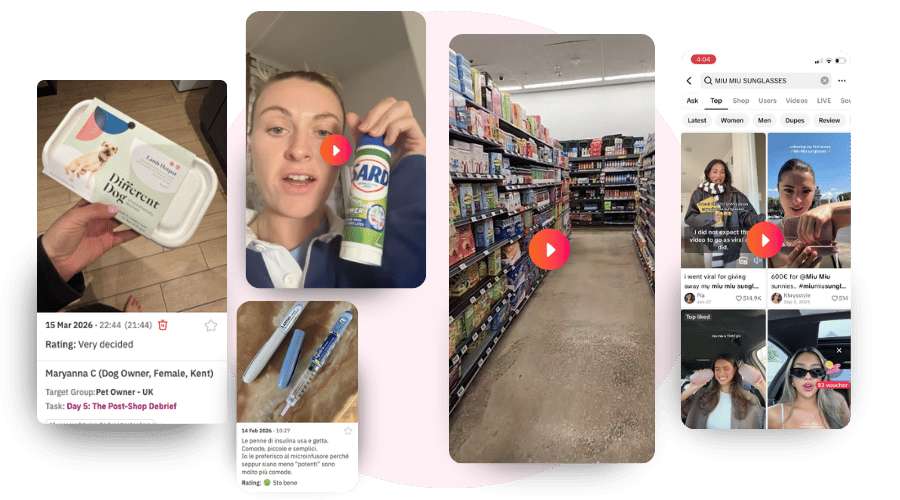
Video diary studies work across a wide range of research contexts. Some of the most common:
Day in the life diary studies
The classic application. Participants document their routines, habits, and priorities over several days, giving you a view of behaviour over time that a single interview can't provide. Repeated daily tasks reveal patterns, and spontaneous moments uncover the motivations behind decisions.
Consumer behaviour and consumption occasions
Consumer diary studies work well for capturing daily or weekly routines around consumption and shopping. Participants document what they consume, when, and where, using videos and photos. Meal time diaries, beverage occasion research, and snacking studies all benefit from the in-the-moment, contextual nature of video.
Customer experience research
Video diaries are well suited to customer experience research because they capture the real customer journey as it unfolds, across days, weeks, or months. They shine a light on pain points and moments of delight at each stage. Showing stakeholders video of a real customer's frustration, or their genuine surprise and pleasure, tends to drive faster decisions than a deck of numbers.
Customer journey mapping
More and more research teams are pairing video diaries with customer journey mapping to create dynamic, video-rich journey maps. Instead of hypothesising touchpoints in a workshop, you can build the map from real customer footage. The result is a journey map grounded in what people actually do, rather than what you assume they do.
UX and design research
Video diary studies combined with mobile screen recording let researchers see how participants actually interact with a product, website, or app in their real environment. Someone navigating your checkout flow at their kitchen table behaves differently from someone in a usability lab. Short video reflections after each task capture the feelings and impressions behind the clicks.
Path to purchase and shopper research
Follow a participant from the moment they first consider a purchase through to the decision itself. Screen recordings with voice-over reveal how they navigate a website or app while you hear what they're thinking. Out-of-home tasks capture the in-store experience.
Healthcare and patient research
Video diaries help researchers understand patient experiences, treatment journeys, and health behaviours as they actually happen. At home, at the pharmacy, during daily routines. Healthcare research benefits especially from this kind of in-context data, because clinic visits rarely capture what life with a condition is really like.
Product testing and in-home usage tests
Put a product, prototype, or concept in front of participants and ask them to unbox, try, and react in their own home. See how a new product fits (or doesn't) into their real routine, over real time, with real use.
How do you analyse video diary data?
AI has taken much of the manual work out of video analysis. Indeemo's platform includes:
- Automated transcription and translation in 30+ languages, so a study running across Japan, Germany, and Brazil can be reviewed by a single team without waiting for external translation
- AI-assisted theme detection and sentiment analysis to surface patterns across all submissions
- Keyword search and keyword cloud tools for fast trend spotting
- Tagging, filtering, and journey visualisation to organise and explore the data
- Subtitled highlight reel creation, so you can share the best, most resonant moments with stakeholders in minutes
You can also import interviews and focus groups from Zoom, Teams, or your computer and analyse them alongside diary data using the same AI video analysis tools. One place, one workflow, from recruitment to highlight reel.
Do you need to be a researcher to run a video diary study?
No. Whether you're an experienced researcher or a brand team exploring qualitative research for the first time, Indeemo can support you.
Use the platform independently if you have the expertise in-house. Or partner with our Catalyst team for study design, recruitment, moderation, analysis, or the full project end to end. If you have research ambitions but not the capacity or expertise to fulfil them, we can lend a helping hand.
Indeemo can be more than a platform. It can be a partnership.
What about security and data management?
Video diary studies capture sensitive material, often from participants' homes, so security is non-negotiable. Indeemo is trusted by some of the world's most pioneering brands and maintains:
- GDPR compliance
- HIPAA certification with Business Associate Agreement (BAA) capability
- ISO 27001 certification
- SOC 2 certification
- Independent penetration testing using OWASP 10 guidelines
- Full security documentation available via our trust centre
Projects remain accessible for six weeks after fieldwork completes. Researchers can request a bulk export or extended hosting at any time, and data is deleted securely at the end of the retention window.
Frequently asked questions
What's the difference between a video diary study and a traditional diary study?
A traditional diary study typically relies on written entries, often collected retrospectively. A video diary study captures video, photos, screen recordings, and texts in the moment, giving researchers richer, more contextual data and reducing recall bias. Video also carries emotional nuance that text alone can't.
How long should a video diary study run?
It depends on what you're trying to capture. A focused day-in-the-life study might run for five days. A longer consumer habits or customer experience study might run for two to four weeks. For journey-based research, some studies run for several months. The right length balances data richness with participant fatigue.
How many participants do you need?
Most video diary studies work well with 15 to 30 participants, though larger programmes can involve hundreds across multiple markets. Because each participant produces rich data across multiple days, you often need fewer people than you'd expect compared to a survey-based approach.
What devices do participants need?
A smartphone with a camera and a reasonable internet connection. Participants download the Indeemo app and respond to tasks by recording video, taking photos, making screen recordings, or writing text entries. The app works on iOS and Android.
Can video diary studies be used alongside interviews and focus groups?
Yes. Many research teams use video diary tasks as pre-work before an interview or focus group, so participants arrive having already reflected on the topic and the moderator has real-world material to reference. They also work well as post-interview follow-ups, bridging what people say in a discussion and what they actually do. See our mobile ethnography guide for more on how the methods combine.